Plenty of ideas, but your UPSC essay won’t flow? Let’s connect them.
Updated
You've written the essay topic in the centre of a page. Around it sit “society”, “economy”, “politics”, “technology” and “ethics”. Under each, you have an example. Now you have to explain why any paragraph should follow the one before it.
I'd pause there. A collection of dimensions can help you find material, but it hasn't yet given the essay an argument. If every paragraph simply repeats that the topic is important, changing the example won't fix the flow.
Let's build a plan for a philosophical essay from one proposition, including a reason to question it. The topic and all scenarios below are original teaching illustrations, not UPSC past questions, quotations attributed to anyone, or verified case studies.
Find a claim you can explain and challenge
Our practice topic is:
A useful map should leave room for an unfamiliar road.
Start by stating how you intend to read it. A map can represent a plan, an established explanation or accumulated knowledge. An unfamiliar road can represent a new experience or possibility. You don't have to pursue every possible metaphor. Choose an interpretation you can develop and make it clear to the reader.
One possible central claim is:
Plans help us act, but they remain useful only if we can revise them when experience exposes their limits.
That sentence gives the essay a relationship to investigate. It also creates a question: when should we revise a plan, and when should we follow it despite difficulty? If you can't answer the second part, the essay may become a prolonged recommendation to “embrace change”.
The 2026 UPSC notification, in its Essay syllabus on printed page 33, asks candidates to remain close to the subject, organise ideas and express them concisely and precisely. It doesn't prescribe this planning method. I'm using the method to make those requirements concrete, not presenting an examiner's private marking formula.
Make the paragraphs do different work
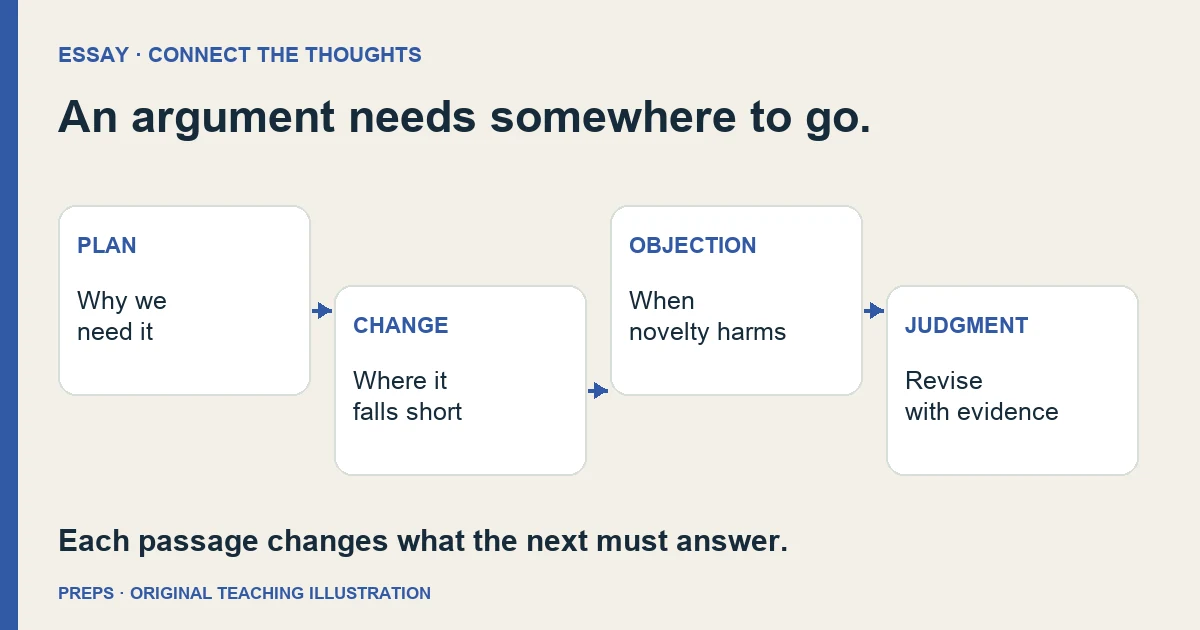
Before collecting more examples, write the thought each passage must advance. Here's one possible sequence for our topic:
- Why we need maps: accumulated knowledge and plans let us make decisions without starting from nothing.
- Why a useful map can become inadequate: circumstances or information can change; a plan's omissions may only become visible in use.
- What happens when the map becomes unquestionable: we may preserve the procedure while losing sight of its purpose.
- Why unfamiliar roads still need scrutiny: novelty doesn't establish safety, fairness or usefulness; a familiar method can remain the better choice.
- How to revise responsibly: examine evidence, consider who bears the risk, test what can be tested and retain a way to correct the decision.
This is a small outline, not a full examination-length essay. It needs development and verified supporting material before it can become one. Nor is five the required number of body sections. The sequence is useful because the later ideas answer questions raised by the earlier ones.
If you now move from an individual's plan to a public institution's policy, explain what changes. An individual's experiment and an institution's decision can expose very different people to consequences. That difference advances the argument; simply adding the heading “political dimension” doesn't.
Follow one example beyond its first sentence
Imagine a town using a fixed route to send water tankers to several neighbourhoods. A new settlement appears outside the route. Officials report that every scheduled stop was served, while households in the new settlement remain outside the service.
Again, this town is hypothetical. In an actual essay, use a verified case if making a factual claim about a real place.
The example helps explain a limitation of the map: the route can measure completion while omitting part of the problem. But don't stop after saying “therefore, we should be flexible”. Identify the consequence and the choice. The town needs to investigate the unmet need and revise coverage, while checking capacity and whether existing areas would lose service.
Now the example has a second use. It complicates your recommendation. A route cannot be changed responsibly merely because somebody proposes a new stop; competing claims and the available supply still matter. You can carry that difficulty into the next paragraph.
Here's an original transition:
The omission calls for revision, but it doesn't tell us which revision is fair. Adding one destination may reduce the water available elsewhere. The value of an unfamiliar road therefore depends on how the decision is tested and whose needs remain outside it.
That passage connects two ideas through a problem the example reveals. It doesn't need “Furthermore” to pretend that the connection exists.
Give the objection a consequence
A mechanical counterargument can sound like this: “However, maps are also important.” You've already said that in the opening. It adds no difficulty to the claim.
A stronger objection asks when experimenting would be irresponsible. In a hypothetical emergency, a tested evacuation route may be safer than an unverified shortcut. Calling the shortcut innovative wouldn't establish where it leads or whether everyone can use it.
The response needn't surrender the whole argument. Distinguish a revision supported by evidence from a change pursued for its novelty. You can defend openness to correction while requiring stronger scrutiny where an error would impose serious costs on others.
That qualification should change your ending. Instead of “we must always explore unfamiliar roads”, the essay can argue that plans deserve continued authority when they remain open to evidence, correction and the purposes they serve. The objection has helped refine the claim.
Use your material without turning it into a procession
Bring in a historical event, policy, scientific development or personal experience only when you can explain the particular point it supports. Check dates, causation and attributed words. A well-known name doesn't rescue a weak connection, and an approximate quotation shouldn't be placed inside quotation marks.
A hypothetical example is useful in practice because it lets you examine the reasoning. It doesn't replace factual breadth in a developed essay. Build that breadth through reliable reading and keep source references beside material you want to reuse. You don't need to manufacture an autobiographical moment to give the opening emotion.
When reviewing a draft, write a short margin sentence stating what each paragraph adds. If several say “change is necessary”, decide which develops the idea best. Use the freed space to explain a condition, consequence or disagreement you haven't addressed. Retain a return to the central theme where it clarifies the relationship; remove repetitions that merely repeat the topic's words.
Then write a complete essay and practise under the actual paper's instructions. An outline tests whether you have a direction. It can't show whether you can sustain it at the required length and within the available time. For feedback, ask a reader to identify where the connection becomes unclear, rather than accepting “improve flow” as a finished diagnosis.
On your next planning page, keep the dimensions if they help you find ideas. Before writing, add the missing sentences between them: what follows, what complicates it, and what your argument must now account for. Those connections are where the essay begins to move.