Struggling to write UPSC Mains answers in English? Start with one clear paragraph.
You can explain the topic to a friend. Put an answer sheet in front of you, though, and an ordinary thought starts looking for a much grander sentence.
“People can't reach the clinic” becomes “the accessibility dimension of healthcare infrastructure poses a multifaceted challenge”. You stop to check multifaceted. The people and the clinic are still waiting.
If English is slowing down your UPSC Mains answers, I'd begin with a smaller task than “improve my English”: make one paragraph say exactly what you mean. You can work on grammar while writing. You don't have to postpone every answer until your language feels impressive enough.
Let's keep the idea and lose the fog
Use this fictional teaching situation, not a finding about an actual health service:
Consultations at a town clinic are free. The clinic opens only while some residents are at work, and those residents cannot leave their shifts. Explain one reason free consultations might not be enough to make the clinic accessible to them. Suggest a response.
Here's a deliberately muddled first attempt:
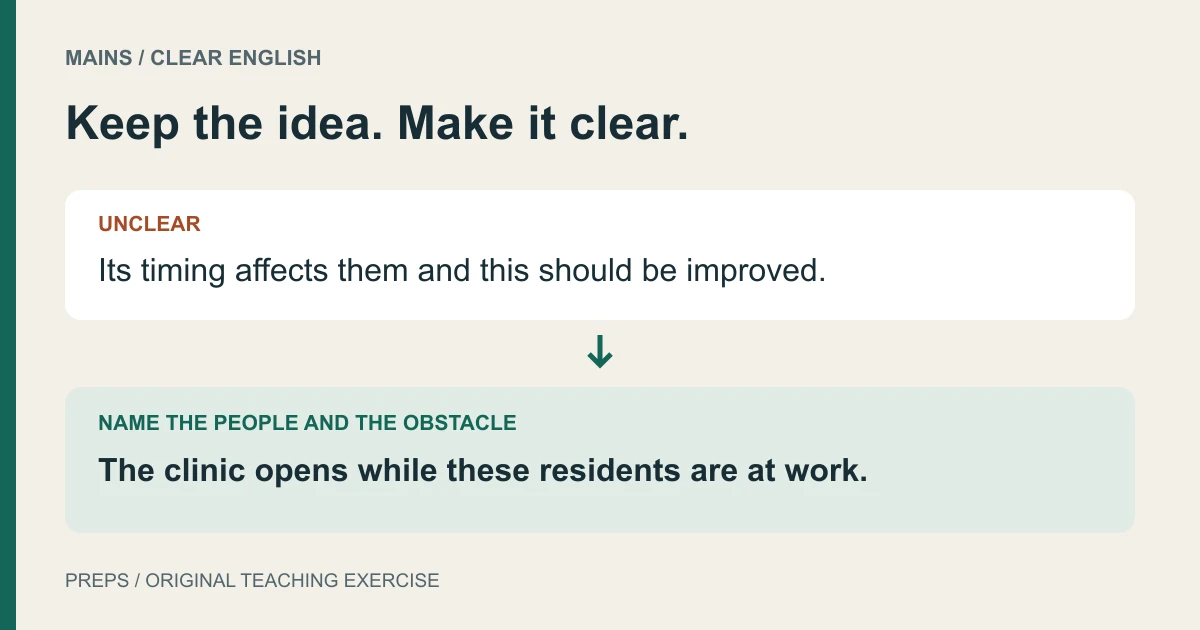
The facility is free but they are unable to utilise it because of its timing which affects them and this should be improved by the administration.
The idea is present. The reader has to work to locate it. Who are “they”? What does “affects them” mean? What should the administration improve?
I'd first write the meaning in rough words:
People work when the clinic opens. They cannot leave work. Free consultation doesn't fix the timing problem.
Now give that meaning a clear sequence:
Free consultations remove the consultation fee, but the clinic's opening hours still prevent these residents from attending. Their shifts overlap with those hours, and they cannot leave work. The administration could test an additional session outside those shifts, subject to staffing and other patients' needs.
This is one possible paragraph for the invented task, not a model answer or a prediction of marks. It identifies the people, explains the obstacle and makes the proposed response conditional. The words are ordinary because the relationship is doing the work.
Simple English still needs to be precise
I wouldn't tell you that grammar doesn't matter. A missing word can change who did something; the wrong tense can turn a proposal into an achievement. Fix mistakes that obscure or alter meaning, rather than assuming the examiner will reconstruct your intention.
The 2026 CSE notification, page 31 values “orderly, effective and exact expression” with economy of words. That supports a useful goal for practice: an answer someone can follow accurately. It doesn't supply a penalty chart for individual grammar errors.
Compare these original sentences:
| Sentence | What needs attention |
|---|---|
| “The clinic changed its hours.” | Reports a completed change |
| “The clinic could change its hours.” | Proposes a possibility |
| “Free consultations guarantee access.” | Claims more than our fictional facts support |
| “Free consultations remove the consultation fee.” | States the narrower change accurately |
Replacing every familiar word with a longer synonym won't repair these differences. Nor should simplification erase necessary subject terms. If you're discussing judicial review, use judicial review and explain the relevant point. Calling it “the court thing” would be shorter and less exact.
Find out where the answer gets stuck
Before treating every difficulty as weak English, try explaining the point aloud or in the language in which you think most comfortably.
If you still can't explain why the clinic remains inaccessible, revisit the facts and the reasoning. A grammar exercise won't supply the missing connection. If you can explain it clearly but cannot put it into English, work on that expression. If each sentence makes sense but the paragraph jumps between unrelated points, the order needs attention.
This is a practical check, not a test of your worth or a permanent label. Several problems can exist in the same answer.
For the clinic paragraph, I would organise the rough plan around what the question asks: what the fee change solves, what obstacle remains and what response addresses it. Another question may need a different sequence. If the task itself is unclear, first use the Mains directive guide to interpret the complete question.
Practise the bit you want to improve
Take a short passage you've actually studied and close the source. Write its main point in your own words. Then check both the meaning and the English. Copying an elegant paragraph can show you how someone else wrote it; it doesn't show whether you can produce your own explanation.
Choose one recurring problem from your writing. Perhaps you leave the subject unclear, join several claims with “which”, or change tense midway through a sentence. Use a reliable grammar reference or ask a competent reader to explain that particular error. Keep the correction beside your original sentence, and write a new sentence where the same distinction matters.
For example, replace:
The residents contacted the officials because they changed the hours.
with whichever meaning you intend:
The residents contacted the officials because the clinic had changed its hours.
or:
The residents contacted the officials to request different clinic hours.
Those revisions say different things. Don't accept a smoother sentence until you've checked that it preserves your intended claim.
If you use an AI tool, ask it to identify the unclear passage, explain the problem and suggest a correction without adding facts. Check its answer yourself. A polished rewrite you cannot explain is difficult to reproduce under exam conditions, and it may quietly change the argument.
Ask for feedback you can use on the next page
“Improve your language” leaves too much work unspecified. Ask a reviewer to point to the first sentence they couldn't follow, say what they understood and identify what they had to guess. Then rewrite that passage and check it again.
A reader outside UPSC preparation can help identify an unclear pronoun. They may not be able to judge whether your constitutional term or subject explanation is accurate. Seek the appropriate kind of feedback for each problem.
Once the paragraph communicates the point, put it back into a complete answer and practise within the paper's actual time and word instructions. A paragraph you can perfect without a clock is useful practice; it doesn't yet establish that you can finish the paper. The worked answer revision shows how expression and substance can be reviewed together.
One boundary matters here: this article is for someone practising English-medium subject answers. English isn't the only permitted Mains medium; the notification's page 29 sets out the language options and conditions. The separate qualifying English paper also needs preparation for its own tasks. Working on a GS paragraph doesn't cover that whole paper or decide which medium suits you.
For now, keep your first draft and the corrected one. Return to the fictional clinic question with a changed constraint: the clinic now opens outside the residents' shifts, but they cannot reach it because transport isn't available. Write a new paragraph. Let the obstacle change your explanation, rather than carrying over a sentence merely because it sounded good last time.