You don’t have to write a new UPSC answer today. You could improve yesterday’s.
Updated

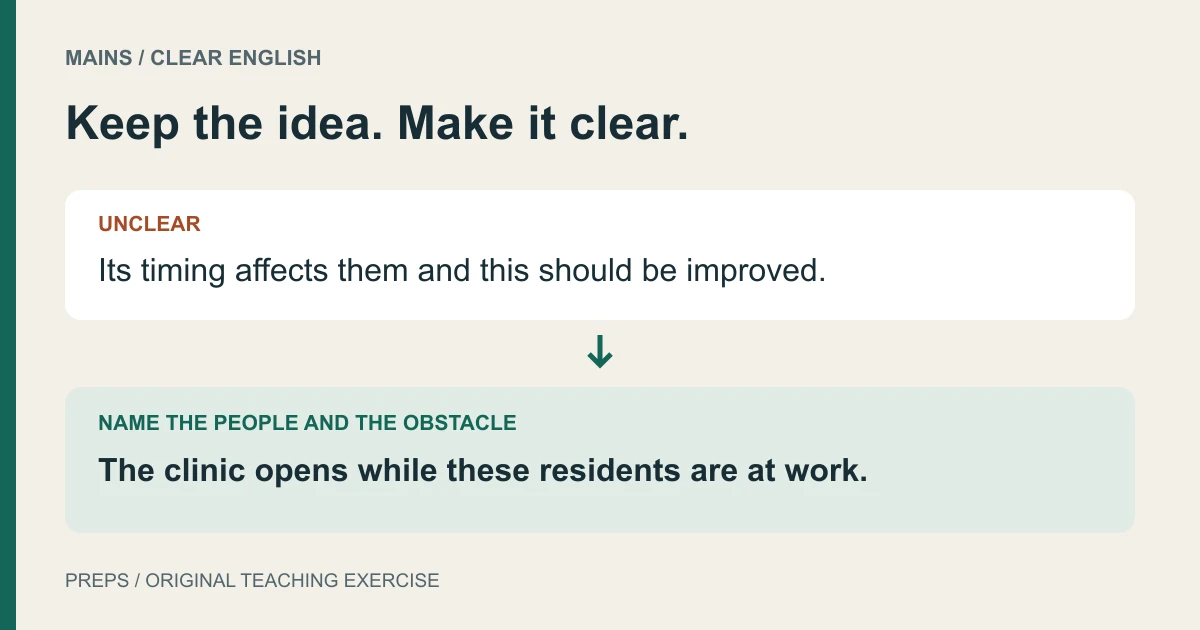
Consider this sentence in an answer about municipalities: “They should be given more funds.” It's relevant. It's also unfinished. More funds to do what? What is stopping the elected council from doing it now?
That's the kind of gap I'd look for in your UPSC answer-writing practice. You may have recalled the right topic and filled the page, yet left the relationship the question asks about unexplained. Before writing another answer, I'd try repairing one such gap in the answer you already have.
Let's work through an example. The question and both attempts below are original teaching illustrations, not UPSC previous-year questions or official model answers. I've set a 150-word limit for the exercise; use the printed instructions when practising an actual paper.
An answer that stays near the topic
Practice question: Why are regular elections alone insufficient to make urban local government effective? Suggest measures to strengthen municipal self-government.
Here's a deliberately incomplete first attempt:
Municipalities are important because they bring democracy closer to people. Elections allow citizens to choose representatives and raise local issues. Urban areas need better roads, sanitation and public services. Therefore, regular elections are necessary for good governance. Municipalities should be made stronger through more funds, training, technology and public participation. Citizens should also cooperate with elected representatives. In conclusion, local government is the foundation of democracy and everyone must work together to strengthen it.
If this resembles a draft you've written, notice that it isn't empty. It recognises the subject and offers some plausible suggestions. I wouldn't discard all of it or prescribe a grander introduction.
I'd stop at the word “alone” in the question. The draft explains why elections matter. The question asks why they aren't sufficient. Those are different tasks, and a polished sentence about democracy won't close the distance between them.
There's a second task too: suggest measures. The answer names funds, training and technology, but never explains which obstacle each would address. You can see the consequence in the conclusion: it has to retreat to “everyone must work together” because the answer hasn't developed a more specific argument.
Find the missing explanation
For this question, I'd begin with a practical problem. An elected council may want to improve a service. That intention doesn't establish who has authority over the service, how the work will be funded, or whether the council has the staff to carry it out.
Now “more funds” has a job in the answer: connect a responsibility to the resources needed to fulfil it. Training becomes relevant if you're explaining a capacity gap. Technology earns space only if you can show what problem it helps solve. You don't have to retain every suggestion from the first draft.
This is also where evidence can sharpen the explanation. Articles 243W–243Y of the Constitution distinguish municipal powers, revenue arrangements and financial review. The linked edition is dated 1 May 2024; see printed pages 131–132.
The role of state law matters here. Don't turn these provisions into a claim that every municipality automatically receives identical powers or revenue. That qualification helps explain the problem the question asks about. It isn't a legal footnote to squeeze in after you've finished the argument.
A revision with a clearer argument
Here's one possible answer within the exercise's 150-word limit:
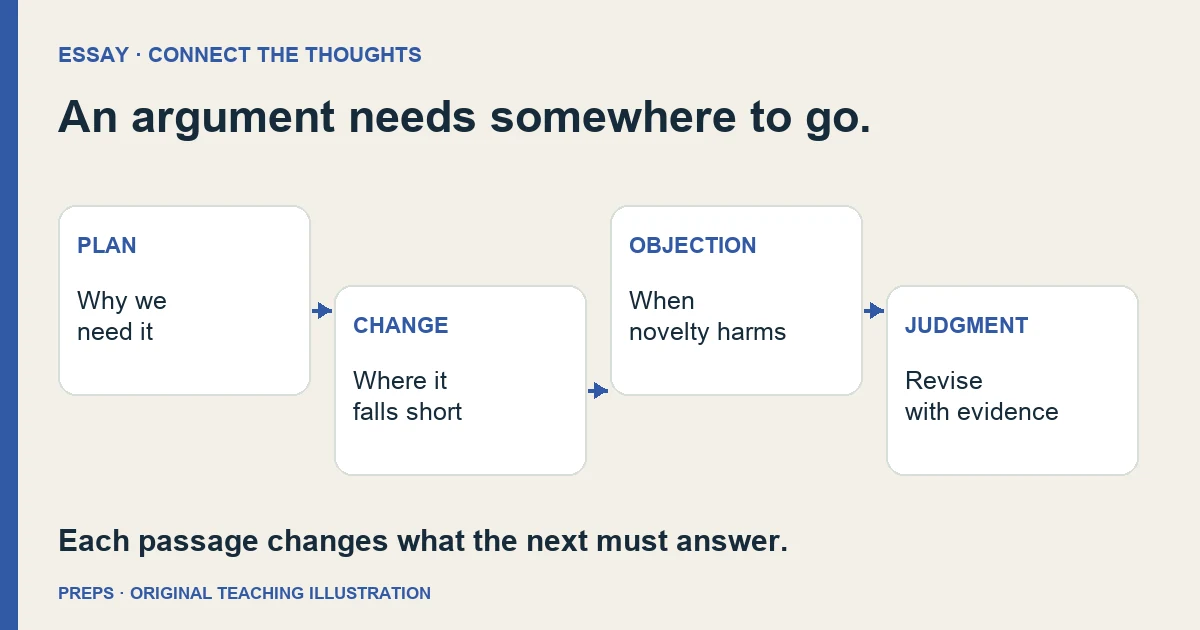
Elections provide representation, but municipal self-government also needs authority, resources and the capacity to implement decisions. An elected council cannot deliver a service merely by resolving to do so if responsibility, funding or staff are unavailable.
Article 243W allows state legislation to confer municipal powers and responsibilities. Article 243X similarly provides for municipal revenue arrangements through state law. Thus, elections alone do not settle what a municipality can do or how it can finance that work.
States should clarify municipal responsibilities and match them with predictable revenue and capable staff. Municipalities should publish budgets and service commitments, while citizen feedback can help identify failures. State Finance Commission recommendations under Article 243Y should receive timely consideration with a clear account of action taken.
Strengthening local democracy therefore requires elected representation together with the practical means to act and answer for results.
The reform suggestions are editorial recommendations, not a list prescribed by those constitutional provisions. This is one defensible response, not a promise of marks or a template you need to memorise.
Compare the openings. The revision gives a reason elections are insufficient immediately. The constitutional references then help explain the institutional arrangements; they aren't dropped in as proof that the writer remembers article numbers. The suggestions follow the diagnosis, and the conclusion can bring those parts together without borrowing a slogan.
I haven't added a statistic or a quotation. Either could be useful in a different answer, but neither would repair the missing explanation on its own. Here, I'd spend the limited words on that explanation first.
Choose the practice condition you need
You don't have to solve knowledge, recall and speed in the same session. Choose the condition that lets you examine the difficulty you're actually facing.
If you understand a chapter while reading but can't organise an answer, write with your notes open. See whether you can identify each task and select material for it. Keep the attempt marked as open-book so you don't mistake it for a recall test.
If you can build a coherent answer with notes but can't retrieve the material without them, try a closed-book attempt next. Check what you forgot and whether the remaining argument still answers the question.
If you can do both but run out of time in a full paper, timed practice deserves attention. A leisurely revision won't tell you how much you can produce under the paper's constraints.
These conditions serve different purposes. Open-book work can help you learn to construct an answer; it doesn't establish exam readiness. Timed work can expose a pacing problem; it doesn't, by itself, explain why a paragraph went off-topic.
For a beginning writer, even an outline with a sentence answering each part can be a useful first attempt. If you've already written many answers, compare several of them. Look for a recurring problem you can point to in the text: perhaps your suggestions don't follow your diagnosis, or your examples keep replacing the explanation.
Make the review small enough to finish
Daily answer writing is a possible routine, but I wouldn't make frequency the main measure. If your available session ends after drafting, leave the next one for checking and revision. Otherwise you can accumulate pages while carrying the same unresolved gap into each answer.
On the next review, underline the sentence that answers each part of the question. Where you can't find one, decide what would need to be explained. Check the facts you'll use, then rewrite that passage. You can leave a serviceable introduction alone.
Keep a short note beside the two versions. For this example, mine would read:
I explained why elections matter, but left their limits unexplained. In the revision, I connected municipal responsibilities to revenue and staff. Next time, I'll check whether each proposed reform answers a problem I've actually described.
That note records an edit you can carry into a different question. “Improve content and structure” would give you very little to act on.
For your next attempt, choose a question on a topic you've studied from the Mains past-question archive. The questions are public; complete model answers require sign-in. Keep your own first version before consulting another response. At the review, you'll need the words you actually wrote, including the sentence that felt convincing until you asked it to explain something.