“Critically analyse” in UPSC Mains—what am I actually supposed to write?
Updated
“Discuss” doesn't tell you what to write until you've read what comes after it. Discussing the causes of a problem is a different task from discussing whether a proposed solution will work.
I'd learn the ordinary work implied by UPSC Mains directive words, then practise reading them with the subject, scope and any additional instruction. Memorising a chart can be a starting aid. It shouldn't persuade you to ignore half a question because the chart has already supplied your headings.
The distinction matters when you've studied a topic well. Familiarity can make it very easy to write the answer you prepared instead of the answer being asked for.
Read the complete task before choosing headings
Take this original practice question, invented for the article:
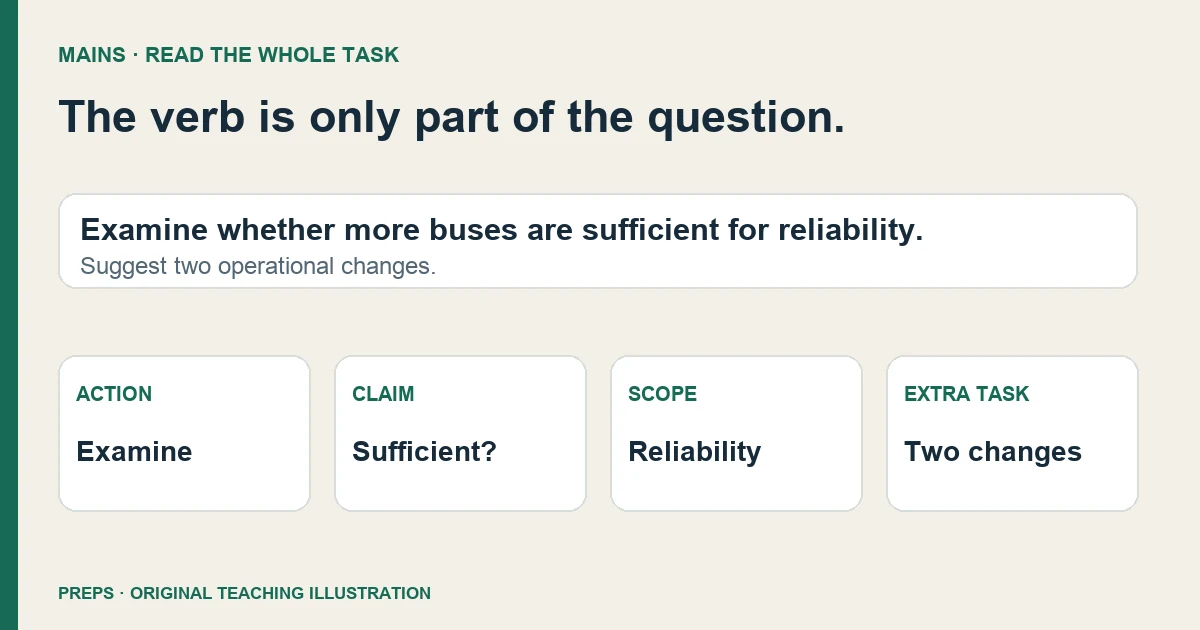
Examine whether adding more buses is sufficient to improve the reliability of an urban bus service. Suggest two operational changes.
There are several instructions inside it. The subject is bus-service reliability. The claim being tested concerns adding buses, and “sufficient” asks whether that measure is enough. There's also a separate request for two operational changes.
An answer about the environmental benefits of public transport might contain sound material while leaving these tasks unresolved. An answer listing every urban transport problem could wander just as far. Keep your explanation attached to reliability and the proposed fleet expansion.
I'd make a short working plan: explain what fleet expansion can address; inspect the other conditions needed to run reliable services; judge the sufficiency claim; propose two changes that follow from the diagnosed problems. This is a plan for this question, not a universal “examine” template.
In the 2026 Civil Services notification, printed pages 32–33 describe Mains as an assessment of understanding and call for relevant, meaningful, succinct answers. That is the official context. The interpretations and planning examples below are editorial guidance, not an official directive dictionary or a marks allocation scheme.
Use the verb to decide what reasoning is needed
These are useful working meanings. They overlap, and the rest of the question can make a more specific demand.
| Directive | Work I'd expect the answer to attempt |
|---|---|
| Discuss | Develop a reasoned treatment of the specified issue, including relevant perspectives rather than merely listing points |
| Examine | Inspect the claim or issue closely, using relevant facts and reasoning to reach a finding |
| Analyse | Explain how the important parts, causes or relationships work together and with what consequences |
| Critically analyse | Analyse the issue while testing assumptions, evidence and limitations, then reach a defensible assessment |
“Critically” doesn't require hostility or a predetermined number of negative points. A reasoned assessment can find an argument strong, weak or valid only under certain conditions. Show why. Equally, an answer without the word “critically” is not excused from accuracy or reasoning.
For “discuss the causes of irregular bus services”, the useful structure might follow causes and their relationships. Automatically dividing it into advantages and disadvantages would answer a different question. Use a glossary to clarify the task, then let the actual task determine the answer.
Follow the bus question far enough to reach a finding
Suppose, in a fictional service, some scheduled journeys never operate because there aren't enough available drivers. Others are cancelled while vehicles await routine maintenance. Additional vehicles could help where vehicle availability is the constraint. In this scenario, however, more vehicles alone wouldn't supply the missing drivers.
You could also inspect maintenance, dispatching and road conditions where they're relevant. Don't assert that all of these are problems in every city. If discussing a real service, support the diagnosis with appropriate evidence; our imaginary case establishes no national fact about urban transport.
One possible outline for the original question is:
More buses may allow additional journeys where the existing fleet is inadequate. Reliability also depends on whether scheduled journeys can actually operate. In the fictional case, a driver shortage would leave some additional vehicles idle, so fleet expansion alone is insufficient. Align driver rosters with the published service schedule, and use preventive maintenance with suitable vehicle availability planning to reduce avoidable cancellations. The changes should be checked against actual service records, rather than judged by the fleet count alone.
This is a compact teaching outline, not a complete examination answer or an official solution. Both diagnoses would need a factual basis if you claimed they described a particular city. A different scenario could justify different changes.
Notice that the verdict follows the explanation. “More buses are good but there are challenges” would leave the sufficiency question largely unanswered. And the suggestions relate to running the service; a lengthy discussion of unrelated transport policy wouldn't fulfil the request more precisely.
Change the question and watch the answer change
Now replace the original with this:
Analyse how staffing and vehicle maintenance affect the reliability of an urban bus service.
You would spend more of the answer explaining those relationships. A driver roster determines whether available vehicles can operate; maintenance arrangements influence vehicle availability. Explain the consequences and connections rather than using the original verdict about fleet expansion as the centre of the answer.
Or try:
Critically analyse the claim that a larger bus fleet necessarily produces a more reliable service.
Now test “necessarily”. When could fleet expansion help? What assumptions must hold? What evidence would distinguish more vehicles on the register from more dependable journeys? Consider the limits of the claim before settling your assessment. You wouldn't invent data simply because the question invites scrutiny.
Some material survives across all three answers. The emphasis and organising question change. That's a more useful distinction to practise than trying to make every directive produce a completely different stock introduction.
Check what each paragraph has answered
Before a practice answer, identify the requested action, the issue it applies to, the boundaries and any additional task. Some questions have several verbs; others embed the task in a statement. Don't expect one word at the end to do all the interpreting.
After writing, point to the passage that fulfils each instruction. In our first question, can you find the finding about sufficiency and two operational changes? If a paragraph discusses something true but unrelated, shorten or remove it. If an argument needs a missing fact, check that fact rather than substituting a grander conclusion.
Use the actual paper's word, space and time instructions. I wouldn't assign fixed percentages to “implicit demand” or promise a point-to-mark formula. Spend the available words on the reasoning this question needs.
For the next practice session, take one topic you've studied and write plans for differently worded questions. Then complete an answer and review the actual sentences. The worked answer-writing revision can help with that second step. Keep the directive chart nearby if useful, but make the question on the page the thing you're answering.