Stuck on what to do in a UPSC ethics case? Let’s work through one.
Updated
You're asked what you would do. You write integrity, empathy, accountability and transparency. Then you reach the end of the page without deciding.
The values may be relevant. The missing work is showing what they require from this person, with these powers, before this deadline.
I'd practise that decision directly.
Begin with a case that leaves you something to resolve
Original fictional teaching case; not a UPSC past question or an actual scheme.
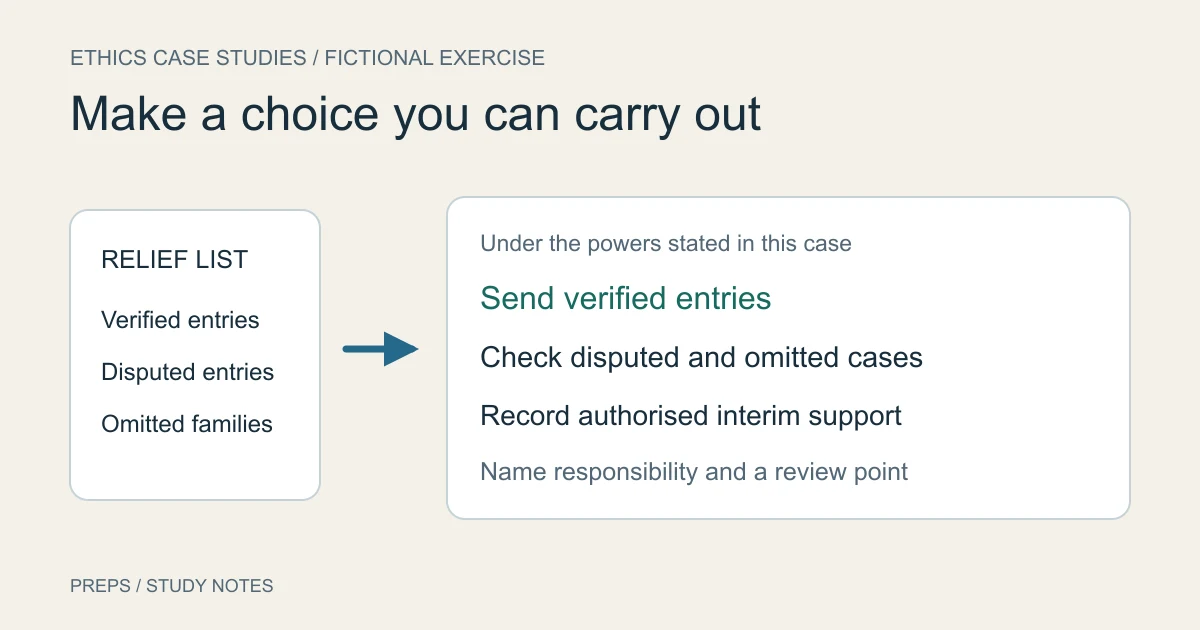
You coordinate relief payments after a flood. The list must be sent by evening. Some entries appear twice. Several displaced families have lost documents and are absent from the list. A senior colleague tells you to send it unchanged to avoid delaying relief.
For this exercise, the temporary rules allow you to send verified entries separately, hold disputed entries for checks, and arrange recorded emergency support while a family's eligibility is checked. You can request field verification, but cannot permanently waive eligibility requirements.
Task: Explain the ethical concerns, compare the feasible courses available, and justify what you would do.
Those stipulated powers matter. If a different case gives you no authority to split the list or arrange interim support, you need a different operational answer. Don't borrow powers from this example and carry them into every case.
UPSC's 2026 GS IV syllabus covers integrity, probity, approaches to conflicts and problem solving, including case studies. My approach below is a practice method, not an official answer format or a promise of marks.
Read for the decision, not just the cast
Here the deadline creates a cost to delay. The duplicates create a risk of improper payment. Missing documents create a risk of excluding people whose need may be real. The colleague's instruction adds pressure, but it doesn't remove your responsibility for what you submit.
A stakeholder list can help you notice those consequences. It shouldn't take over the answer. Naming families, colleagues and the public is useful only if you explain what your decision means for them.
Also separate what you know from what you suspect. A duplicate-looking entry needs checking; it is not automatically proof that a person committed fraud. Losing documents is not proof of eligibility either. Your response has to preserve both distinctions.
Compare options you could actually take
Submit the list unchanged. This meets the deadline quickly. It also leaves known discrepancies unresolved and does nothing for omitted families.
Hold the entire list until all checks finish. This avoids approving entries before checking them. But it delays verified recipients as well, despite the exercise allowing separate submission.
Submit verified entries, check disputed cases and use authorised interim support. This limits avoidable delay while preserving checks. It requires staff, records and follow-through; omitted families could still be overlooked unless someone owns their review.
The third course is my choice under these stated rules. Its attraction isn't that it sounds balanced. It separates decisions that can be made now from ones that need more information, while providing an authorised response to immediate need.
That choice still has costs. Field staff may be stretched. Someone must explain the pending status, prevent duplicate support and resolve disputes. An answer that ends at “verify the list” leaves these responsibilities floating.
Write the decision as actions
Here is a worked response to the decision-and-justification subpart only. It isn't a complete answer to every possible case-study question.
I would submit the verified entries separately and hold the disputed entries for rapid checks, as the temporary rules permit. I would record the discrepancies and explain the proposed course to the senior colleague, including the avoidable harm of delaying verified recipients.
I would assign field checks for apparent duplicates and omitted families, recording responsibility and a review deadline. The check should establish whether entries refer to the same recipient; suspicion alone should not be treated as fraud. Families without documents would be helped to use the verification process allowed by the rules.
For immediate need, I would arrange the authorised emergency support, record it separately and check for overlapping assistance. A named contact and an accessible way to raise omissions would help families follow up.
I would review pending cases, communicate decisions and preserve reasons and records for scrutiny. If pressure continued to submit known discrepancies unchanged, I would document it and seek review through the appropriate supervisory channel. This course protects timely assistance without treating urgency as permission to abandon eligibility checks.
“Accessible” needs substance in a real case. If families cannot reach the office or use an online form, naming a portal is insufficient. You would need to work within the communication channels and staff the case actually provides.
Let a changed fact change your answer
Now remove the permission to split the payment list. You can no longer recommend separate submission as though nothing happened.
You might seek urgent authorisation from the competent authority, explaining the discrepancies and the consequences of delay, while using only the emergency support already permitted. You still need to say what you'll do if the authority cannot respond before the deadline. The available rules and the precise task would determine that further choice.
Try a second change: field verification is impossible today. Your original review deadline now needs reconsideration. State how immediate support can be recorded and followed up under the stipulated rules; don't claim a check has been completed because your preferred answer needs it.
This is where ethical reasoning becomes harder than listing values. You may have to acknowledge a remaining harm and explain why the feasible alternative would be worse.
Practise answering the subquestions you were given
Use official GS IV papers for subsequent practice. Read each case's subquestions and instructions before deciding your allocation of space. A question asking you to evaluate options needs that evaluation; a decision alone won't fulfil it.
For this case, reread your answer and underline each action someone could actually carry out. Circle every action that assumes an unstated power. Repair those assumptions, then change one constraint and write the decision again.