Civil Services Prep

Weekly digest

UPSC current affairs, 28 Sep-4 Oct, 2026

105 entries, published 28 September 2026.

Monday, 28 Sep

Science & Technology

01

Indian Standard Time as India’s Mandatory Legal Time

Science & Technology

Why in news?

The Legal Metrology (Indian Standard Time) Rules, 2026 make Indian Standard Time the mandatory time reference for legal, administrative, commercial and official purposes.

How IST is maintained

  • IST is five hours and thirty minutes ahead of Coordinated Universal Time: UTC+5:30.
  • Its historical reference meridian is 82.5° east longitude, passing near Mirzapur in Uttar Pradesh.
  • Modern time is not measured from the Sun at that meridian. CSIR–National Physical Laboratory maintains IST using caesium atomic clocks and links it with the global UTC system.
  • Atomic clocks measure the extremely stable microwave frequency associated with transitions in caesium-133 atoms.

What the rules change

  • Official systems must synchronise with IST through approved methods rather than rely on unrelated foreign time servers.
  • Regional reference laboratories and satellite or network-based distribution can improve resilience and reduce timing errors.
  • Precise common time is essential for banking, telecom networks, stock exchanges, power grids, cybersecurity logs, navigation and 5G systems.
Why it matters

A legally uniform and accurately distributed time standard is critical infrastructure for digital transactions, networks and public administration.

Environment

02

Begonia rajvikramanii: New Species from the Western Ghats

Environment

Why in news?

Researchers identified Begonia rajvikramanii, a previously unknown plant species growing on moist rocky cliffs in Kerala’s Western Ghats.

Begonia rajvikramanii plant with broad asymmetric leaves and pale-pink flowers
The newly identified Begonia species has broad asymmetric leaves and small pale-pink flowers and grows on moist rocky cliffs in the Western Ghats.

Key features

  • Begonias are generally herbs with asymmetric leaves and separate male and female flowers on the same plant.
  • The new species is adapted to shaded, wet rock surfaces and appears to have a narrow geographical range.
  • It flowers and fruits during the wet season, when moisture is available in its cliff habitat.

Conservation significance

A species found in a very small area is vulnerable to quarrying, road construction, tourism pressure, plant collection and changes in moisture. Its discovery underlines the Western Ghats’ high endemism and the need to conserve specialised microhabitats, not only large forests.

Why it matters

The discovery highlights both the Western Ghats’ biological richness and the fragility of narrowly distributed cliff-dwelling plants.

Polity

03

Digital Self-enumeration under Census 2027

Polity

Why in news?

About 2.6 crore people are expected to use digital self-enumeration during the first phase of Census 2027, which will cover nearly 32 crore households.

How self-enumeration works

  1. A household enters its details through the official portal within the notified period.
  2. The system generates a unique reference number.
  3. The enumerator verifies completion during the field visit instead of collecting the same information again.
  4. No documentary proof is ordinarily required for answers given in the census schedule.

Constitutional and legal basis

  • Census is a Union subject: Entry 69 of the Union List gives Parliament authority over it.
  • The Census Act, 1948 authorises census operations and protects the confidentiality of individual answers.
  • The Registrar General and Census Commissioner of India under the Ministry of Home Affairs conducts the census.
  • The exercise has two broad phases: house-listing and housing census, followed by population enumeration.

Benefits and concerns

Self-enumeration can save time and reduce transcription errors, but it must accommodate limited digital access, language barriers and disability. Strong cybersecurity, minimal data collection and strict confidentiality are essential because census data cover every household.

Why it matters

Digital self-enumeration can modernise India’s largest statistical exercise while testing the State’s ability to combine inclusion, accuracy and privacy.

Environment

04

COP31 and the Fossil-fuel Transition Debate

Environment

Why in news?

Preparations for COP31 renewed disagreement over whether climate negotiations should call for a phase-out of fossil fuels or the more flexible transition away language, and how the costs should be shared between developed and developing countries.

United Nations Framework Convention on Climate Change

AdoptionAdopted at the 1992 Rio Earth Summit and entered into force in 1994.
MembershipNear-universal participation by countries and the European Union.
SecretariatBonn, Germany.
ObjectiveStabilise greenhouse-gas concentrations at a level that prevents dangerous human interference with the climate system.
Core principlesEquity; common but differentiated responsibilities and respective capabilities; precaution; and sustainable development.

Institutional structure

  • The Conference of the Parties, or COP, is the Convention’s supreme decision-making body.
  • The Subsidiary Body for Implementation reviews implementation, while the Subsidiary Body for Scientific and Technological Advice connects negotiations with scientific and technical knowledge.
  • The CMA serves the Paris Agreement and the CMP serves the Kyoto Protocol.
  • The Global Environment Facility and Green Climate Fund form important parts of the financial mechanism.
  • The Intergovernmental Panel on Climate Change supplies scientific assessments but is not formally part of the Convention.

From Kyoto to Paris

  • The Kyoto Protocol placed binding emission targets mainly on developed countries.
  • The Paris Agreement requires every party to submit progressively stronger nationally determined contributions, or NDCs, and uses a five-year Global Stocktake to assess collective progress.
  • COP31 must confront the gap between national plans and the emission cuts required, alongside finance, technology transfer and a just transition for fossil-fuel-dependent economies.

Joint presidency challenge

A joint Australia–Türkiye presidency would need clear responsibility for consultations, agenda-setting and political mediation. COP presidencies facilitate consensus; they cannot impose an outcome on parties.

Why it matters

COP31 will test whether countries can convert broad transition language into equitable finance, stronger NDCs and measurable reductions in fossil-fuel dependence.

International Relations

05

UN Sea-level Declaration and UNCLOS

International Relations

Why in news?

A UN declaration on sea-level rise supported the continuity of statehood and existing maritime entitlements for countries threatened by rising seas. The declaration is politically important but is non-binding and does not amend the law of the sea.

United Nations Convention on the Law of the Sea

  • UNCLOS was adopted in 1982, entered into force in 1994 and is often called the “constitution for the oceans.” India ratified it in 1995.
  • It sets rules for navigation, maritime zones, marine resources, environmental protection, scientific research and dispute settlement.
  • A coastal State has sovereignty over its territorial sea, but only specified sovereign rights over resources in its exclusive economic zone.
Maritime zoneExtent and coastal-State authority
Internal watersLandward of the baseline; treated broadly like land territory.
Territorial seaUp to 12 nautical miles; sovereignty applies, subject to innocent passage.
Contiguous zoneUp to 24 nautical miles; limited enforcement relating to customs, fiscal, immigration and sanitary laws.
Exclusive economic zoneUp to 200 nautical miles; sovereign rights over natural resources and specified economic activities.
Continental shelfRights over seabed and subsoil, sometimes extending beyond 200 nautical miles if legal and geological conditions are met.
High seasBeyond national jurisdiction; open to all States under international rules.

Institutions created by UNCLOS

  • The International Tribunal for the Law of the Sea in Hamburg hears specified maritime disputes.
  • The International Seabed Authority in Kingston regulates mineral activities in the international seabed area.
  • The Commission on the Limits of the Continental Shelf examines scientific submissions concerning outer continental-shelf limits.

Why sea-level rise creates a legal problem

Maritime zones are measured from coastal baselines. If coastlines retreat or islands become uninhabitable, repeated movement of baselines could shrink zones and create uncertainty over resources and statehood. Small island States therefore support maintaining, or “freezing,” lawfully established baselines and maritime limits despite physical change. The declaration strengthens that interpretation politically, but binding clarification still depends on State practice, adjudication or treaty development.

Why it matters

Sea-level rise is becoming a question of territory, statehood and control over ocean resources—not only an environmental threat.

Tuesday, 29 Sep

Environment

01

Delhi’s Winter Air-pollution Mitigation Plan

Environment

Why in news?

Delhi announced a preventive winter action plan to control the pollution spike associated with low temperatures, stagnant winds, road dust, construction and vehicle emissions.

Major measures

  • Non-BS-VI vehicles registered outside Delhi are to face entry restrictions from November 1.
  • “No PUCC, No Fuel” will be enforced at about 500 fuel stations, supported by automatic number-plate recognition.
  • Government and private offices may operate with 50% work-from-home during severe pollution.
  • Construction and demolition can be stopped during critical periods, office timings staggered and parking charges increased.
  • The plan envisages 60 continuous monitoring stations, 334 enforcement teams and an AI-enabled command-and-control system.

Important concepts

  • PM10 consists of particles up to 10 micrometres wide; PM2.5 is fine enough to penetrate deep into the lungs and enter the bloodstream.
  • An airshed is a region sharing the same air circulation and pollutant load. Delhi’s air therefore depends on action across the National Capital Region and adjoining States.
  • The Graded Response Action Plan activates progressively stronger emergency restrictions as air quality worsens. A winter action plan is broader and preventive.
  • The Commission for Air Quality Management coordinates action across Delhi, Haryana, Punjab, Rajasthan and Uttar Pradesh under the CAQM Act, 2021.

Limitation

Emergency restrictions can reduce peak exposure, but lasting improvement requires year-round control of transport, industrial emissions, dust, waste burning and pollution across the wider airshed.

Why it matters

The plan combines preventive restrictions, real-time monitoring and regional coordination to reduce Delhi’s recurring winter pollution peak.

Science & Technology

02

Orphan Drugs and India’s Rare-disease Pharmaceutical Sector

Science & Technology

Why in news?

India is examining how its pharmaceutical industry can develop affordable medicines for rare diseases and become a global manufacturing centre for orphan drugs.

Meaning and scale

  • A rare disease affects a very small proportion of the population. Around 8,000 rare diseases have been identified globally and 1,004 rare genetic disorders have been reported in India.
  • Only about 5% of rare diseases have an approved treatment.
  • Orphan drugs serve small patient populations and were historically neglected because conventional commercial markets were too limited.
  • Some treatments can cost roughly ₹1 crore per patient each year.

Why development is difficult

  • Patients are geographically dispersed, diagnosis often requires genetic testing and clinical trials have very small samples.
  • Many therapies require personalised or small-batch production, making research and manufacturing expensive.
  • The United States’ Orphan Drug Act, 1983 demonstrated how tax support, grants, fee relief and market exclusivity can encourage development.

India’s policy and opportunity

  • The National Policy for Rare Diseases, 2021 broadly separates diseases into one-time curative conditions, conditions requiring long-term treatment and conditions with definitive but extremely expensive therapies.
  • Eligible patients treated at notified Centres of Excellence may receive financial support of up to ₹50 lakh.
  • India offers large patient cohorts, identifiable genetic clusters, expertise in generics and biosimilars, lower-cost manufacturing and emerging cell-and-gene-therapy capacity.
  • Rule 101 of the New Drugs and Clinical Trials Rules, 2019 can permit reliance on specified foreign approvals, subject to Indian regulatory safeguards.

India needs national patient registries, carefully designed small-population trials, pharmacovigilance, predictable procurement and benefit-sharing safeguards. Faster approval must not dilute evidence on safety and effectiveness.

Why it matters

Rare-disease policy must reconcile tiny patient populations and high research costs with equitable access to potentially life-saving treatment.

Economy

03

Tackling Food Loss and Waste — India’s Opportunity

Economy

Why in news?

September 29 is the International Day of Awareness of Food Loss and Waste. India produces enough food for about 1.4 billion people, yet a significant quantity is lost between farms and consumers.

A “triple win”

  • Improve food security and nutrition.
  • Reduce pressure on land, water and energy while lowering emissions.
  • Increase farmers’ incomes and supply-chain productivity.

Food loss and food waste

  • Food loss occurs between production and retail during harvesting, drying, storage, transport or processing.
  • Food waste occurs at wholesale markets, shops, hotels, restaurants and households when edible food is discarded.

India’s evidence base — a global first

  • India is the only country to have conducted three nationally representative post-harvest loss surveys.
  • They covered 45 commodities in 2005–07, 45 in 2012–14 and 54 in 2020–22, following the chain from farm to retail.
  • A fourth national survey is under way.
  • The evidence supports reporting under the Food Loss Index, but data on retail, food-service and household waste remain limited.

Wholesale markets — the overlooked opportunity

  • A major wholesale market may generate up to 100 tonnes of organic waste a day.
  • In some cities, markets contribute nearly one-fifth of urban organic waste reaching landfills.
  • Such markets generate an estimated 3.5 million tonnes annually across India.
  • Treating this material could avoid about 3.3 million tonnes of carbon-dioxide-equivalent emissions a year and potentially create nearly $30 million in carbon-credit value.

Surat model and national response

  • A 50-tonne-per-day bio-CNG facility in Surat has operated through a private partnership for more than five years and reportedly prevents about 7,500 tonnes of methane-related emissions annually.
  • Priority technologies include scientific storage, drying, moisture control, energy-efficient cooling, processing and digital traceability.
  • Urban systems should measure, prevent, reduce, redistribute and valorise waste—convert unavoidable residues into compost, biogas, bio-CNG or other useful products.
  • Finance must make these technologies accessible to farmers, producer organisations and small enterprises.

Food-loss reduction should be integrated into agricultural planning, food-processing policy, urban waste management, climate action and investment decisions.

Why it matters

India already has surveys, technology and workable market models; the challenge is to close data gaps and scale investment across the food chain.

Economy

04

National Commission on Farmers and Agricultural Distress

Economy

Why in news?

M.S. Swaminathan’s contribution to agricultural policy returned to focus amid climate stress, rising input costs and concern about farm incomes.

Agricultural context

  • Agriculture contributes roughly 15–18% of GDP but supports about 46% of India’s workforce.
  • Nearly 86% of farmers cultivate less than two hectares.
  • The National Commission on Farmers, constituted in 2004 under Swaminathan, submitted five reports between 2004 and 2006.

Central approach

The Commission argued that agricultural policy must measure farmers’ economic well-being rather than crop production alone. It recommended remunerative prices, institutional credit, insurance, land and water reform, farmer organisations, storage, processing, marketing, recognition of women farmers and ecological sustainability.

Cost concepts behind MSP

  • A2: paid-out expenditure on seeds, fertilisers, hired labour, fuel and other purchased inputs.
  • A2+FL: A2 plus the imputed value of unpaid family labour.
  • C2: A2+FL plus imputed rent on owned land and interest on fixed capital.

The widely discussed recommendation was an MSP providing at least a 50% margin over the weighted average cost of production. The policy debate concerns which cost measure should be the base. Price support alone cannot resolve fragmented holdings, groundwater depletion, climate risk, weak markets and indebtedness.

Why it matters

The Commission shifted agricultural policy from production targets towards farmer income, risk protection and ecological sustainability.

Science & Technology

05

Caste Bias in Generative AI

Science & Technology

Why in news?

India became the leading market for a popular image-generation model as retro-1980s portraits spread online. The trend raised concern that generative models reproduce upper-caste, urban and economically privileged memories while marginalising other communities.

What the article’s evidence showed

  • In 1983, 44.5% of Indians—about 323 million people—were below the poverty line, while only about one-quarter of households had electricity in 1980. Family photo archives therefore over-represented households that could afford cameras or studio portraits.
  • The SC/ST (Prevention of Atrocities) Act was enacted only in 1989, after the decade being recreated as uncomplicated nostalgia.
  • One language-model test produced a stereotypical caste association in 80 of 105 sentences.
  • A separate examination of 1,536 generated images found caste-coded patterns through food, neighbourhood, occupation and worship even when prompts used Indian names without caste labels.
  • The ₹10,371-crore IndiaAI Mission is supporting Indian AI capability, making public evaluation of bias particularly important.

How bias enters a model

  • Generative AI learns statistical associations from text and images rather than independently understanding caste.
  • Historical archives and internet datasets are not socially neutral. Dalit, Adivasi and working-class lives were often photographed by officials, activists or researchers rather than represented through ordinary family archives.
  • Names, occupations, food, clothing, neighbourhoods, language and places of worship can operate as caste proxies even when caste is not directly stated.
  • The machine did not create the prejudice; it inherited and “industrialises it” by reproducing the association at scale.

Types of harm

  • Representational harm: communities are stereotyped, erased or shown only in degrading roles.
  • Allocative harm: biased systems influence access to employment, credit, welfare or policing.
  • Feedback loop: generated stereotypes re-enter the internet and may later become training data.

Safeguards

  • Diverse, consent-based datasets and community photo archives covering 1975–95, with clear documentation of what is missing.
  • Mandatory disclosure of training-data composition and the conditions under which data labellers worked.
  • Caste-aware evaluations, red-team testing and publication of disaggregated results.
  • Human review and grievance mechanisms for consequential uses such as recruitment, education, credit and public services.

A dataset can appear technically balanced while preserving historical inequality. Fairness testing must therefore examine outcomes, not merely whether a protected characteristic was removed from the input.

Why it matters

Generative AI can automate existing caste stereotypes unless Indian social realities are deliberately included in data governance and evaluation.

Paradip, Odisha

Geography

Paradip is a major port city in Odisha’s Jagatsinghpur district, situated near the Mahanadi delta on the Bay of Bengal. Its deep-water port handles coal, iron ore, crude oil, petroleum products and fertilisers. It hosts a refinery and petrochemical industries. The city entered the news after the Coast Guard stabilised a distressed tanker offshore, preventing a large palm-oil spill incident.

Sign in to read this story

Rakhine State, Myanmar

Geography

Rakhine State lies along Myanmar’s western coast, bordering Bangladesh and the Bay of Bengal. Its capital is Sittwe. The region is home to Rakhine Buddhists and Rohingya Muslims and has witnessed prolonged conflict, displacement and statelessness. It is strategically important to India because the Kaladan Multi-Modal Transit Transport Project links Sittwe Port with Mizoram through river and road routes directly.

Sign in to read this story

Dholera, Gujarat

Geography

Dholera lies in Gujarat’s Ahmedabad district, within the Delhi–Mumbai Industrial Corridor. It is being developed as a greenfield industrial smart city and semiconductor-manufacturing hub. The project includes trunk infrastructure, logistics, housing, utilities and an international airport. Its low-lying coastal setting also makes drainage, water security, salinity, ecological safeguards and climate-resilient urban planning especially important for long-term industrial development and investment.

Sign in to read this story

Wednesday, 30 Sep

Polity

01

Preventive Detention under the National Security Act

Polity

Why in news?

  • The Supreme Court quashed a preventive-detention order connected with the Sambhal violence and directed the State to pay compensation.
  • It found that a confession allegedly made to a police officer could not, by itself, establish the need for preventive detention.

Preventive and punitive detention

  • Punitive detention follows conviction after a criminal trial.
  • Preventive detention seeks to stop an anticipated act considered harmful to public order or national security. It is not punishment for a proved offence.

Constitutional safeguards

  • Article 21 requires any deprivation of personal liberty to follow a just, fair and lawful procedure.
  • Article 22(4)–(7) permits preventive detention but places limits on it.
  • The detainee must ordinarily be informed of the grounds and given an early opportunity to make a representation.
  • Continued detention beyond the prescribed initial period requires Advisory Board scrutiny unless Parliament validly provides otherwise.

National Security Act, 1980

  • The NSA permits detention to prevent specified threats to national security, public order or essential supplies and services.
  • The material relied upon must have a real and proximate connection with the anticipated threat.
  • Preventive detention cannot replace ordinary criminal proceedings merely because they are inconvenient.
  • Courts examine whether the authority applied its mind independently and supplied enough material for an effective representation.
Why it matters

Preventive detention is an exceptional power, so courts closely examine its necessity, procedure and evidentiary basis.

Polity

02

Niyamgiri, the Fifth Schedule and Forest Rights

Polity

Why in news?

  • A proposal to revive bauxite mining in Odisha’s Niyamgiri hills renewed opposition from the Dongria Kondh community.
  • In 2013, twelve affected Gram Sabhas unanimously rejected an earlier proposal following a Supreme Court-directed process.

The Fifth Schedule

  • Article 244(1) applies the Fifth Schedule to the administration of notified Scheduled Areas and Scheduled Tribes.
  • The President declares Scheduled Areas, generally considering tribal population, geographical compactness, administrative viability and relative backwardness.
  • The Governor reports to the President on Scheduled Area administration and may modify the application of parliamentary or State laws there.
  • The Governor may restrict tribal-land transfers, regulate land allotment and control exploitative moneylending. Such regulations require consultation with the Tribes Advisory Council and the President’s assent.
  • A Tribes Advisory Council can have up to 20 members; as nearly as possible, three-fourths must be Scheduled Tribe legislators.
  • Unlike the Fifth Schedule, the Sixth Schedule creates Autonomous District and Regional Councils with wider legislative, administrative and judicial authority.

PESA, 1996

  • The Panchayats (Extension to Scheduled Areas) Act adapts Panchayati Raj to Fifth Schedule areas.
  • It recognises the Gram Sabha’s role in protecting tribal customs, cultural identity, community resources and customary dispute resolution.
  • State laws are expected to empower local institutions to prevent land alienation, restore unlawfully transferred land, manage minor forest produce and participate in planning and rehabilitation.
  • Implementation remains uneven because many powers depend on State laws and rules.

Forest Rights Act, 2006

  • The Act corrects the historical non-recognition of customary rights of forest-dependent communities.
  • Forest-dwelling Scheduled Tribes must primarily reside in and depend on forests; relevant occupation must predate December 13, 2005.
  • Other Traditional Forest Dwellers must establish residence and dependence for three generations, or 75 years, before the cut-off date.
  • Individual rights cover land already occupied for habitation or self-cultivation, limited to actual occupation and a maximum of four hectares.
  • Community rights include grazing, fishing, water bodies, minor forest produce and management of community forest resources. The Act also recognises PVTG habitat rights.
  • Rights are heritable but generally non-transferable. Eligible forest dwellers cannot be evicted until claims are decided.
  • The Gram Sabha initiates claims; the Sub-Divisional Level Committee examines recommendations and appeals; the District Level Committee takes the final decision.

Constitutional provisions

ArticleProtection
14Fair, non-arbitrary State action
21Life, dignity, livelihood and environmental interests
25–26Religious practices and affairs
29(1)Conservation of a distinct culture
46Protection of Scheduled Tribe interests
244(1)Application of the Fifth Schedule
275(1)Union grants for tribal welfare
338ANational Commission for Scheduled Tribes
339Union oversight of tribal welfare
342Identification of Scheduled Tribes
300AProperty deprivation only by authority of law
48A and 51A(g)Protection of forests, wildlife and the environment

The Niyamgiri decision

  • In Orissa Mining Corporation v. Ministry of Environment and Forests (2013), the Supreme Court asked Gram Sabhas to examine individual, community, habitat, cultural and religious rights affected by mining.
  • The inquiry included worship of Niyam Raja and protection of the sacred landscape.
  • All twelve affected Gram Sabhas rejected the proposal, establishing the Gram Sabha as a rights-determining institution rather than a token consultative body.
Why it matters

Niyamgiri connects Scheduled Area governance, forest rights and religious freedom with community control over development decisions.

Polity

03

Muthanga and Tribal Land Alienation

Polity

Why in news?

  • Court rulings in 2026 revived discussion about the 2003 Muthanga Adivasi land agitation in Kerala.
  • The debate concerns criminal accountability as well as the unresolved problem of tribal landlessness and land alienation.

What is tribal land alienation?

  • It means losing ownership, possession, access or effective control over land traditionally held or used by a tribal person or community.
  • It is wider than a registered sale: formal title may remain while access to forests, farms, water or common land disappears.
ConceptMeaning
AlienationTransfer or loss of rights and control over land
DisplacementPhysical removal from a home or habitat
DispossessionLoss of land or resource access without necessarily changing title

How it occurs

  • Distress sales caused by poverty, illness or crop failure.
  • Exploitative debt, mortgage and moneylending.
  • Fraudulent documents, benami control and misleading leases.
  • Manipulated records that classify customary land as forest, government or vacant land.
  • Encroachment, development acquisition or conservation restrictions imposed without recognising lawful customary rights.

Why tribal land is different

  • The same land can provide housing, cultivation, forest produce, grazing, water, sacred sites and community identity.
  • Customary or collective tenure is often poorly reflected in individual written titles.
  • Land loss can therefore produce a cycle of livelihood decline, debt, migration and further dispossession.

Constitutional and legal safeguards

  • Fifth Schedule: permits restrictions on tribal-land transfers, regulation of allotment and control of moneylending in Scheduled Areas.
  • Article 46: directs the State to protect Scheduled Tribes from social injustice and exploitation.
  • PESA, 1996: expects State laws to empower tribal institutions to prevent land alienation and restore unlawfully transferred land.
  • Forest Rights Act, 2006: recognises individual, community and habitat rights and bars eviction until eligible claims are decided. It was enacted after Muthanga and cannot retrospectively determine the legality of events in 2003.
  • State land-transfer laws: restrict transfers to non-tribal persons and may provide restoration, though benami deals and delayed enforcement weaken them.
  • Land Acquisition, Rehabilitation and Resettlement Act, 2013: provides Social Impact Assessment, compensation and additional safeguards for Scheduled Tribes, especially in Scheduled Areas.
  • SC/ST (Prevention of Atrocities) Act, 1989: wrongful dispossession or interference with enjoyment of land and water may constitute an offence when statutory conditions are met.

What is needed?

  • Accurate records of customary, community and individual rights.
  • Early legal assistance and scrutiny of fraudulent or benami transfers.
  • Actual restoration of possession when a transfer is illegal.
  • Rights recognition and lawful consultation before displacement.
Why it matters

Tribal land alienation can simultaneously undermine livelihood, culture, identity and community self-government.

Polity

04

Viksit Panchayat and Spatial Planning through GPDPs

Polity

Why in news?

  • A national workshop examined how Panchayats can connect people, places, resources and opportunities through spatial and integrated planning.
  • It focused on GIS, village master plans and integration of spatial data into Gram Panchayat Development Plans.

Constitutional foundation

  • The 73rd Constitutional Amendment gave Panchayati Raj Institutions constitutional status.
  • Article 243A recognises the Gram Sabha; Article 243G enables devolution to Panchayats.
  • The Eleventh Schedule lists 29 potential subjects, including agriculture, water, housing, roads and health.
  • Articles 243I and 243ZD provide for State Finance Commissions and District Planning Committees.

GPDP and spatial planning

  • A GPDP identifies local needs, prioritises projects and combines funds from different schemes through community participation.
  • GIS can map land use, water bodies, roads, facilities, hazards and infrastructure gaps.
  • Spatial information helps test whether a proposed asset is accessible, environmentally suitable and connected to other services.
  • Integration with eGramSwaraj and the Panchayat Advancement Index can support monitoring.

Challenges

  • Many Panchayats lack staff, technical skills and predictable finance.
  • Functions may be devolved without matching funds and functionaries.
  • Inaccurate records or weak participation can reproduce existing inequalities.
  • Spatial plans must remain accountable to the Gram Sabha rather than become purely technocratic exercises.
Why it matters

Spatially informed GPDPs can connect local priorities with land, infrastructure and natural-resource planning.

Environment

05

Great Nicobar Project: Forest Rights and Judicial Review

Environment

Why in news?

  • Litigation concerning the Great Nicobar infrastructure project reached the Supreme Court.
  • The dispute concerns forest-rights compliance, standing of petitioners and judicial review of administrative clearances.

Project and strategic case

  • The proposal includes an international container-transshipment terminal, airport, township and power infrastructure.
  • Supporters expect it to strengthen maritime trade and India’s strategic presence near important sea lanes.

Ecological and tribal concerns

  • Great Nicobar contains tropical forests, coastal ecosystems and high biodiversity within a biosphere reserve.
  • Galathea Bay supports giant leatherback turtle nesting. Construction can fragment habitat, alter drainage and increase sedimentation.
  • The island is home to the Shompen, a PVTG, and the Nicobarese community.
  • The Forest Rights Act requires eligible individual, community, cultural and habitat rights to be determined before diversion of forest land.

Regulatory framework

  • Forest diversion, environmental clearance and coastal-zone approval are separate requirements.
  • Assessment must consider cumulative effects, disaster risk and feasible alternatives.
  • Judicial review examines legality, procedure and reasonableness rather than replacing expert agencies with the court’s own project design.
Why it matters

The case tests whether strategic infrastructure can advance without weakening safeguards for fragile islands and vulnerable communities.

Thursday, 1 Oct

Geography

01

Southwest Monsoon Ends with a 12.6% Deficit

Geography

Why in news?

India received 759.4 mm of rain during the 2026 southwest monsoon, against the normal 868.6 mm.

Key findings

  • Rainfall was 12.6% below normal, making this the weakest southwest monsoon since 2015.
  • The country received 87% of the Long Period Average, or LPA.
  • East and northeast India recorded a 25.6% deficit and their driest monsoon since systematic records began in 1901.
  • The southern peninsula received 24.3% less rain than normal.
  • Monthly rainfall varied sharply: June received 65% of normal, July 1% above normal, August 84% and September 92.4%.

Long Period Average

LPA is average rainfall over a fixed multi-decade period. The India Meteorological Department uses it as the benchmark for classifying a season as normal, deficient or excess.

Why the deficit matters

  • A strengthening El Niño weakened conditions favourable to the monsoon, although El Niño does not produce drought every time.
  • Weak or uneven rain can reduce soil moisture, reservoir storage, groundwater recharge and hydropower production.
  • Rain-fed crops are especially vulnerable, while lower farm output can add to food inflation and rural distress.
  • A national average can conceal serious regional shortages, as the east and northeast figures show.
Why it matters

The deficient season shows why monsoon assessment must consider timing and regional distribution, not only the all-India total.

Environment

02

Supreme Court’s Approach to Green Firecrackers

Environment

Why in news?

The Supreme Court ruled out a nationwide firecracker ban and considered limited use of approved green crackers during specified hours.

What are green crackers?

  • They use formulations designed to produce less noise, particulate pollution and solid waste than conventional crackers.
  • CSIR–National Environmental Engineering Research Institute tests and approves the formulations.
  • New-generation crackers must exclude prohibited chemicals such as barium compounds and be manufactured only by licensed producers.
  • Tests indicated around 30% lower emissions and a 4% to 32% reduction in solid waste compared with conventional joined crackers.
  • They must remain within prescribed noise limits. Green crackers reduce pollution; they do not eliminate it.

The Court’s balance

  • A complete prohibition can affect livelihoods and cultural practices.
  • Unrestricted bursting can harm children, older people and those with respiratory illness.
  • The Court therefore considered approved products, limited time windows, continued scientific testing and stronger enforcement.

Limitations

  • Counterfeit products may be sold as green crackers.
  • Even reduced emissions can worsen winter pollution when weather prevents dispersion.
  • Firecrackers are only one source: vehicles, industries, construction dust and crop-residue burning also require control.
Why it matters

The case illustrates how environmental regulation balances clean air, public health, livelihoods and cultural practice.

Economy

03

Rising Household Debt and Consumption Borrowing

Economy

Why in news?

India’s household debt rose to about 45.5% of GDP in September 2025, from 42% in June 2023 and 39.2% in March 2021.

What household debt includes

  • Housing, vehicle, education and business loans.
  • Personal and consumer-durable loans.
  • Credit-card balances, digital loans and buy-now-pay-later credit.

Why the purpose of borrowing matters

  • Asset-building borrowing finances housing, education or productive assets that may improve future income.
  • Consumption borrowing pays for current expenses without necessarily creating an asset.
  • Distress borrowing occurs when income or social protection is inadequate for food, rent, healthcare or education.

Economic implications

  • Instant digital credit reduces transaction costs but can encourage borrowing beyond repayment capacity.
  • Unsecured personal and credit-card loans are riskier because no asset backs them.
  • Credit-funded consumption can raise demand in the short run, but rising repayments later reduce disposable income and spending.
  • Household net financial savings improved from 5.2% of GDP in 2023–24 to around 6% in 2024–25, so the issue is not simply how much households owe. It is why they borrow, at what cost and against what income.
Why it matters

Credit improves welfare when it builds assets, but repeated borrowing for essentials can signal income stress and weaken future consumption.

Government Schemes

04

Green Energy Corridor Phase III

Government Schemes

Why in news?

The Cabinet approved the third phase of the Green Energy Corridor for large-scale renewable-energy transmission and storage.

NatureIntra-State Transmission System project
Main objectiveCarry electricity from renewable-energy projects to the grid
Renewable capacityUp to 135 GW
Battery storage50 GWh of Battery Energy Storage Systems
Estimated cost₹1,86,405 crore
Central support₹54,082 crore
Completion targetFinancial year 2032–33

How it works

  • Solar and wind projects are often far from major centres of demand. New lines and substations carry their electricity to the wider grid.
  • Batteries store surplus power and release it when renewable generation falls or demand rises.
  • The corridor therefore reduces transmission congestion and helps manage the variable output of solar and wind power.

Significance and challenges

  • It can reduce renewable-power curtailment, improve grid stability and help renewable-rich States supply other regions.
  • Storage can reduce dependence on fossil-fuel plants for balancing the grid.
  • Land acquisition, forest clearances, storage costs and poor coordination between generators and transmission agencies may delay implementation.
Why it matters

Renewable capacity is useful only when transmission and storage can deliver its electricity reliably to consumers.

Government Schemes

05

National Coastal Mission 2.0

Government Schemes

Why in news?

Guidelines for National Coastal Mission 2.0 were launched to improve coastal resilience, restore ecosystems and support sustainable livelihoods.

Illustration of a coastal landscape labelled National Coastal Mission Scheme
The mission combines ecosystem restoration, climate resilience and sustainable coastal livelihoods.
TypeCentral Sector Scheme
Nodal ministryMinistry of Environment, Forest and Climate Change
PeriodUp to 2030–31
Outlay₹767 crore
CoverageNine coastal States and four coastal Union Territories
FocusResilience, ecosystem restoration, pollution control, biodiversity and coastal planning

Major components

  • Assess vulnerability to erosion, cyclones, sea-level rise and storm surges.
  • Restore mangroves, coral reefs, seagrass beds, dunes and other coastal ecosystems.
  • Control marine litter and land-based coastal pollution.
  • Use scientific coastal spatial planning and support sustainable tourism and livelihoods.

Significance and challenges

  • Mangroves and dunes provide natural protection, while coral reefs and seagrass support fisheries, biodiversity and carbon storage.
  • The mission links conservation with climate adaptation and the blue economy.
  • Overlapping jurisdictions, competing development pressures and weak long-term monitoring can reduce its impact.
  • Fishing communities must participate in decisions that affect access, livelihoods and traditional use of the coast.
Why it matters

Ecosystem-based protection can make India’s densely populated coast more resilient while sustaining biodiversity and livelihoods.

Friday, 2 Oct

Polity

01

OBC Reservation in Local-body Elections

Polity

Why in news?

  • The Andhra Pradesh High Court struck down the State’s local-body reservation orders because the combined quota exceeded the 50% ceiling.

What the orders provided

  • 34% reservation for Backward Classes in Panchayati Raj Institutions.
  • 33.33% reservation for Backward Classes in Urban Local Bodies.
  • The court directed the State and State Election Commission to begin elections within six weeks.
  • The State may reconsider the quota after collecting proper local-body-specific data.

Constitutional provisions

  • Article 243D(6): States may reserve panchayat seats and chairperson posts for backward classes.
  • Article 243T(6): Provides the same power for municipalities.
  • These provisions permit reservation but do not automatically validate a fixed percentage.

Supreme Court’s “triple test”

  1. Establish a dedicated commission.
  2. Conduct a current, rigorous inquiry into political backwardness.
  3. Fix the quota for each local body while keeping total SC, ST and OBC reservation within 50%.

Why local data are required

  • Population alone does not prove inadequate political representation.
  • Conditions differ between villages, municipalities and districts.
  • A uniform State-wide percentage can therefore produce excessive reservation in some local bodies.
Why it matters

The judgment protects affirmative action while requiring evidence-based quotas that do not repeatedly delay local elections.

Environment

02

Indore Water Contamination and Urban Governance

Environment

Why in news?

  • A judicial commission found that deaths caused by contaminated drinking water in Indore were preventable and resulted from institutional failure.

Major findings

  • More than 30 people reportedly died, although the commission directly linked 22 deaths to contaminated water.
  • Over 100 people suffered gastroenteritis, diarrhoea, vomiting and dehydration.
  • Sewage entered the drinking-water system through damaged and poorly maintained infrastructure.
  • One pipeline project took approximately 859 days because of delays in tenders, approvals and implementation.
  • Important inspection and infrastructure records were reportedly missing.

Why the failure occurred

  • Ageing water and sewer pipelines were not replaced in time.
  • Different agencies handled water supply, sewage and urban development without effective coordination.
  • Officials delayed tenders and approvals even after risks were identified.
  • Monitoring concentrated on water delivery rather than water quality and pipeline safety.

Constitutional provision

  • The Twelfth Schedule, read with Article 243W, lists water supply, public health, sanitation and solid-waste management among municipal functions.

What cities require

  • Regular testing at the source, treatment plant and household level.
  • Separate mapping of water and sewer pipelines.
  • Time-bound replacement of ageing infrastructure.
  • Public disclosure of water-quality results and clear responsibility when multiple agencies are involved.
Why it matters

Expanding water connections is insufficient if ageing infrastructure and administrative delay make the supplied water unsafe.

Science & Technology

03

Xenocortication: Human Brain Tissue Grown inside Mice

Science & Technology

Why in news?

  • Researchers transplanted human cortical tissue into mice whose cerebral cortex had been genetically prevented from developing.

What is xenocortication?

  • Xeno means belonging to another species, while cortication refers to development of cortical brain tissue.
  • The technique allows human cortical tissue to grow within the functioning nervous system of another species.

How the tissue was produced

  • Adult human cells were reprogrammed into induced pluripotent stem cells.
  • These cells were guided to form a three-dimensional brain organoid, which resembles some features of an organ but is not a complete human brain.
  • The organoid was placed in immunodeficient mice lacking much of the cortex and hippocampus, reducing both competition and rejection.

Findings

  • Within three months, human tissue formed approximately 92% of the animals’ cortical tissue.
  • It produced developing neurons and supporting cells and connected with parts of the mouse nervous system.
  • After five hours of oxygen deprivation, stress markers appeared in the human graft.
  • Changes in movement appeared two days later, suggesting that the graft responded to injury.

Uses and ethical limits

  • The method may help study early brain development, cerebral palsy, disease-causing mutations and possible treatments.
  • The tissue remained immature and did not form an organised human cortex.
  • There is no evidence that the mice developed human-like consciousness.
  • Larger or more mature grafts could affect cognition or capacity to suffer; experiments involving embryos or non-human primates would need stricter scrutiny.
Why it matters

Xenocortication offers a living model of human brain development while raising new questions about animal cognition and research limits.

Economy

04

Changing Composition of India’s GST Revenue

Economy

Why in news?

  • India collected ₹2.03 lakh crore in gross GST during September 2026.
  • The important change was not merely higher revenue: GST collected on imports grew much faster than GST collected from domestic transactions.

What changed?

  • Import-linked GST increased by 25.9%, while GST from domestic transactions increased by 10.1%.
  • Imports contributed a record 32.2% of gross GST collections.
  • The domestic share fell to its lowest recorded level of 67.8%.
  • In simple terms, a larger part of the government’s GST revenue is coming from goods entering India, while the relative contribution of sales within India has declined.

How GST is collected on imports

  • Imported goods attract Integrated GST, or IGST, when they enter India.
  • The tax is calculated on the value of the imported goods along with applicable customs duties.
  • A business may later claim this IGST as input-tax credit if the imported goods are used for taxable business activity.
  • Import IGST is different from customs duty, even though both are collected at the border.

Why import-linked GST may rise

  • India may be importing more goods or importing higher-value products.
  • A weaker rupee and higher international prices increase the taxable value of imports.
  • Improved customs checks can also raise collections.

How the change matters

  • Total GST can overstate domestic strength: higher collections do not mean Indian production and domestic sales are growing equally fast.
  • Some imports support investment: machinery and industrial inputs can expand future domestic production.
  • Finished imports can displace local goods: domestic manufacturers may lose market share and the trade deficit may widen.
  • Revenue becomes more exposed to the world economy: exchange rates, commodity prices and supply disruptions can affect collections.
  • Domestic GST still grew by 10.1%, so the figures do not prove that domestic activity is declining. They show that imports contributed more strongly to overall growth.
Why it matters

GST growth must be read with production, consumption and trade data because rising import taxes do not automatically indicate stronger domestic activity.

Economy

05

Trade Fragmentation and the WTO System

Economy

Why in news?

  • Government economists warned that bilateral and regional trade blocs could weaken growth if they replace, rather than complement, the multilateral trading system.

Three possible global scenarios

ScenarioMeaningEstimated effect by 2050
Geo-fragmented worldTrade organised around rival geopolitical blocsGlobal GDP falls 5.1%; exports fall 18.6%
Network of FTAsCountries favour FTA partners and discriminate against outsidersGlobal GDP falls 6.9%; exports fall 26.9%
Enhanced cooperationMultilateral rules and cooperation become strongerGlobal GDP rises 2.9%; exports rise 17.9%

These figures describe scenarios, not definite forecasts.

Multilateral and preferential trade

  • The WTO’s Most-Favoured-Nation principle generally requires similar trade treatment for all members.
  • A Free Trade Agreement gives preferential treatment only to participating countries.
  • WTO rules permit FTAs, but they should facilitate trade rather than create new barriers for outsiders.

Trade creation and diversion

  • Trade creation: cheaper imports from an efficient partner replace expensive domestic production.
  • Trade diversion: preferential tariffs shift imports from an efficient non-member to a less efficient FTA partner.

Why fragmentation is risky

  • Businesses must follow different tariffs, standards and rules of origin.
  • Countries outside major blocs may face higher costs and reduced market access.
  • Supply chains become more vulnerable to political rivalry.
  • India can use FTAs to secure markets, but these agreements work better when supported by predictable WTO rules.
Why it matters

Regional trade deals can open markets, but replacing common WTO rules with rival blocs may raise costs and weaken global growth.

Marshall Islands

Geography

Marshall Islands is a Micronesian island country in the central Pacific Ocean, comprising 29 atolls and five islands. Its capital is Majuro. The United States conducted 67 nuclear tests there between 1946 and 1958, especially at Bikini and Enewetak atolls. Continuing radiation, displacement and compensation disputes prompted renewed United Nations concern over America’s responsibility for the region’s continuing nuclear-testing legacy.

Sign in to read this story

Lamu Island

Geography

Lamu Island lies off Kenya’s northern coast in the Indian Ocean and forms part of the Lamu Archipelago. Lamu Old Town, a UNESCO World Heritage Site, is among East Africa’s oldest continuously inhabited Swahili settlements. Construction of a large refinery has renewed debate over development, mangroves, fisheries, cultural heritage, local livelihoods and the wider Lamu Port–South Sudan–Ethiopia Transport corridor project.

Sign in to read this story

Saturday, 3 Oct

Polity

01

Gujarat Uniform Civil Code

Polity

Why in news?

  • Gujarat’s Uniform Civil Code Bill received Presidential assent.
  • It creates common rules for marriage, divorce and succession but excludes specified tribal and customary-law communities.

Main provisions

  • Prohibits bigamy and establishes common rules for marriage, divorce, inheritance and succession.
  • Regulates live-in relationships.
  • Applies to Gujarat residents, including those temporarily living outside the State.
  • Excludes Scheduled Tribes notified under Article 342 and communities whose customary rights receive constitutional protection under Part XXI.

Constitutional provisions

  • Article 44: The State should work towards a Uniform Civil Code.
  • Article 342: Identification of Scheduled Tribes.
  • Concurrent List, Entry 5: Parliament and States can legislate on marriage, divorce and succession.
  • Articles 200-201: Reservation of State Bills for Presidential consideration.
  • Article 254(2): A State law conflicting with a Union law may operate in that State after Presidential assent.

Why Presidential assent matters

  • Marriage and succession fall in the Concurrent List, where both Parliament and States can legislate.
  • Presidential assent can allow a State law to operate despite inconsistency with an earlier parliamentary law.
  • Parliament can still enact a later law overriding it, and courts can examine whether the State law violates Fundamental Rights.

Key concern

A common civil law may promote equality, but it must balance individual rights with constitutionally protected tribal customs and cultural autonomy.

Why it matters

The law tests how a State can pursue uniform civil rules while protecting equality, tribal customs and constitutionally recognised cultural autonomy.

Polity

02

National Tribunals Commission and Common Recruitment Rules

Polity

Why in news?

  • Common recruitment and service rules were notified for chairpersons and members of 16 tribunals and appellate bodies.
  • The rules operationalise the newly created National Tribunals Commission.

National Tribunals Commission

  • It is headquartered in Delhi and consists of a chairperson and four members: two judicial and two technical.
  • A retired Supreme Court judge or retired Chief Justice of a High Court may become chairperson.
  • It is intended to reduce direct ministerial control over tribunal appointments and administration.

What the rules provide

  • Recruitment must begin at least six months before a vacancy arises.
  • Search-cum-selection committees may use expert evaluation, personal interaction and written exercises.
  • A formal inquiry mechanism will examine misconduct complaints.
  • The chairperson will receive ₹2.5 lakh per month and members ₹2.25 lakh.

Constitutional provisions

  • Article 323A: Administrative tribunals.
  • Article 323B: Tribunals for taxation, labour, land reforms and other specified matters.
  • Article 50: Separation of the judiciary from the executive.

Why it matters

  • Tribunals provide specialised adjudication, but their independence suffers when the same ministry controls appointments, funding and administration.
  • In L. Chandra Kumar, the Supreme Court held that tribunal decisions remain subject to judicial review by High Courts.
  • The Commission’s effectiveness will depend on transparent appointments, secure tenure and administrative independence.
Why it matters

A common, independent appointment system can improve the consistency and credibility of India’s specialised tribunals.

Polity

03

Constitution Bench in the Election Commission Appointment Case

Polity

Why in news?

  • A two-judge Supreme Court Bench delivered a split verdict on whether challenges to the Election Commissioners appointment law should be referred to a Constitution Bench.
  • The disagreement concerned the appropriate size of the Bench, not the merits of the challenge.

Background

  • Article 324 places the supervision and conduct of elections with the Election Commission.
  • In Anoop Baranwal v. Union of India (2023), a five-judge Bench created an interim selection committee consisting of the Prime Minister, Leader of the Opposition and Chief Justice of India.
  • The subsequent law replaced the Chief Justice with a Union Cabinet Minister nominated by the Prime Minister.

Key Articles

  • Article 324: Election Commission and conduct of elections.
  • Article 141: Supreme Court judgments bind all courts.
  • Article 145(3): Cases involving a substantial constitutional question require at least five judges.

Why the Bench size matters

  • A smaller Bench cannot overrule a judgment delivered by a larger Bench.
  • If the dispute requires interpreting the Constitution or reconsidering a five-judge ruling, a Constitution Bench becomes necessary.
  • The Chief Justice, as Master of the Roster, decides which judges hear a case.

Larger concern

Different Bench sizes and delayed references can produce uncertainty. The case therefore concerns both Election Commission independence and the Supreme Court’s internal consistency.

Why it matters

The dispute links Election Commission independence with the rules that keep constitutional adjudication consistent across Supreme Court Benches.

Environment

04

Climate-damage Payments to the Global South

Environment

Why in news?

  • A proposal called for wealthy countries to compensate people in developing countries for climate damage.
  • Payments would be linked to the adoption of effective carbon pricing by recipient countries.

Proposed mechanism

  • Developed countries would contribute because of their larger historical share of accumulated emissions.
  • Payments would go directly to affected people rather than only to governments.
  • Developing countries would adopt a carbon price or emissions-trading mechanism in return.

What is carbon pricing?

  • A carbon tax fixes the price charged per unit of emissions.
  • An emissions-trading system fixes an overall pollution limit and allows firms to buy and sell emission permits.

Evidence from Surat

  • An emissions market was tested among 150 textile plants.
  • Compliance reached about 99%, particulate pollution declined by approximately 20%, and firms achieved compliance at a cost at least 10% lower than under conventional regulation.

How it differs from Loss and Damage funding

Loss and Damage assistance responds to climate harm that cannot be avoided through mitigation or adaptation. This proposal additionally makes compensation conditional on future emission-control measures.

Concerns

  • Poor countries may view conditional payments as shifting responsibility away from historical emitters.
  • Direct transfers require reliable beneficiary identification and financial systems.
  • Carbon pricing can increase household costs unless vulnerable groups receive protection.
Why it matters

The proposal connects historical climate responsibility with incentives for developing countries to reduce future emissions.

Economy

05

Revision of India’s Model Bilateral Investment Treaty

Economy

Why in news?

India is revising its 2015 Model Bilateral Investment Treaty after nearly a decade of experience with investment agreements and arbitration disputes.

What is a BIT?

  • A Bilateral Investment Treaty protects investments made by investors of one country in another.
  • It normally covers protection from arbitrary treatment, discrimination and unlawful expropriation.
  • Many BITs allow foreign investors to initiate international arbitration against the host State.

Features of the 2015 Model

  • It adopted a narrow definition of investment and protected the government’s power to regulate in the public interest.
  • Investors had to use domestic legal remedies for five years before seeking international arbitration.
  • Broad treaty clauses that could expose India to unpredictable claims were restricted.

What experience has changed?

  • Recent treaties have adopted a three-year domestic-remedy period instead of five years.
  • India has increasingly used consultation and dispute-prevention mechanisms.
  • Newer agreements consider investor obligations and allow States to raise counterclaims.
  • A single rigid template may not suit every negotiating partner.

Issues for the revision

  • Whether to restore a carefully limited Most-Favoured-Nation clause.
  • How to define fair and equitable treatment and the time allowed for domestic remedies.
  • Whether investors should carry environmental, labour and anti-corruption obligations.
  • How to protect legitimate regulation without denying genuine investors an effective remedy.
Why it matters

The revised model must make India attractive to investors without exposing legitimate public-interest regulation to unpredictable claims.

Ban Keun

Geography

Ban Keun is a settlement north of Vientiane, the capital of Laos. Its airfield now hosts a Chinese-Laotian military support and training centre described as China’s first overseas air-force base. Its position strengthens China’s reach into mainland Southeast Asia and the Mekong region. The facility also raises questions about dual-use infrastructure, regional military balance and Laos’s strategic dependence on China.

Sign in to read this story

Dnipro River

Geography

The Dnipro, also known as the Dnieper, is one of Europe’s rivers. It rises in Russia, flows through Belarus and Ukraine, and enters the Black Sea. It divides Kyiv and supports transport, irrigation, hydropower and industry. Russian strikes restricted three Kyiv bridges, showing how river crossings become strategic chokepoints and how infrastructure attacks disrupt civilian movement and commerce during war.

Sign in to read this story

Sunday, 4 Oct

Science & Technology

01

3D-printed Houses under PMAY-G

Science & Technology

Why in news?

Andhra Pradesh began a national pilot to construct 177 rural houses using 3D Concrete Printing under PMAY-G.

Pilot detailInformation
LocationsBurripalem: 100 houses; Pothuru: 77 houses
Total outlay₹13.93 crore, excluding taxes
Union contribution₹9.44 crore
State contribution₹4.49 crore

How does 3D concrete printing work?

  • A digital Building Information Model provides the house design.
  • A computer-controlled robotic printer extrudes a specially prepared concrete mixture through a nozzle.
  • The material is deposited in successive horizontal layers to form walls.
  • The mixture must flow easily through the nozzle but harden quickly enough to support subsequent layers.

Benefits and concerns

  • The method can shorten construction time, reduce material waste and improve consistency across large housing projects.
  • Digital designs can be adapted for different house sizes and local requirements.
  • Printed structures must meet earthquake, fire and weather-resistance standards.
  • Machines, specialised materials and trained operators may initially be expensive.
  • Adoption should be accompanied by reskilling so that automation does not abruptly displace construction workers.
Why it matters

The pilot tests whether automated construction can deliver rural housing faster without weakening safety, local suitability or employment.

Miscellaneous

02

Rising Child Leprosy Cases in India

Miscellaneous

Why in news?

  • India recorded 3,832 child leprosy cases in 2025-26, including 37 children with visible Grade-2 disability at diagnosis.
  • Child cases were 91.6% above the programme target of 2,000.

Understanding leprosy

  • Leprosy, or Hansen’s disease, is a chronic infection caused mainly by Mycobacterium leprae.
  • It primarily affects the skin, peripheral nerves, eyes and lining of the upper respiratory tract.
  • It spreads mainly through prolonged close contact with an untreated patient and is curable through multidrug therapy.

Why child cases matter

  • Infection in a child below 15 years suggests recent and continuing transmission in the community.
  • Grade-2 disability means visible damage or serious impairment. Its presence at diagnosis indicates delayed detection.

Important figures

  • India detected 91,783 new cases during 2025-26, with a prevalence rate of 0.56 per 10,000 people.
  • A total of 1,945 newly detected patients had Grade-2 disability.
  • The national Grade-2 disability rate was 1.34 per million, against the target of less than one per million.

India’s strategy and challenges

  • The National Strategic Plan for Leprosy 2023-27 seeks to interrupt transmission at the district level by 2027.
  • A district qualifies after recording no new indigenous child case for five consecutive years.
  • Active case detection, examination of household contacts and focused campaigns in high-burden districts are central to the strategy.
  • Remote populations, stigma, poor awareness and delayed diagnosis remain major obstacles.
Why it matters

Continued infection and disability among children show that transmission and delayed detection remain barriers to India’s 2027 goal.

Polity

03

Jammu and Kashmir: Statehood and Autonomy Resolutions

Polity

Why in news?

  • The J&K Assembly passed a resolution seeking the “immediate and urgent restoration of full Statehood”.
  • It received the support of 61 members in the 90-member Assembly but caused disagreement because it referred to earlier autonomy and special-status resolutions.

What changed in 2019?

  • Article 370 was made inoperative and the former State was reorganised under the Jammu and Kashmir Reorganisation Act, 2019.
  • Jammu and Kashmir became a Union Territory with a legislature, while Ladakh became a Union Territory without one.
  • Restoration of Statehood requires parliamentary legislation.

Constitutional link

  • Article 3 allows Parliament to create a State, alter State boundaries or change the status of an existing unit.
  • Such a Bill requires the President’s recommendation. The concerned legislature may express its views, but Parliament is not legally bound by them.

The 2000 autonomy resolution

  • It proposed restoring J&K’s pre-1953 constitutional position, with Union jurisdiction largely limited to defence, foreign affairs and communications.
  • It also proposed restoring older titles such as Sadr-e-Riyasat and Wazir-e-Azam. The Union Cabinet rejected the proposal.

Present issue

  • The current resolution was primarily framed around Statehood, not restoration of Article 370.
  • Its references to the 2000 and 2024 resolutions created disagreement over its scope.
  • The episode also raised questions about the relationship between an elected Union Territory government, its legislature and the bureaucracy.
  • Statehood and restoration of J&K’s former special constitutional status remain legally separate questions.
Why it matters

The debate separates the constitutional route to Statehood from the distinct political demand for J&K’s earlier special status.

Environment

04

River Interlinking and the Spread of Invasive Species

Environment

Why in news?

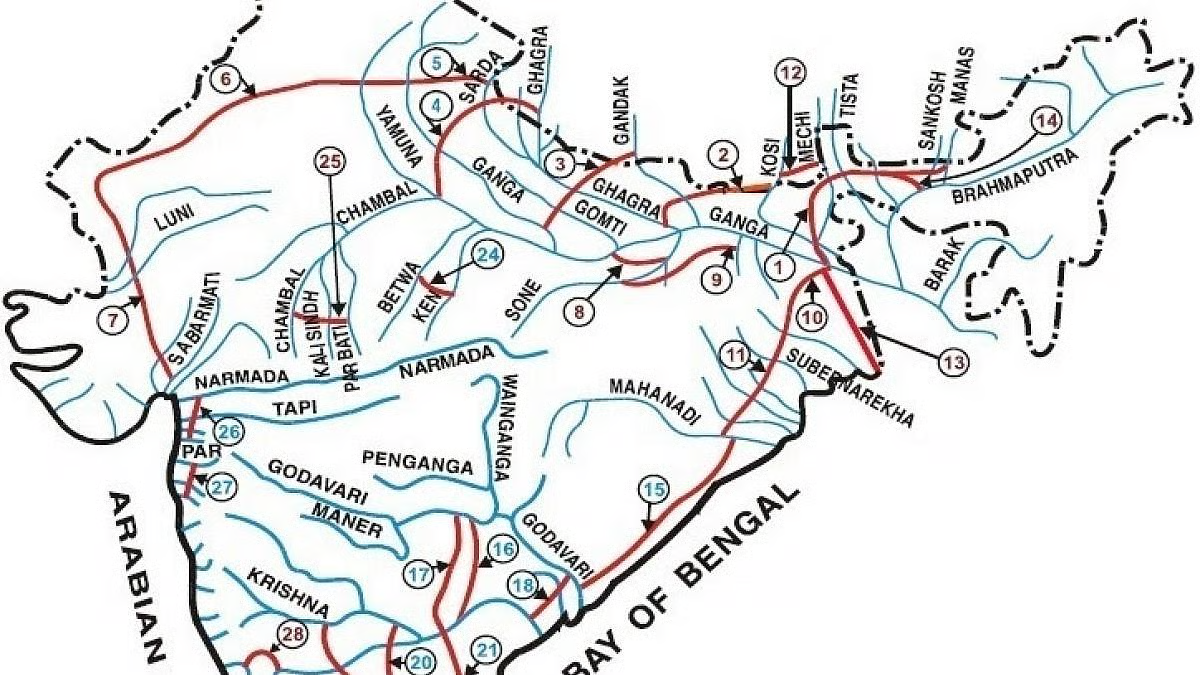
Researchers warned that connecting presently separate rivers could create “ecological highways” through which invasive species and aquatic pathogens spread to new basins.

Schematic map of India showing proposed links among northern and peninsular river basins
Illustrative map of proposed inter-basin links; the alignments and numbered links are schematic.

National River-Linking Project

  • The project proposes connections among 37 major river basins.
  • It could redistribute about 174 billion cubic metres of water and generate around 34,000 MW of power.
  • Its broad objective is to transfer water from basins considered “surplus” to those considered “deficit”.

How river links can spread invasive species

  • Separate river basins act as ecological barriers and allow distinct aquatic communities to develop.
  • Canals and reservoirs remove these barriers, allowing an invasive fish, plant, parasite or pathogen to enter a basin where native species have no natural defence.
  • Invasive species may compete for food, prey on native species or alter breeding habitats.

Vulnerable basins

  • Northeastern and peninsular river basins were found to be particularly vulnerable.
  • The Lower Ganga basin contains around 13-15 invasive alien species and could become a source for the Mahanadi basin, which supports 69 threatened species.
  • The Western Ghats, Krishna, Kaveri and Brahmaputra basins contain diverse and specialised aquatic habitats.

Other concerns and safeguards

  • Links may reduce downstream water and sediment, disrupt fish migration, alter wetlands and spread aquatic diseases.
  • Planning requires basin-wise biological-risk assessment, environmental-flow guarantees and long-term monitoring of fish, pathogens and water quality.
  • India also needs a national framework for preventing, detecting and controlling aquatic invasive species.
Why it matters

Moving water between basins can also move organisms and disease, so engineering benefits must be weighed against irreversible ecological connections.

Economy

05

Artificial Intelligence and the IT Industry’s “Bench” Model

Economy

Why in news?

Indian IT companies are reducing the number of employees kept without billable projects as AI changes staffing and skill requirements.

What is a “bench”?

  • It consists of employees who remain on a company’s payroll but are not assigned to a paying client project.
  • Companies maintain a bench so trained staff can be deployed quickly when new projects arrive, but these workers continue to cost the firm while generating no direct client revenue.

What has changed?

  • Average bench duration at major IT-service firms reportedly fell from 45-60 days in FY2020 and FY2021 to 35-45 days in 2025.
  • The estimated share of employees on the bench declined from 10-15% to around 2-5%.
  • Some firms are moving towards “just-in-time” recruitment instead of hiring large numbers in anticipation of future contracts.

How AI affects the model

  • AI tools can automate coding, testing, documentation and routine support work.
  • Companies increasingly assess employees according to deployable skills rather than only experience or seniority.
  • Workers between projects may join internal AI projects or short assignments, while internal talent marketplaces match available staff with suitable work.

The balancing act

  • A smaller bench can improve utilisation and profit margins but may leave a company short of trained staff when demand rises.
  • Employees get less time to find another project and face greater pressure to reskill.
  • Continuous training in AI, data, cloud computing and cybersecurity is becoming central to employability.
Why it matters

AI is changing both the economics of India’s IT-service model and how employment risk is shared between firms and workers.

Desert National Park

Geography

Desert National Park lies in the Thar Desert across Jaisalmer and Barmer districts of Rajasthan, near India’s western border. Its arid grasslands, dunes and rocky terrain support the critically endangered Great Indian Bustard. Captive-bred birds are being prepared here for release into the wild. The park also supports chinkara, desert fox, migratory raptors and other desert-adapted wildlife species and plants.

Sign in to read this story

Tigray

Geography

Tigray is a mountainous region in northern Ethiopia, bordering Eritrea and Sudan. Mekelle is its capital. The Tigray People’s Liberation Front dominated Ethiopian politics for decades before conflict with the federal government erupted in 2020. The 2022 Pretoria Agreement ended major fighting, but renewed rebel withdrawals and government advances have raised fears of instability, displacement and another regional humanitarian crisis.

Sign in to read this story

Earlier editions

  1. 44 26 Oct-1 Nov, 2026 10 entries
  2. 43 19-25 Oct, 2026 72 entries
  3. 42 12-18 Oct, 2026 73 entries
  4. 41 5-11 Oct, 2026 88 entries
  5. 39 21-27 Sep, 2026 109 entries
  6. 38 14-20 Sep, 2026 111 entries