Choosing UPSC answer evaluation: inspect the feedback before paying
Updated
Before paying for UPSC answer evaluation, I’d ask for one complete evaluated copy in your language and intended format. Then I’d look for a comment you could act on in your next answer.
If you can’t find one, I’d hold off on the purchase. A total score and a page full of markings don’t yet tell you what help you’ll receive.
Put two comments beside the same answer
Here’s an original practice prompt: “Explain one advantage and one limitation of moving a public service online.” Imagine an answer that explains the advantage, then finishes with “digital services are the future.” The limitation never appears.
One evaluator writes:
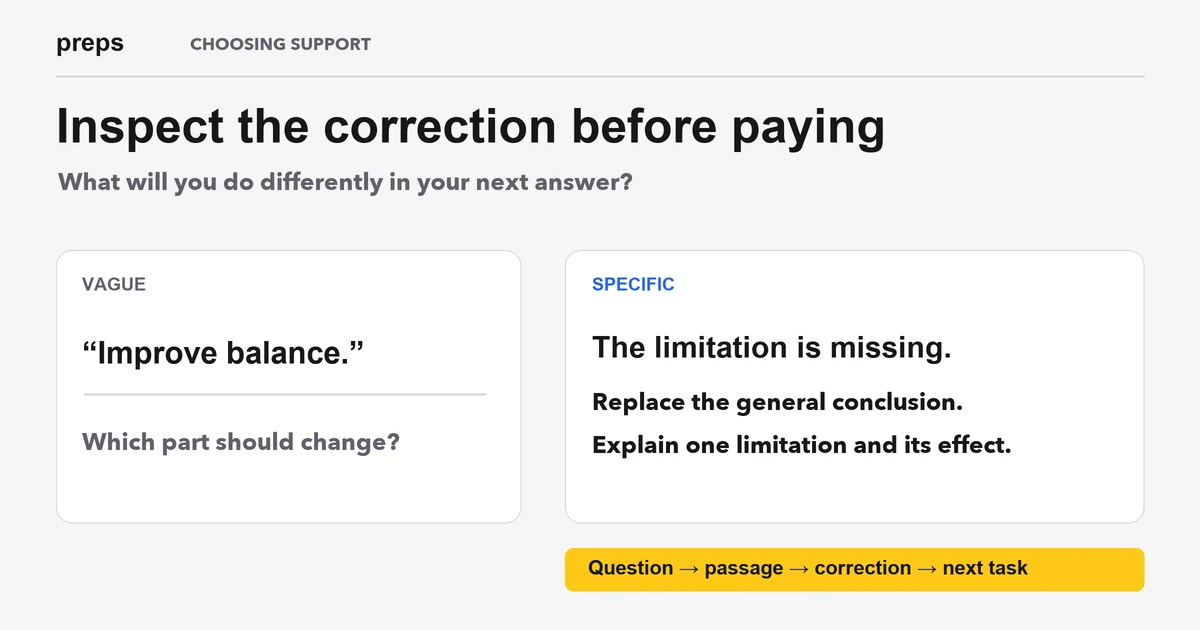
Add examples. Improve balance. Work on presentation.
Another writes:
The question asks for an advantage and a limitation. Your answer covers only the advantage. Replace the final general sentence with a limitation and explain its effect. For example, an application form that works poorly with a screen reader can make the service inaccessible to a user. In the next answer, reserve space for every requested part before expanding the first one.
I’d find the second comment more useful because I can point to the missing part, locate the passage to change and attempt the change. “Improve balance” might be a reasonable diagnosis, but it leaves you to work out what the evaluator means by it.
Both comments and the question are invented for this comparison. They don’t describe a provider’s actual service or establish what marks the answer deserves. The screen-reader example is hypothetical and consistent with the Government of India’s website and app accessibility guidance.
A short comment can do this job. A long one can still leave you guessing. When you inspect a real sample, follow one comment back to the sentence it concerns. Then try the correction. If the advice remains impossible to interpret, that’s something to resolve before buying more of it.
Decide which problem you’re paying to solve
Suppose you understand the subject but keep answering only half the question. A review that identifies those omissions could help. If you don’t understand the underlying concept, another set of margin comments may leave you with the same difficulty; I’d look for teaching or a clearer source with a way to resolve doubts.
Repeated factual errors need reliable checking and a correction process. Answers that overrun the time available need timed practice and attention to where the time goes. A study plan that repeatedly exceeds your capacity calls for a conversation about the work you can actually do.
These needs can overlap. A package may include teaching, material, evaluation and personal guidance, but I wouldn’t assume the course title proves that each is available in the form you need. Ask about the particular service you intend to use.
This is also why I’d resist comparing a recorded lecture library, automated answer review and one-to-one mentoring by the number of items in the package. First establish which job each option can do for you. Then compare its cost and terms.
Check what happens after the sample
An impressive demonstration tells you about that demonstration. Ask whether it represents the ordinary service and the plan you’d actually buy. A promotional appearance by a named mentor doesn’t, by itself, establish that you’ll receive personal feedback from them.
I’d also ask directly whether feedback is human, automated or a combination, and what review or moderation is included. The label alone doesn’t settle the quality. Inspect whether the actual feedback is accurate, relevant to the question and useful for the next attempt. Ask what happens when you dispute a factual correction.
Turnaround deserves a precise answer. Find out when the clock starts, what time is promised and how delays are handled. If you plan to use the feedback before another scheduled test, a vague promise of “quick evaluation” won’t tell you whether the service fits that plan.
And check how clarification works. Can you ask why a comment was made? Who replies, and through which channel? If resubmission is included, does anyone compare the revised answer with the earlier attempt? Those details determine whether you can follow a correction through.
Use one worksheet for each option
Make a copy for each service and another for your existing support or self-study option. Fill it with observed terms. Leave a missing answer marked as unresolved rather than assuming it’s included.
| Decision field | What to record |
|---|---|
| Option | Service name, existing support or self-study |
| Problem I need solved | A specific gap in my recent answers |
| Sample feedback | What it corrected, which passage changed and what I’d do next |
| Evaluator | Who supplies feedback and what review or moderation is included |
| Factual checking | How errors are checked and disputed corrections handled |
| Turnaround | Promised time, when it starts and what happens if it’s missed |
| Clarification and rewrite | How to ask a follow-up question and whether a new attempt is reviewed |
| Language and format | Supported answer language, handwriting, file type and page count |
| Access and limits | Number of answers or tests, expiry and what I can retain afterwards |
| Total terms | Payable amount, cancellation, refund and renewal terms |
| Still unresolved | Evidence I haven’t seen or questions nobody has answered |
Compare the same field across your copies. A low price can matter a great deal, but it won’t resolve a missing service. Equally, an expensive package needs to justify what it adds to the option you already have.
When I’d consider paying
I’d consider paid review when you’re producing answers, there’s a recurring weakness you can’t diagnose or correct on your own, and you’ve checked that the service can help with that weakness. A service you can afford and use consistently may be worth considering. Paying for it doesn’t establish that the rest of your preparation plan works.
You may also already have enough support for the next step. A peer can check whether your answer addresses every part of the question, while factual disagreements still need a reliable reference. For self-review, keep the first answer and underline the sentence addressing each requested task. Check the factual claims, then rewrite the weakest passage. The worked answer-writing revision shows that process in more detail.
If a trial or sample review is available, use one of your own answers. Explain the correction back in your own words, then try applying it to a different question from the public Mains past-question archive. Keep both attempts. Record what changed and what remains difficult; don’t turn one evaluation score into a prediction of your examination result.
That’s the evidence I’d want before recommending a purchase: you can name the help you need, show where the service provides it and explain how you’ll use the correction. If you can’t do that yet, ask the remaining question before paying for the package.