Before you call yourself weak at CSAT, let’s look at where you got stuck.
Updated

A price rises by 20% and then falls by 20%. You start with ₹100. Is the final price ₹100 again?
If you subtract the two percentages and say yes, the calculation has gone wrong before you reach the arithmetic. If you use the right method but multiply incorrectly, you have a different problem. And if you solve it comfortably after the timer ends, “I don't know percentages” may be the wrong diagnosis altogether.
This is an original teaching example, not a UPSC question. I'll use it to make a practical point about CSAT preparation: find the step that's failing before choosing another course, book or practice target.
Follow the mistake back to its cause
The increase takes ₹100 to ₹120. The decrease is then 20% of ₹120, which is ₹24. The final price is ₹96. The base changed between the two percentage operations.
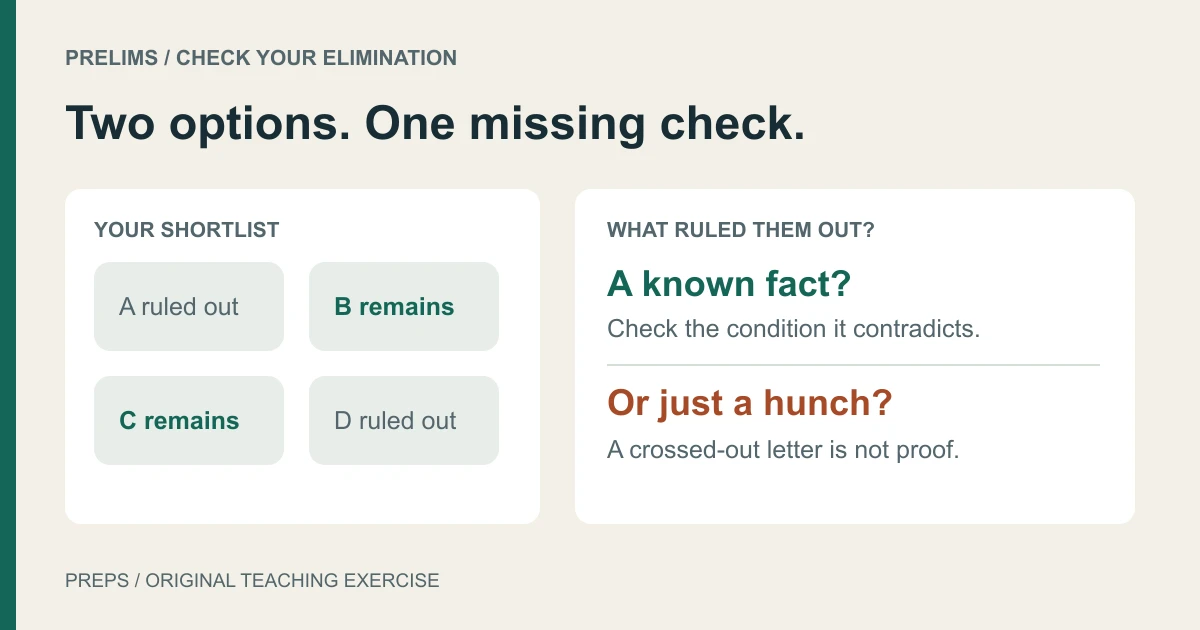
Suppose you answered ₹100. Read your working before reading another solution. Did you assume the percentages cancel? Did you know the second percentage applied to ₹120 but rush the calculation? Or did you miss the word “then” and treat the changes as simultaneous adjustments to the original price?
I'd give those attempts different follow-up work.
If the base is unclear, work through the explanation and a few fresh examples, writing the amount each percentage applies to. If your method is sound but the multiplication is wrong, inspect that operation and practise accurate working. If you misread the sequence, make the order explicit before calculating again.
Now try a fresh variation: ₹100 rises by 10%, then falls by 10%. You should get ₹99, because the second change is ₹11. Explain that before checking a solution. Remembering ₹96 from the first example isn't evidence that you've resolved the underlying difficulty.
Use a past paper to find the problems this example can't show
One arithmetic example tells you nothing about your reading comprehension or reasoning. Use a recent, previously unattempted CSAT paper from the official UPSC question-paper archive to see a wider range of work. Read its instructions and use the syllabus to identify areas you avoided.
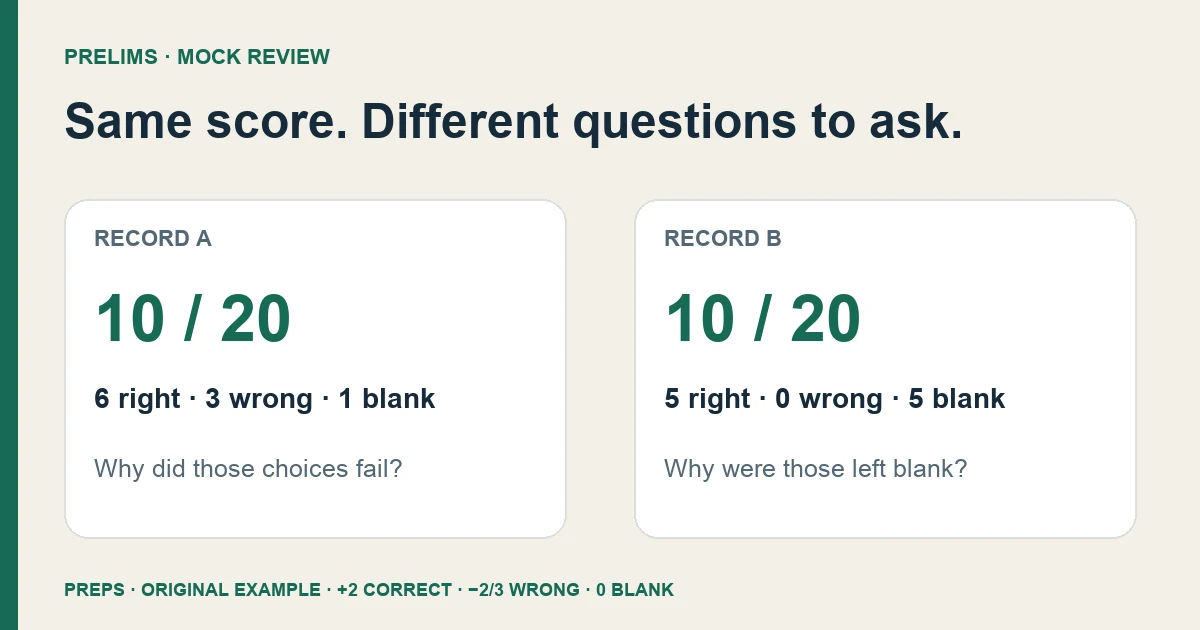
Under the 2026 Civil Services notification, General Studies Paper II is a 200-mark, two-hour qualifying paper with a 33% minimum. The preliminary scheme also specifies a penalty of one-third of a question's marks for a wrong answer and no penalty for leaving it unanswered. Check the rules for your target examination. Qualifying CSAT doesn't replace meeting the separate requirements of General Studies Paper I.
I'd attempt an unfamiliar paper under its stated conditions, then keep time for review. An unfinished paper can still show you where to begin. Don't quietly add extra time, consult notes and then treat the result as a timed score. Keep those activities separate so the record means what you think it means.
Use the official key for that paper when available. A coaching solution can help explain a method, but it isn't an official key. If you already remember the answers, choose another paper for the timed check and use the familiar one for explaining methods.
Turn the review into a study decision
For wrong, uncertain and skipped questions, locate the difficulty as precisely as you can. You don't need an elaborate tracker; your working and a short note are enough.
| What happened | What I'd investigate next |
|---|---|
| You couldn't begin even with time available | The underlying concept or method; work through a suitable explanation before another timed set |
| You followed the method but made a calculation error | The particular operation and your written working; check whether speed is making it worse |
| You understood individual sentences but chose an unsupported conclusion | The passage or premises supporting your choice; identify the extra assumption you supplied |
| You could solve it unaided after the paper ended | Question selection, reading time and where the attempt stalled; inspect the timed record |
| You chose correctly but couldn't explain why | Rework the reasoning; keep the result separate from an answer you understood |
This is an editorial review aid, not an official classification or a measure of your ability. Several difficulties can occur in the same question. Fix the one you can identify, then see what remains.
For comprehension, return to the passage and locate the support for your selected option. Check whether it says less, more or something different from the author's claim. General knowledge that sounds plausible doesn't automatically answer a question about that passage.
For reasoning, write down the premises and test the inference. For numeracy, keep the quantities and units visible. If a question remains unclear after a careful attempt, that's a useful question to take to a teacher or suitable solution source. “Please show where this step stops following from the previous one” gives them more to work with than “I'm bad at CSAT.”
Build the week from what you found
If the review exposes a basic concept gap, I'd reserve a study session for that concept and follow it with fresh questions. If you can solve isolated questions but struggle when different types arrive together, use mixed practice. If time repeatedly disappears in particular questions, examine where you continued working after you had stopped making progress.
Keep some contact with the areas you're more comfortable in. A plan that removes every uncomfortable category can make your practice feel tidier while leaving your view of the paper incomplete. The CSAT syllabus reference helps you check that blind spot.
I wouldn't prescribe the same daily question count to someone rebuilding numeracy and someone mainly adjusting question selection. Decide what the next session must clarify, do that work, and inspect the result. Retest a repaired skill in a mixed set before assuming it holds under pressure.
Full-paper attempts serve another purpose: checking how those decisions work together over the paper's duration. A successful short set doesn't establish that you can sustain the same approach for two hours. Equally, a weak full-paper result needs investigation; repeating papers without that investigation can keep the same difficulty in circulation.
Don't turn the qualifying mark into a universal attempt target
A fixed number of attempts says little without accuracy and the penalty for wrong answers. A plan based on “I'll do only comprehension” also assumes that the available questions and your performance will cooperate. I'd test any proposed selection strategy on more than one unfamiliar paper and inspect the areas it leaves out.
There isn't a practice score I can promise will make the examination safe. You can get a more useful view by checking whether you can explain your methods, complete fresh work under the stated conditions and avoid the same errors across different papers. Keep any safety margin you choose distinct from the official qualifying rule.
For your next session, take one reviewed question and write the exact step you couldn't justify. Find or ask for an explanation of that step, then try a fresh variation without the solution beside you. Keep both attempts. That's the evidence you'll use to decide what deserves another session.