Two options left in UPSC Prelims. Should you take the chance?
You've crossed out two options. The other two are staring back at you, and the question has already taken longer than you'd like.
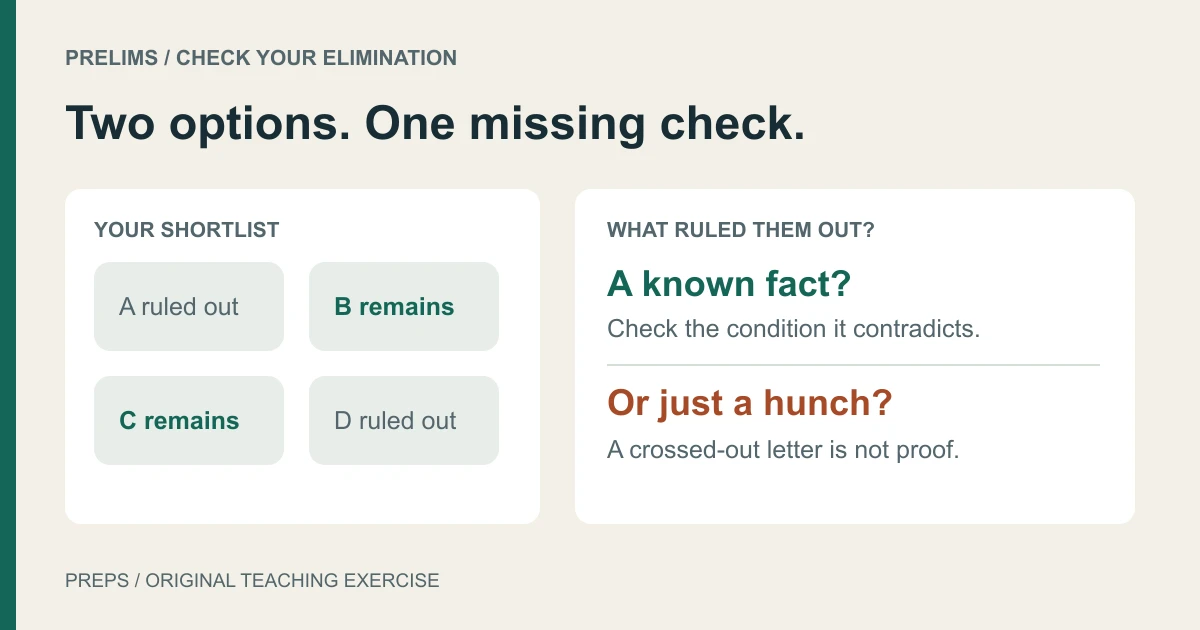
“Attempt every fifty-fifty” sounds reassuring at that moment. I'd ask one question before borrowing the confidence: what made the crossed-out options wrong?
If you ruled them out using something you know, you've changed the decision. If you ruled them out because they sounded unfamiliar, the uncertainty may still include all four. The pencil marks look the same. The reasoning doesn't.
Before you trust the shortlist, check how you made it
Here's an original fictional exercise, not a UPSC question. Everything needed to solve it is in the description:
A reading room admits registered members every day except Monday. Visitors who aren't registered may enter only on Saturday. On Tuesday, who may enter?
A. Every visitor, whether registered or not
B. Registered members only
C. Nobody, because Tuesday is the closure day
D. Unregistered visitors only
Suppose you've crossed out A and C and are choosing between B and D. A contradicts the restriction on unregistered visitors. C gives the wrong closure day. Those are defensible eliminations. But D also contradicts the Saturday-only condition, so reading that condition settles the question: B.
Now imagine you crossed out B because “only” looked too extreme. You've discarded the correct answer. No calculation about the two options left can restore it.
The lesson isn't to distrust every elimination. It's to attach each rejection to a fact, condition, counterexample or valid inference. A restrictive word tells you what to inspect. It doesn't tell you whether the statement is false.
In a real question, you won't always have the missing fact. You may genuinely be unable to distinguish the remaining choices. Keep that separate from overlooking a condition already supplied.
The arithmetic helps, provided you keep its assumptions
The 2026 CSE notification, page 25 specifies a penalty of one-third of a question's marks for a wrong answer. A blank has no penalty. Use the printed instructions for the actual paper you're taking; a commercial mock may have its own scheme.
For the following hypothetical calculation, give each question 2 marks and each wrong answer a penalty of two-thirds of a mark. If your probability of being correct is p, the expected marks from an attempt are:
2p − (2/3)(1 − p).
That is positive when p is greater than one-quarter. At exactly one-quarter, the expectation is zero. At one-half, it is two-thirds of a mark per attempt.
This explains why a sound two-option decision can be worth taking. It does not mean that crossing out two letters gives you a measured probability of one-half. That probability assumes the correct answer remains in your shortlist and an equally likely choice between the two survivors. Either assumption can fail.
And expected marks are an average under the stated model, not a promise about your next question. A favourable decision can still produce a wrong answer. A weak guess can still earn marks.
See how much the quality of elimination changes
Take these two invented batches of 12 uncertain attempts, using the same stipulated marking scheme:
| Batch | Actual outcome | Net marks |
|---|---|---|
| A | 6 correct, 6 wrong | 12 − 4 = 8 |
| B | 2 correct, 10 wrong | 4 − 20/3 = −8/3, about −2.67 |
Both batches could have been labelled “down to two” before checking the answers. The label cannot distinguish them. Batch B might include false eliminations, poor choices between valid survivors, or several kinds of error. Inspect the actual working before deciding which explanation applies.
Don't respond by declaring all risk foolish. Batch A shows why avoiding every uncertain question can also cost potential marks. Equally, one profitable batch doesn't establish a permanent success rate. Familiar questions, a narrow subject test or a small sample can flatter your confidence.
I'd review several comparable, unfamiliar sets and keep the conditions visible. Don't use remembered PYQ answers to estimate how well you'd make an uncertain choice for the first time.
Find out whether your “fifty-fifty” deserves the name
During practice, record a short reason for each rejection before seeing the solution. You don't need a dissertation beside every question. “Contradicts the Monday closure condition” is enough for the reading-room example. “Looks unlikely” is useful to record too, because it tells the truth about the attempt.
After checking a reliable answer, ask two separate questions:
- Did my rejected options actually exclude the correct answer?
- If the correct answer survived, what led me towards or away from it?
That distinction changes the repair. A false fact needs correction. A missed qualifier needs closer reading. A sound shortlist followed by an unresolved choice is still uncertainty; don't invent a rule from the outcome alone.
Keep guesses that worked in the record. Otherwise, your notebook will describe every wrong guess as a gamble and every right guess as knowledge. It will be an excellent publicist and a poor guide to the next test.
If the solution itself is disputed, verify it and keep that item separate meanwhile. For the wider review, the low-mock-score article also examines blanks, transfer errors and correct guesses. Here, the narrower task is checking what your eliminations actually achieved.
Make room to leave and return
There's another cost the expected-marks formula leaves out: time. An uncertain question can occupy time you could have used on a more tractable one. I'd practise moving on when another reading produces no new reason, then returning if the paper's remaining time allows.
The point is to preserve access to the rest of the paper. It isn't an instruction to follow a universal number of rounds or a fixed attempt target. Test your order under realistic conditions, including answer-sheet work, rather than discovering an elaborate system on exam day.
When you return, look for something specific: a missed condition, a relevant fact you can retrieve, or a relationship between the statements. If nothing changes, recognise that the decision still carries uncertainty. Neither panic about your attempt count nor the neatness of two crossed-out options supplies evidence.
For your next Prelims practice session, keep one line beside each uncertain choice: “I rejected this because…” Before judging whether the gamble worked, judge whether that sentence holds up.