Low score in your UPSC Prelims mock? Let’s figure it out.
Updated
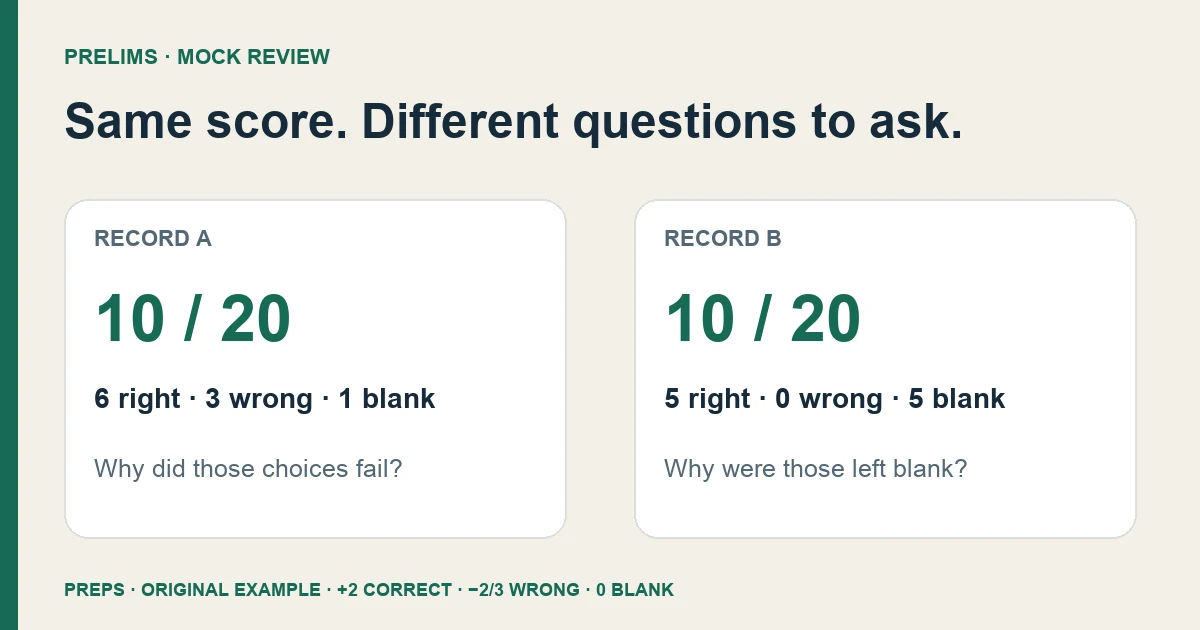
Two people finish the same ten-question practice set with 10 marks out of 20. One answered nine questions and got three wrong. The other answered five and got all five right.
I'd want to see both papers before telling either person what to change. The same score can hide quite different work. It certainly doesn't tell me that the first person needs to attempt fewer questions or that the second needs to attempt more.
If a low UPSC Prelims mock score has left you choosing between another test series and another complete reading of your books, keep the marked paper open for a little longer. There are smaller decisions to make first.
Start with what produced the marks
Here's the arithmetic behind those invented practice records. This is a hypothetical ten-question set, not a UPSC paper or a real learner's result. Each correct answer earns 2 marks, each wrong answer loses two-thirds of a mark, and a blank earns zero.
| Record | What happened |
|---|---|
| A | 6 correct, 3 wrong, 1 blank: 12 − 2 = 10 marks |
| B | 5 correct, 0 wrong, 5 blank: 10 − 0 = 10 marks |
The penalty follows the one-third rule in the 2026 CSE notification; the two-mark question value is stipulated for this illustration. For a commercial mock, check its own printed marking instructions before calculating your result.
For record A, I'd inspect the three wrong answers. Were they guesses, mistaken facts, misread conditions or answers changed without a defensible reason? I'd also inspect the six correct ones. A correct guess doesn't show the same understanding as a choice you could explain.
For record B, I'd examine the blanks. Perhaps the person never reached those questions. Perhaps they read them and didn't know the material. Perhaps they could make a sound choice but declined because they doubted it. “Attempt more” would deal very differently with each situation.
Your paper may contain all of these patterns. Keep what you actually did during the test separate from what seems obvious after reading the solution.
Review the question before labelling the mistake
“Careless” is a convenient label. It can also end an investigation before you've found anything you can change.
Suppose an original teaching question, written for this article, asks when the six-week period for an ordinance begins if the two Houses of Parliament reassemble on different dates. You select the earlier date.
Under Article 123(2) of the Constitution, the relevant date is the later one. See the explanation on printed page 57 of the linked edition, dated 1 May 2024.
Now inspect your working. If you didn't know the rule, write that. If you knew it but overlooked the words about different dates, identify the missed condition. If you selected the later date on the paper but filled the wrong option on the answer sheet, the transfer step needs attention. Those errors can cost the same marks while requiring different repairs.
I'd replace “careless polity mistake” with one sentence you can act on:
I used the first reassembly date because I hadn't learned how Article 123 handles different dates. Check that explanation and answer a changed example without looking.
Or, if the problem was transfer:
My working and marked option disagree. Practise the answer-transfer step under the mock's conditions and check the question number before moving on.
These are hypothetical explanations. Don't select one because it sounds kinder or more impressive. Use the evidence on your own paper. When you can't reconstruct the original reasoning, mark it as uncertain and record it during the next attempt.
Give correct answers and blanks some attention too
Take a correct answer you reached through elimination. Which statement did you rule out, and why? A sound distinction is worth retaining. “This word looked too absolute” needs checking against the subject matter. The wording alone doesn't establish whether a statement is true.
For a guess that happened to work, keep it recorded as a guess. You can study the underlying issue afterwards without rewriting the history of your attempt. Otherwise, the next paper gets planned around knowledge you didn't actually use.
For a blank, try the question again before reading its solution. Record that this is an untimed follow-up. If you can solve it now, inspect why you couldn't finish it during the paper. If you still can't explain the method or fact, additional time alone hasn't resolved the gap.
And check the proposed answer itself. A coaching key is a source to examine, particularly when its explanation contradicts a reliable reference. Keep a disputed item separate while you verify it. Don't force it into your error count merely to finish the spreadsheet.
You don't have to investigate every correct answer at equal length. Concentrate on uncertain reasoning, unexpectedly slow work, disputed solutions and repeated problems. A test review should leave you able to study something, rather than occupied indefinitely with describing the test.
Leave the review with work that fits before the next test
I'd choose a few actions you can complete, rather than copying every unfamiliar fact into a new notebook. Here's an original example of a review note:
Study: Check the ordinance reassembly rule in the source and explain a new scenario.
Attempt: In the next timed set, record when I leave a question and whether I return to it.
Check: Keep uncertain correct choices visible during review; don't count them as secure knowledge.
If several questions expose a missing foundation, give that topic a proper study slot. If the issue is transferring answers, another chapter of theory won't test the correction. If your review keeps adding more work than the week can hold, reduce new tests temporarily and make room for the corrections already identified.
Use the syllabus and actual past questions to keep the reading relevant. A mock setter's unusual fact doesn't automatically deserve a whole evening. Equally, don't dismiss a difficult question just because the score was unwelcome. Ask whether it examines something within the syllabus and whether the explanation is sound.
Compare the next attempt carefully
A higher score on an easier paper doesn't prove that your correction worked. A lower score on a different paper doesn't prove that it failed. Record the source, coverage, familiarity, timing and any interruptions beside the result before comparing it with an earlier one.
Then look for the particular change you practised. Did you apply the reassembly rule correctly? Did your selected option reach the answer sheet? Did leaving one difficult question give you time to finish questions you understood? Those observations are narrower than a prediction about Prelims, but they help you decide what to retain.
Don't compare an unrelated mock score directly with an official cutoff and declare yourself safe. The papers, participants and conditions differ. Your score still matters; it needs its context.
If the review points to a concept you keep recognising but can't explain, use the worked revision example to build the next task. Before booking another test, put that task into an actual slot. The marked paper has done its first job when it changes what you do between tests.