Already know the UPSC PYQ answer? Try explaining the other options.
Updated
You recognise the question. You remember which option was correct. The answer arrives before you've worked through the statements.
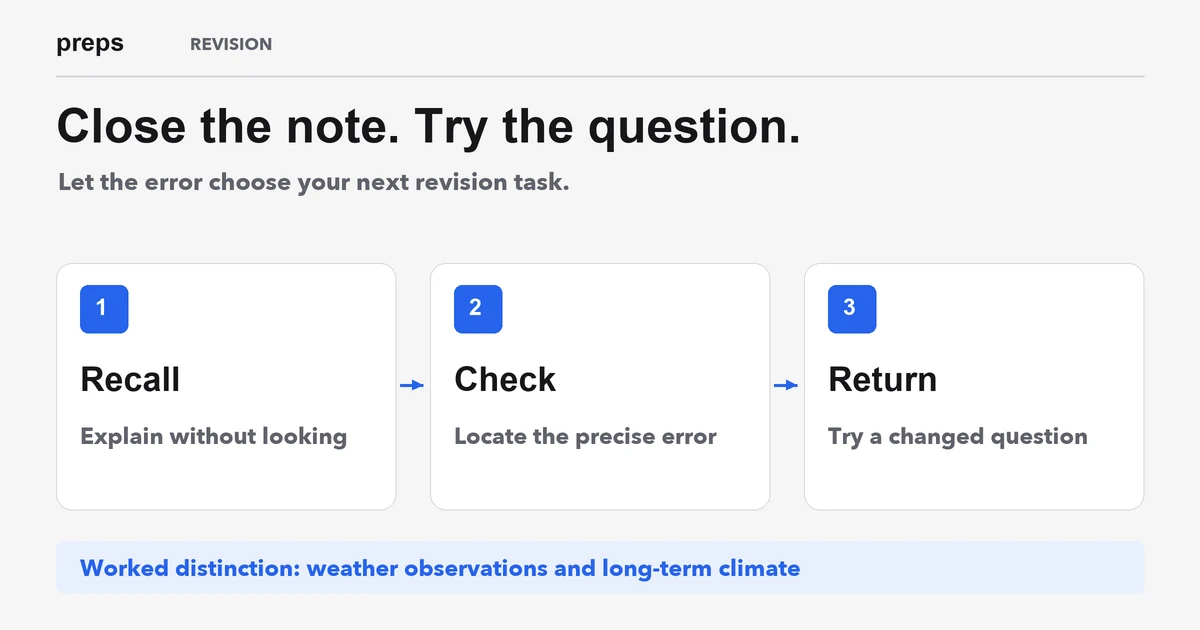
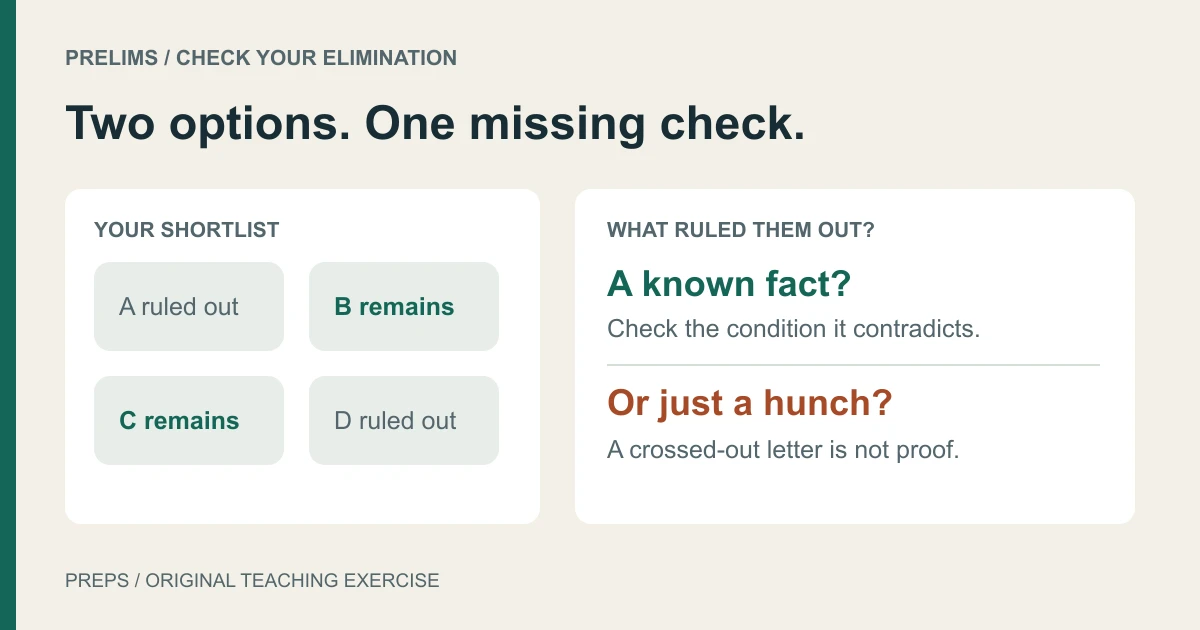
At that point, the question can still help you study, but it has stopped being a clean test of what you could solve unseen. I'd change the task: explain the reasoning that makes the answer defensible, including the options you would reject. If you can't do that yet, the familiar answer has shown you where the analysis needs to begin.
Give the question a purpose before repeating it
Use the official UPSC previous-question-paper archive to identify the exact paper, year and question. Match the booklet or series when consulting an official answer key. Keep an unofficial explanation labelled as such; it can be a useful source of reasoning without becoming the Commission's key.
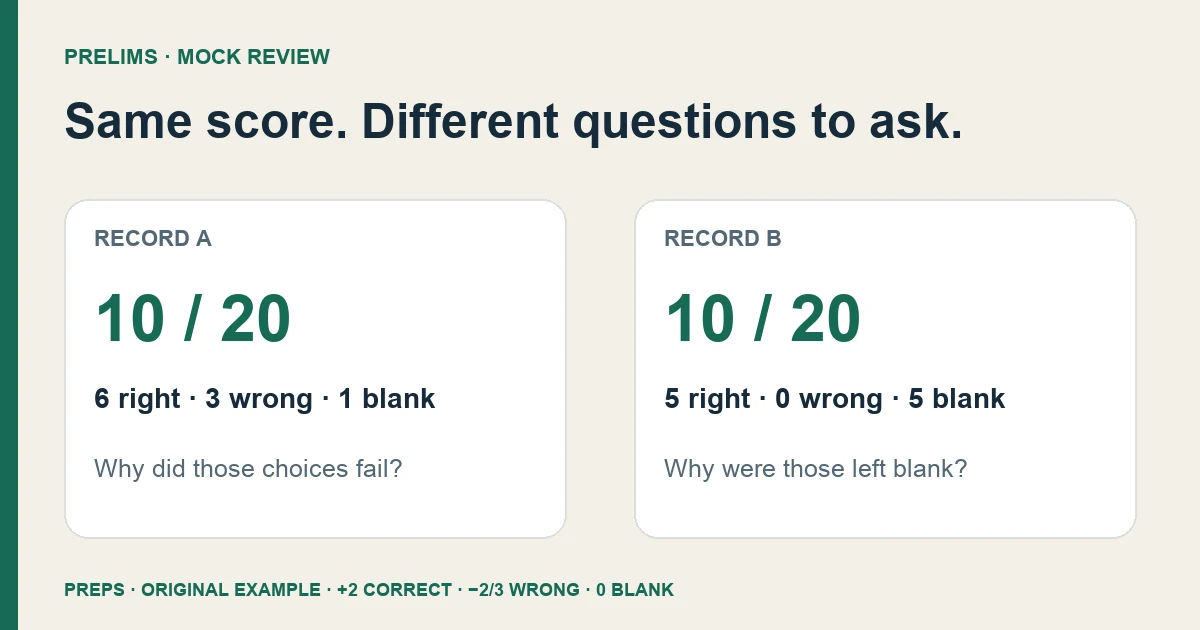
Then decide what you're doing with the question. If you want to test current performance under time, choose unfamiliar material where possible. If you're reviewing a question you recognise, record that condition and use it to inspect an explanation, distinction or inference. Don't combine those two sets of results into a claim about an unseen paper.
Topic-wise PYQs help you compare related concepts. A full paper asks you to make decisions across a mixture of topics under its instructions. I'd use each for its purpose rather than infer paper readiness from a comfortable run within your strongest subject.
Make the reasoning visible
Before opening the solution, write what you can justify. For a statement-based question, inspect each statement. Which part do you know? Where does a qualification matter? What, exactly, makes a rejected option untenable?
“Option C is familiar” belongs in that record if it's the honest reason. So does “I couldn't distinguish the last two.” A correct answer reached through uncertain reasoning still gives you work to do.
Here's an original logical illustration, not a PYQ, a real scheme or an excerpt from the Preps question bank:
In this exercise, every approved project has an independent audit. Project K has an independent audit. Does that establish that Project K is approved?
It doesn't. The rule tells you something about approved projects; it doesn't say that only approved projects can have audits. An unapproved project with an audit would fit the stated rule too.
Now suppose the statement is changed to: “Project K has no independent audit.” Under this exercise's rule, K cannot be an approved project. The two inferences behave differently even though they use almost the same vocabulary.
If you initially accepted the first inference, another reading of the words “independent audit” won't repair it. I'd write the direction of the rule and check which conclusion follows. If you already knew the logical relationship but overlooked “no” in the variation, that points to a reading error instead.
The point isn't to turn every General Studies question into formal logic. It's to locate whether the missing step was knowledge, attention to the wording, or an inference the stated facts don't support. In an actual subject question, you'll also need to verify the underlying facts and exceptions from an appropriate source.
Keep a record that changes your next attempt
You don't need a second textbook disguised as an error notebook. Keep the entry tied to the question and to a decision about what you'll do next.
For the invented project example, I'd write:
Question condition: familiar reasoning pattern, untimed. My inference: an audit establishes approval. Why it fails: the rule runs from approval to audit; it doesn't exclude audits elsewhere. Next check: explain what follows if the audit is absent, then try a different rule with the same one-way relationship.
That is a worked entry for this article. For a real PYQ, add its year, paper and question identifier, the source you checked, and the precise fact or step you need to revisit.
Keep the next action small enough to carry out. If you confused two institutions, compare their particular powers from a suitable source. If a time period or condition changes the truth of a statement, keep that condition in the note. If the concept is new, return to the explanation before attempting a pile of loosely related questions.
You can stop once you've resolved the question's reasoning and identified the relevant study gap. There's no requirement to turn every noun in every option into a separate research project. Some questions justify a longer investigation; others need one corrected distinction.
Use repetition without treating it as prediction
When you compare papers, define what you're counting. A broad label such as “environment” doesn't establish that the same concept was tested twice. A question may involve more than one topic, so a table that assigns it to one category can produce a different total from a table that allows several labels.
Before using anyone's weightage chart, check the years, included papers, classification method and whether multi-topic questions can appear in more than one category. If those details aren't available, I'd treat the chart as a rough description, not a calculation precise enough to decide which syllabus areas you can leave out.
Past appearances show what was asked. They don't establish what must appear next. A repeated topic may deserve study because it matters in the syllabus and your understanding is weak; calling it “due” doesn't add evidence.
The same caution applies to language shortcuts. A word such as “all” or “only” is a reason to examine a statement carefully, not a rule for automatically marking it wrong. A universal claim can be true. You'll need the subject knowledge or reasoning that supports your decision.
Decide whether to revisit the source or try fresh work
After analysing a small set, look at the gaps together. If several questions depend on the same missing concept, I'd study that concept in one bounded session. If the explanations make sense but your attempted reasoning keeps adding assumptions, try unfamiliar questions and make those inferences explicit. If the same wording error returns, check for it before committing the next choice.
Come back to some earlier questions with the explanations covered. Being able to reconstruct the reasoning is useful, even if you remember the option. Test whether that understanding transfers using unfamiliar questions too; keep their results separate from rehearsed material.
The Prelims PYQ archive can help you locate papers, while the subject guides give you a place to revisit a concept. Practice answers and explanations remain subject to the site's access and allowance rules. If you need help organising the return to a topic, the revision-session example follows a specific misunderstanding through another attempt.
For the next PYQ you recognise, leave the remembered option alone for a moment. Write the sentence that makes it correct and the reason your closest alternative fails. Those two explanations will tell you more about the next study session than another tick beside an answer you already knew.