UPSC revision: what to do when rereading is not enough
Updated
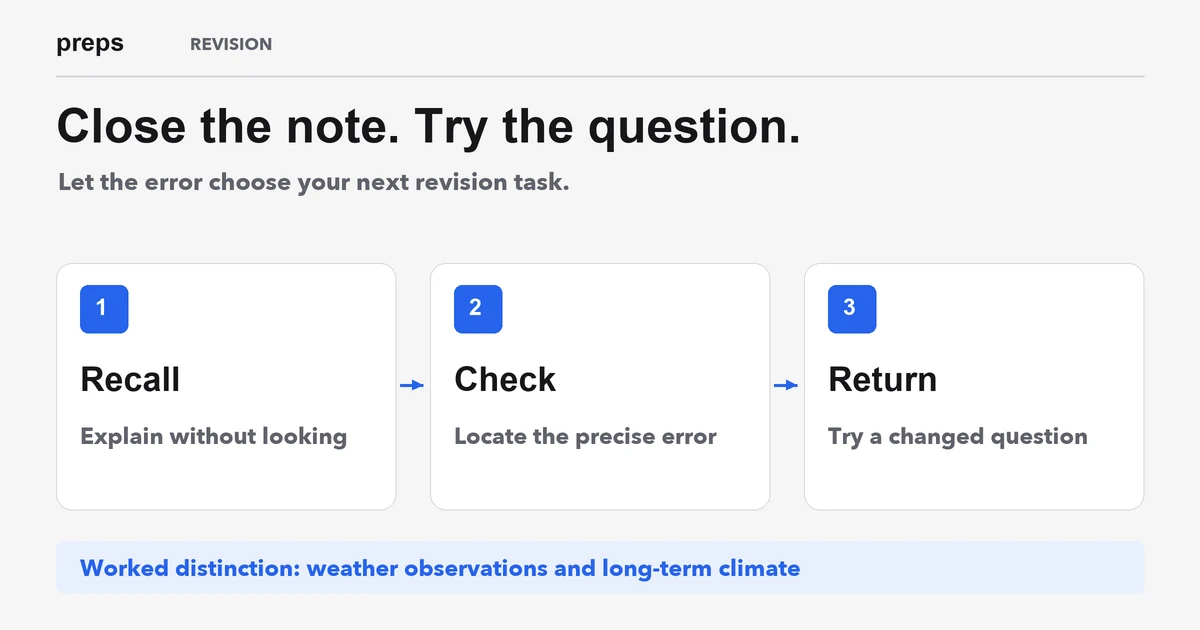
Weather and climate both mean temperature. Climate is the temperature after 30 years, so we just need to wait.
That’s an invented answer for this article. It’s wrong in a useful way: it tells us what the next revision session needs to fix.
Compare that with “revise geography.” One task has a visible problem. The other could absorb an afternoon without showing whether the problem changed.
If you keep rereading a familiar page and still struggle to answer questions from it, I’d start with one explanation you can produce without looking. It may be incomplete or wrong. Keep it long enough to find out why.
Find the misunderstanding inside the answer
Here’s the original practice prompt behind that answer:
Yesterday was unusually cold in a town. Is that observation enough to describe its climate? Explain the distinction.
The World Meteorological Organization’s weather reference gives us the factual foundation. Weather concerns the state of the atmosphere at a particular time; climate describes weather conditions over a long period. A climatological standard normal uses 30 years of data.
Our invented answer has compressed all of that into “temperature” and treated thirty years as a waiting period. Rereading the definition may help, but I’d want you to confront those two mistakes explicitly. Weather includes more than temperature. Climate isn’t one reading taken after waiting long enough.
A corrected explanation could be:
One cold day describes a weather observation. Climate describes longer-term conditions for a location; a 30-year standard normal is one way to summarise typical conditions. One day alone cannot establish that long-term pattern.
You now have a specific correction to check in later work. Highlighting the entire definition again would make it more yellow, but it wouldn’t show whether you still believe the waiting-period explanation.
These examples are original teaching material, not UPSC past questions or records of an aspirant’s performance.
Keep a note that makes you attempt the explanation
I’d keep the question and the correction together, with the answer covered when you return. You don’t need to transcribe the chapter into a second notebook.
| Part of the note | Filled example |
|---|---|
| Question to attempt | Why can one unusually cold day coexist with a warmer long-term climate? |
| Explanation to check afterwards | The day is a short-term observation; the climate description concerns a long-term pattern. They refer to different time scales |
| My error to watch | Treating climate as one temperature reading after a waiting period |
| Source | WMO, Weather: definition and Overview |
| Next task | Classify a different example and explain what evidence supports that classification |
The question needs to be small enough that you can tell what an adequate answer contains. “What does a 30-year normal summarise?” gives you something to check. “Do I know climate?” leaves too much room for a reassuring nod.
Change the example before trusting the sentence
Later, after working on another geography topic, try this original practice question:
A report compares a town’s average July rainfall for 1991–2020 with rainfall on one particular day. Which describes a longer-term reference, and which describes an individual weather observation? Why should the two figures not be treated as equivalent?
The period average is the longer-term reference; the day’s rainfall is an individual observation. Explain the time scales before checking the source. There are no rainfall values to memorise in this exercise.
I’d use your explanation to choose the next task. If you repeat the earlier sentence without applying it to rainfall, try another example. If the distinction is sound but a factual detail is wrong, correct that detail. If you can’t explain the distinction at all, return to the foundation with the source open.
That’s a suggested way to inspect your understanding. It isn’t a scientific review interval or a promise about examination results.
“More revision” may be the wrong diagnosis
The weather–climate example involved a mistaken concept. Your difficulty may be different, and I wouldn’t give every difficulty the same prescription.
| What your work shows | What I’d try next |
|---|---|
| The explanation never made sense | Find a clearer explanation and work through an example with the source open |
| You understand a cue but can’t answer unaided | Reduce the recall question and check the missing part |
| You recall something confidently, but it’s wrong | Verify and correct that statement, then test the distinction |
| Your explanation is sound, but you misread the question | Identify the word or inference that changed your answer |
| You planned more than the session could hold | Reduce the work and name what moves to another slot |
A low score alone won’t tell you which row applies. Look at what you wrote, what you chose and the reasoning behind it. If you need a defined topic to work on, the subject and topic guides can help you choose one.
For something you corrected only after a cue, keep another unaided attempt in the plan. For something you explained independently, move on while bringing it back into later mixed practice. You can give the next attempt a date, then change that date when your work or available time gives you a reason. I wouldn’t treat a perfectly spaced calendar as proof of understanding.
When Tuesday’s revision lands on Wednesday
Suppose Tuesday’s plan contained three tasks: this weather–climate distinction, an economy note and a polity question. Work runs late. None gets done.
I wouldn’t attach all three to Wednesday automatically. First look at what was unfinished. If the climate explanation was still wrong, protect a short correction attempt. Move another task to a named later slot and reduce new work if that’s what the day requires.
If this happens repeatedly, revise the amount you’re planning. A timetable that keeps transferring the same work forward is giving you information about its own capacity.
With a longer backlog, separate concepts you never understood, errors that keep returning and material you haven’t revisited recently. Make room for weak areas and a rotating sample of the rest of the syllabus. Otherwise, one difficult chapter can keep winning every revision slot while whole subjects quietly disappear.
If the pile is mostly current-affairs notes, revisit what you choose to record from the newspaper too. You may need to reduce what enters the pile as well as improve how you revisit it.
Before closing Wednesday’s plan, write the actual question for the task you moved. “Explain why one cold day doesn’t establish a climate pattern” can be attempted. “Clear backlog” will still be waiting when you next open the notebook.