How to read the newspaper for UPSC when everything looks important
Updated
You read about a policy in the newspaper. A daily analysis video explains it again. The monthly compilation arrives, and you make another note because this version looks more complete.
One issue now occupies three places in your preparation. Finding the right page has become a small research project of its own.
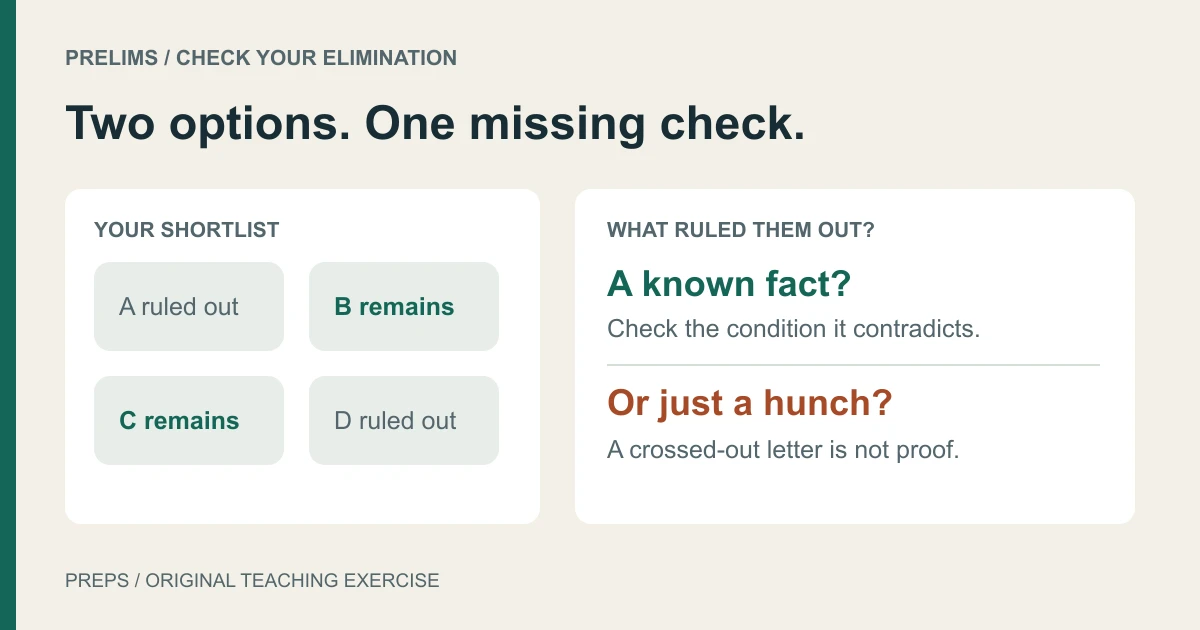
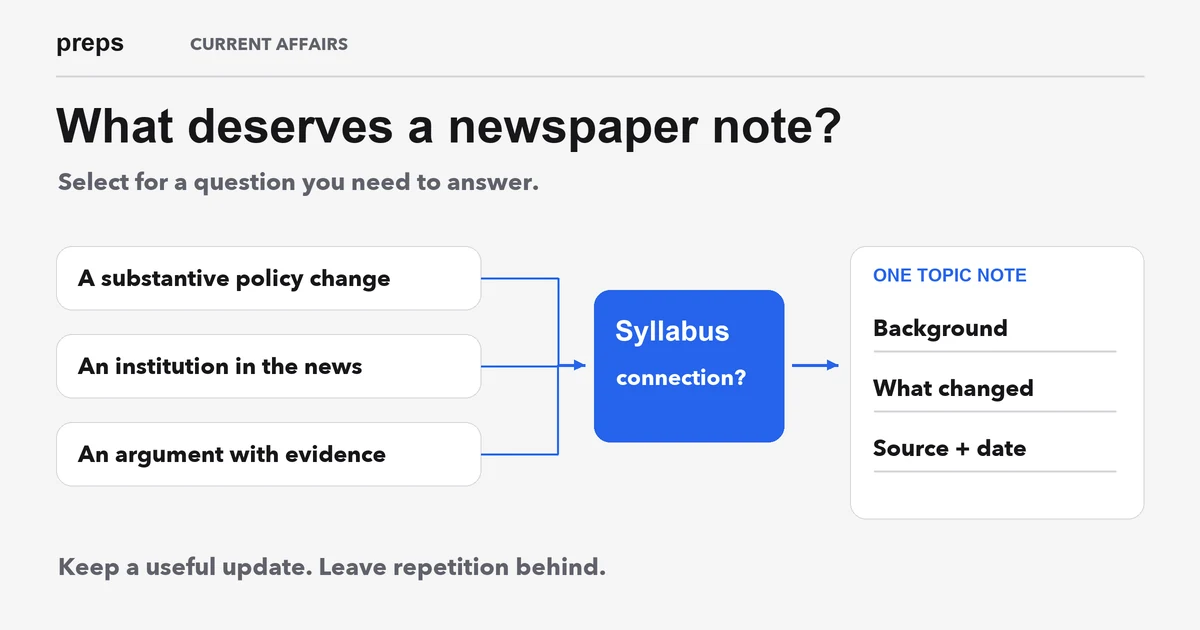
If this is happening, I’d change what you ask the newspaper to do. Before making a note, name the question the article helps you answer. That gives you a reason to keep something—and a reason to stop copying it.
Follow one issue through the paper
Take an illustrative report about a G20 meeting. I’d read it for the issue being discussed, any substantive outcome and the background I need to understand both. A photograph of the leaders doesn’t need a place in my revision notes merely because it occupies half the front page.
The official CSE syllabus gives this reading a boundary: current events, governance, economic and social development, international relations and the other specified areas. Keep the relevant syllabus headings beside you while you’re learning to make these connections.
Then look at what an actual question asks. This UPSC Prelims 2023 question about the G20 asks about the institution’s background and a substantive presidency priority. You can inspect the question without treating it as a prediction of the next paper.
That’s the kind of connection I want you to practise: identify what you need to understand, then decide which part of the report supplies it. A syllabus connection makes an article worth considering. It doesn’t make every sentence worth recording.
Give the next report somewhere to go
For that G20 example, I’d keep one topic note with a small background section and a separate news update. Here’s an illustrative version:
Topic: International economic cooperation
Institution: G20, a forum of major advanced and emerging economies
Background: Established in 1999 following financial crises in the late 1990s
Organisation: The presidency rotates; there is no permanent secretariat
Meeting update: Record the particular meeting’s substantive outcome, with its source and date
The institutional details are supported by the official G20 website. The meeting update has to come from the report you’re actually reading; the box above doesn’t invent an outcome for today’s news.
When another meeting makes the news, return to this note. Perhaps the new report adds an agreement, a disagreement or a change in implementation. Perhaps it adds nothing you need to retain. Either way, you have a place to make that decision without starting another page of G20 history.
I’d use the same approach for a policy or institution that keeps returning to the paper. Keep the background you can reuse, and add developments that change your understanding. Otherwise, every monthly compilation becomes an invitation to rewrite the same introduction.
Some reports need a different decision
The G20 example is fairly straightforward. Two other situations deserve more care. These are teaching illustrations, not a list of today’s headlines.
The policy is unchanged, but the political argument continues
Scan for a new decision, document, constitutional issue or evidence about implementation. If the report adds one, examine it. If it repeats an exchange you already understand, I’d move on without expanding the note.
Don’t turn that into a rule to skip political reporting. A political dispute may expose exactly the governance problem you need to understand. The useful distinction is whether the report adds something material, not whether politicians appear in it.
The technology explanation is difficult
Start with what the technology does, its basic principle, applications and limitations. If an unfamiliar concept prevents you from understanding the report, identify that concept and study it separately.
I wouldn’t advise you to ignore technical details automatically. The depth needed depends on the subject and the questions. Equally, copying a difficult paragraph doesn’t resolve the difficulty. Leave yourself a specific task—“understand this basic mechanism”—instead of several lines you still can’t explain.
Read an editorial as an argument
With an editorial, I’d make a different kind of note. Write down the author’s central claim, the evidence offered for it, and the strongest objection you can identify. Then connect the argument to a possible syllabus question.
For instance, if an author recommends a policy change, separate the problem they identify from their proposed solution. Ask what would have to be true for that solution to work. That gives you something to examine and use in an answer, rather than a paragraph to reproduce because it sounds authoritative.
Keep an opinion labelled as an opinion. If you retain a statistic, keep its source and date too. You may agree with the author; you should still be able to explain why.
Choose a routine you can return to
If you’re switching between newspapers, videos and compilations every day, I’d choose one main source for daily reading. Use another when you need a clearer explanation or a fact checked. Give the additional source a job before giving it more of your time.
A monthly compilation can help you find omissions and revisit issues. Compare it with your existing note. Add a useful correction or development; don’t copy the background again just to say you’ve completed the compilation. If a concept is still unclear, go back to a foundational explanation.
Your routine will also depend on the time available. For a starting time box, you could try five minutes scanning, twenty minutes on selected reports, ten on an editorial or explainer, and five updating notes. Those are adjustable planning choices, not a UPSC requirement.
On a short weekday, I’d rather you understand one selected issue and record the next unresolved question than leave yourself “finish everything I skipped.” But a small daily selection needs a wider check: keep a separate weekly slot to notice syllabus areas you’ve repeatedly missed.
Tomorrow, take one report and look for its existing note before opening a fresh page. If you’re unsure what deserves space, compare the issue with subject-wise past questions. Keep what helps you understand or answer something. Let the newspaper’s page count remain the newspaper’s problem.