UPSC Mains: preparation thi, answers bhi aate the, lekin questions reh gaye
The last half-hour arrives, and there are still several questions you haven't touched. Now every answer becomes an argument with the clock. You shorten the next one, rush the one after that, and leave knowing you had more to say.
I'd resist diagnosing that experience as “my hand is too slow” straight away. Sometimes it is the writing. Sometimes you're waiting for a fourth point, polishing an introduction or deciding what the question meant after you've already started answering it. Those problems need different practice.
Start with the last test you couldn't finish. Beside each answer, write what you remember doing when the pen stopped. That is more useful than another promise to write faster.
Your pen may be waiting for your answer
Read these invented practice observations. Which resembles your test?
| What happened | What I'd investigate first |
|---|---|
| You knew the point but took a long time to put it on paper | Legible writing pace and sentence length |
| You repeatedly stopped after a heading to search for an example | Retrieval and choosing enough relevant material |
| You wrote a page, noticed a second demand and started squeezing it in | Reading and planning before writing |
| The first answers were elaborate; the final ones were skeletal | Allocation across the whole paper |
| A familiar question kept growing because you knew so much | Selecting material and stopping |
These are clues, not exclusive categories. A single answer can contain several delays.
For your next practice set, note the start and finish of each answer on a separate practice log. Immediately afterwards, add a short explanation of any long pause. Don't interrupt every sentence to operate a stopwatch; the log should help you see the problem, not become a new one.
If the missing material only appears when you reopen your notes, do some closed-book planning on that topic. If you had the material but wrote it twice, edit the answer. Copying pages quickly won't teach you which argument belongs in a question about accountability.
Make the whole budget add up before borrowing a timetable
The 2026 CSE notification, page 29 gives each Mains paper a three-hour duration. Follow your own paper's instructions and any approved accommodation. The example below uses the standard 180 minutes and concerns a hypothetical GS practice paper; it isn't a universal timetable for Essay, optional papers or ethics case studies.
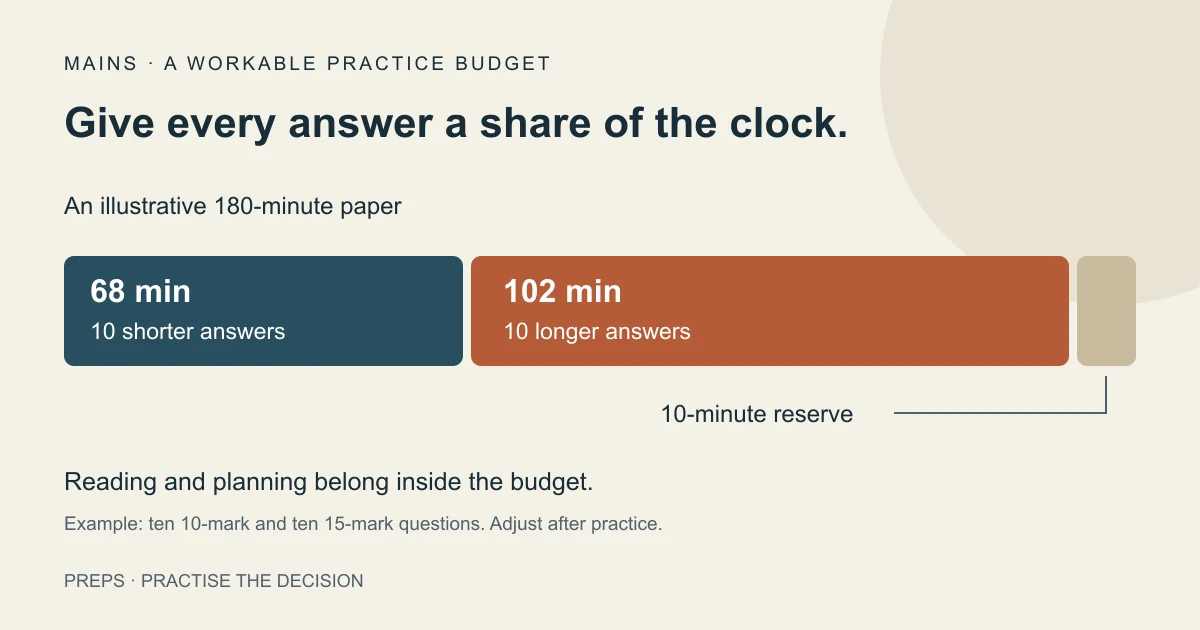
Suppose your practice paper contains ten 10-mark questions and ten 15-mark questions. Set aside 10 minutes across the session for checking instructions, tracking question numbers and returning to gaps. That leaves 170 minutes for the answers, including reading and planning them.
One starting allocation distributes that time in proportion to marks:
- Ten shorter answers: 68 minutes in total, roughly 6 minutes 48 seconds each.
- Ten longer answers: 102 minutes in total, roughly 10 minutes 12 seconds each.
- Reserve across the paper: 10 minutes.
The arithmetic is 68 + 102 + 10 = 180. It doesn't prove this allocation will suit you. It gives you a plan you can actually test. You can adjust the split and reserve after seeing your work, while keeping the total honest.
Beware of combining attractive advice from several places: eight minutes for every shorter answer, twelve for every longer answer, then a generous review at the end. In this invented paper, the answers alone would need 200 minutes. Your hand cannot repair the timetable's arithmetic.
Give yourself a point at which to move on
For that same practice paper, you could check progress after each group of five answers. If you write the shorter answers first, their two groups share the 68-minute allocation; the two longer-answer groups share the 102 minutes. Account for any reserve you've already used when comparing with the clock.
Choose an order during practice and track whether it works. Starting with longer answers may suit one writer; another may settle into the paper through shorter ones. An elaborate order costs attention and can create numbering mistakes. You need evidence from your own full tests before making it your exam routine.
What happens when you reach your planned stopping point and the answer isn't ideal?
First ask what remains. If you've missed an explicit part of the question, give that part a concise, relevant response. If you're adding a second example to a point already explained, I'd usually move on during the practice test and record the tradeoff afterwards. A better sentence here consumes time that another answer may need for its first sentence.
Keep the question number and designated answer space correct. If you leave a gap to revisit, follow the booklet's instructions and make a note in your practice tracking so you don't lose it. Don't turn jumping between questions into a second puzzle.
Try shortening the decision, not just the sentence
Here's an original miniature exercise, not a UPSC question or model answer:
A district moves an application process online. Some applicants lack reliable internet access. Explain the access problem and suggest an administrative response.
Before writing, a rough plan might be:
Online submission needs a connection → some applicants cannot reliably submit → assisted access with safeguards and a way to track unresolved applications.
That plan gives the paragraph somewhere to go. You still need to explain the response: for example, staffed submission assistance, an acknowledgement the applicant can keep and controls protecting personal information. “Create awareness” alone doesn't solve a missing connection.
A delay can occur when you reject those relevant points because you want something more impressive. The next minute disappears while you search for a committee name. Use an accurate example when it strengthens the answer; don't invent one or make every point wait for a quotation.
Afterwards, check whether your response addressed both parts and whether the safeguard had a purpose. A faster answer that misses the access problem hasn't solved the exercise. The directive guide can help if interpreting the task is where you stall.
Practise the delay you actually found
If planning is the problem, take a small set of unfamiliar questions on studied topics. Draft brief answer plans without writing full answers. Check whether each plan covers the whole demand, then write selected answers under a clock. Planning practice and writing practice tell you different things; you need both.
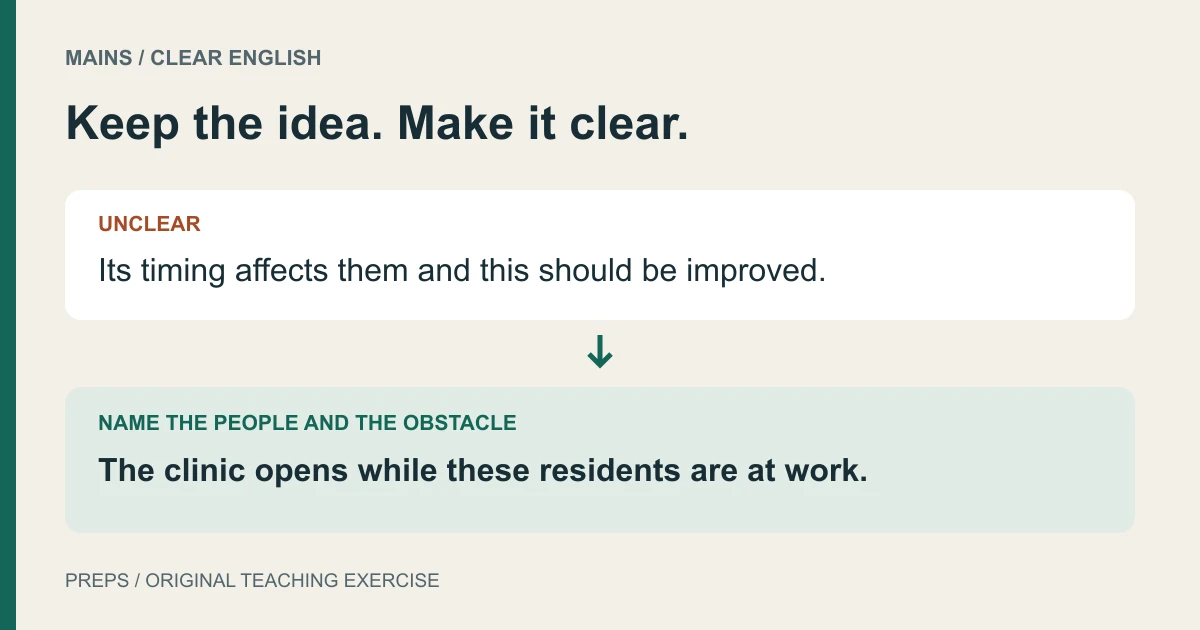
If expression is the problem, shorten an overlong passage while preserving its explanation. Writing one clear paragraph is a manageable place to begin. Keep necessary subject terms. Replacing a reason with a slogan saves words and loses meaning.
If writing itself is the constraint, practise at a sustainable pace with the paper and pen you expect to use. Check whether someone else can read the result. The notification's page 31 allows a deduction for handwriting that isn't easily legible and values precise, economical expression. Racing into unreadable script is a poor bargain.
Then return to a full timed paper. An isolated answer doesn't reproduce the decisions, sustained writing and accumulated overruns of a complete session. Stop at the time limit and mark what remains; finishing later may be useful for learning, but record it separately from the timed result.
Compare more than the number completed. Did you cover the demands? Could you read the final answers? Did your opening answers consume the reserve? Review an early answer beside a late one, using the worked revision approach if you need help judging substance.
For the next test, choose one change you can observe: a brief plan before writing, a group checkpoint or a firmer stopping decision on familiar questions. You don't have to solve every delay at once. You do need to know which one you're working on before the clock starts.