UPSC interview prep: you don’t need a script for every DAF question.
Updated
“Worked in operations.”
That can occupy one line in an application and lead to a conversation about what you did, what went wrong and how you made decisions. A list of fifty questions about the company may leave those parts untouched.
I'd begin UPSC interview preparation with the account you can truthfully give of your own background. Then I'd practise what happens when someone asks a follow-up you haven't prepared.
Start with the record you actually submitted
You may know this work as DAF preparation. Use your submitted application and any officially requested updates, rather than an old form template from a coaching folder.
The 2026 CSE notice uses “Application Form” in its update instructions on printed pages 10–11. Its Personality Test section on pages 31–32 says the Board has a career record and describes a directed conversation assessing suitability for public service, including judgment and clear expression. It also expects an intelligent interest in academic subjects and events around you.
That gives you a sensible preparation area. It doesn't tell you which questions your Board will ask, or what proportion will come from your application. Check the current official instructions separately for submission requirements and dates; this article deals with preparing to discuss your background.
Build one sheet from one entry
Here's an invented candidate, used only to demonstrate the exercise:
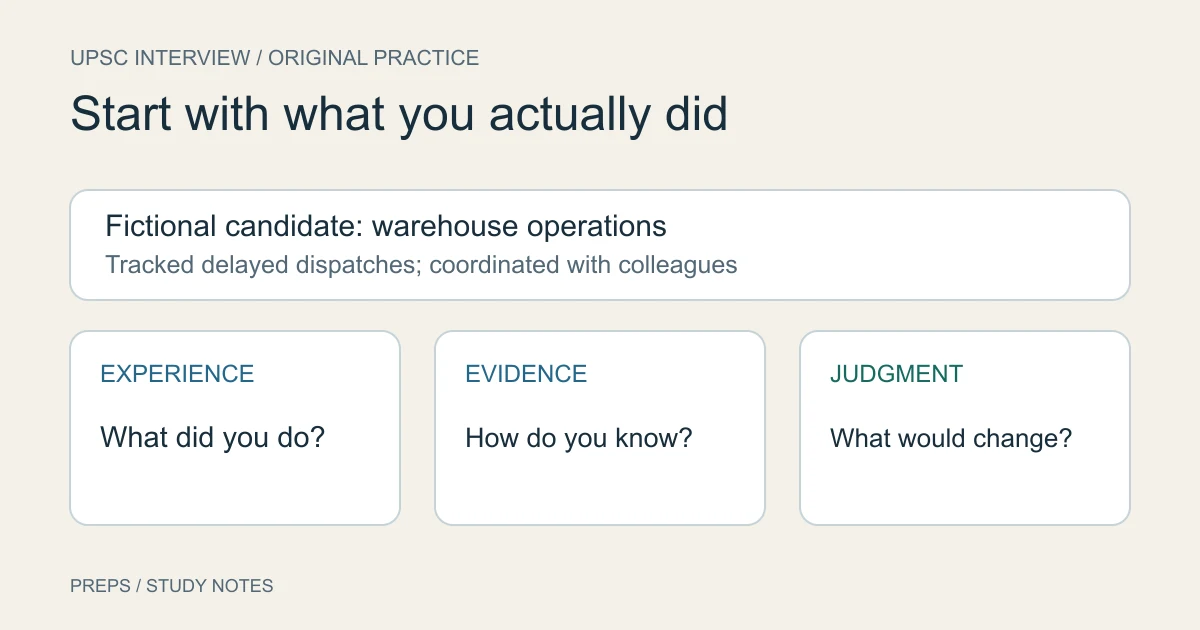
A commerce graduate worked in a warehouse operations team. Their responsibilities included tracking delayed dispatches and coordinating with colleagues. They did not set company-wide logistics policy.
Choose an entry from your actual application and separate three kinds of material.
Your own experience. What was your role? Which decisions were yours? Can you describe one specific task, difficulty or disagreement without inflating your responsibility?
Facts you can check. Which terms, institutions or current developments are relevant? Keep a reliable source beside an external claim. Your experience of one workplace cannot establish what happens across an industry.
Judgments you need to explain. What did the experience lead you to think? What evidence would qualify that view? What changes when the decision affects people outside your organisation?
You don't need to turn every entry into an encyclopaedia. Follow a connection far enough that you can explain it and recognise its limits.
Practise the follow-up that interrupts the polished answer
For the fictional candidate, a useful question could be:
Why were some dispatches delayed?
An original practice reply might begin:
In the team I worked with, some delays occurred when orders reached dispatch before stock discrepancies had been resolved. I tracked those cases and coordinated with the responsible colleagues. I wasn't responsible for the inventory system, so I can't speak for every cause across the company.
The reply defines a problem and the person's role. It doesn't yet prove that their proposed solution was effective. Follow it with:
How would you know whether your work reduced the delay?
Now the candidate needs an honest answer about evidence. If they have a real before-and-after record, they should explain the period, measure and limits. If they don't, they should say so. “I followed up on pending cases, but I don't have a reliable estimate of the reduction attributable to my work” is a defensible admission. It isn't an invitation to invent a percentage.
A third practice question changes the setting:
Could the same method be used in a public office?
The candidate should examine the comparison. Tracking a pending task may transfer; the authority to demand information, the people affected and the duties to explain a decision may differ. A workplace story becomes more useful when you can identify what the analogy leaves out.
These questions and replies are original illustrations, not an interview transcript, a successful candidate's experience or predicted Board questions. Use your own facts.
Let your home, studies and interests generate different work
An academic entry may need a clear explanation of a basic idea, a return to a subject you've neglected, or a current issue connected to it. Read enough to answer the question you've identified; don't assume preparation is complete because you can name your favourite topic.
For your home region, distinguish something you've personally observed from a larger claim. Seeing a flooded road doesn't establish the cause of flooding across a district. If you want to discuss that wider problem, check suitable official data and competing explanations.
For an interest, begin with what you actually do. If you read fiction, be ready to discuss a book you've read and a judgment you formed about it. You don't need a newly acquired “administrative” interpretation of every hobby.
Treat gaps in employment or study with the same honesty. State what happened at a level of detail you can comfortably and truthfully discuss. Don't manufacture a productive project to make every period sound planned.
Use a mock to find a specific weakness
Ask someone to choose an entry and follow up on your answer. They should be able to challenge an unsupported claim, ask what a term means or offer a reasonable objection. A conversation that simply follows your prepared list gives you less evidence about how you respond.
Afterwards, keep the exact point that needs work:
- “I described the whole department's work as my own.”
- “I gave an opinion, then couldn't explain its basis.”
- “I answered a question about my decision with the organisation's history.”
- “I kept talking after acknowledging that I didn't know the fact.”
These are original examples of useful feedback. Each suggests something you can correct. A general instruction to “be more confident” needs a more specific observation before you can act on it.
You can be honest about not knowing without assuming it has no consequence for your assessment. Nobody outside your actual evaluation can promise how a particular exchange will be marked.
Leave space for a real conversation
Keep working on relevant current affairs as well as your own record. Your application is a starting point for preparation, not a fence around the conversation.
Before the next practice session, choose one entry and prepare a short, accurate account of it. Add one external fact to verify and one question about your judgment. Then let the other person choose the follow-up. That's where you'll find out whether the preparation has given you something you can discuss.