Civil Services Prep

Weekly digest

UPSC current affairs, 2-8 Nov, 2026

19 entries, published 2 November 2026.

Monday, 2 Nov

Economy

1

Falling unemployment and the shortage of decent work

Economy

Why in news

  • An analysis of Periodic Labour Force Survey data shows that falling unemployment has not ensured secure jobs, adequate earnings or social protection.

What is decent work?

  • Decent work provides a reasonable income, workplace rights, social protection and opportunities for workers to express their concerns.
  • A person may count as employed while working without a written contract, paid leave, insurance or dependable earnings. Employment numbers therefore reveal only part of the labour-market picture.
  • Sustainable Development Goal 8 connects economic growth with productive employment and decent work.

What the analysis shows

  • India’s unemployment rate declined from 6.1% in 2017–18 to 3.2% in 2023–24.
  • The analysis constructed a Decent Work Index using employment status, employment opportunities and social security across five major industries.
  • The overall index improved from 0.247 to 0.302, but gains remained uneven.
  • Manufacturing improved from 0.324 to 0.411, while agriculture improved from 0.211 to 0.267 and continued to perform poorly.
  • Women belonging to Scheduled Tribes and Other Backward Classes experienced worsening decent-work outcomes even as outcomes for men improved.

Important concepts

  • Informal employment means employment without effective access to formal protections or benefits. It can exist even inside a registered enterprise.
  • Underemployment occurs when people work fewer hours than they need or perform work that inadequately uses their skills.
  • Intersectional disadvantage arises when disadvantages overlap, such as those associated with gender, caste and insecure employment.

Significance and policy priorities

  • Insecure earnings weaken household consumption, savings and resilience during illness or unemployment.
  • Social protection should cover informal, self-employed and platform workers and remain accessible when workers change employers or locations.
  • Registration on e-Shram helps identify workers, but registration alone does not provide insurance, pensions or income security.
  • Formalisation should improve actual working conditions through written contracts, paid leave and social-security contributions.
  • Childcare, safe transport, skill training and protection against discrimination are necessary to address unequal outcomes.
Geography

2

Successive cyclones and compound disaster risks

Geography

Why in news

  • Cyclone Murasu developed over the Bay of Bengal while Andhra Pradesh and Odisha were still recovering from Cyclone Arnab.

Current context

  • As of 1 November, the storm was expected to intensify and approach the Andhra Pradesh coast around the night of 2–3 November.
  • Five Andhra Pradesh districts were placed on red alert.
  • Andhra Pradesh prepared 1,688 medical teams and 116 relief camps.
  • The previous cyclone had already damaged crops, roads and electricity infrastructure, reducing the time and resources available for recovery.

How a tropical cyclone develops

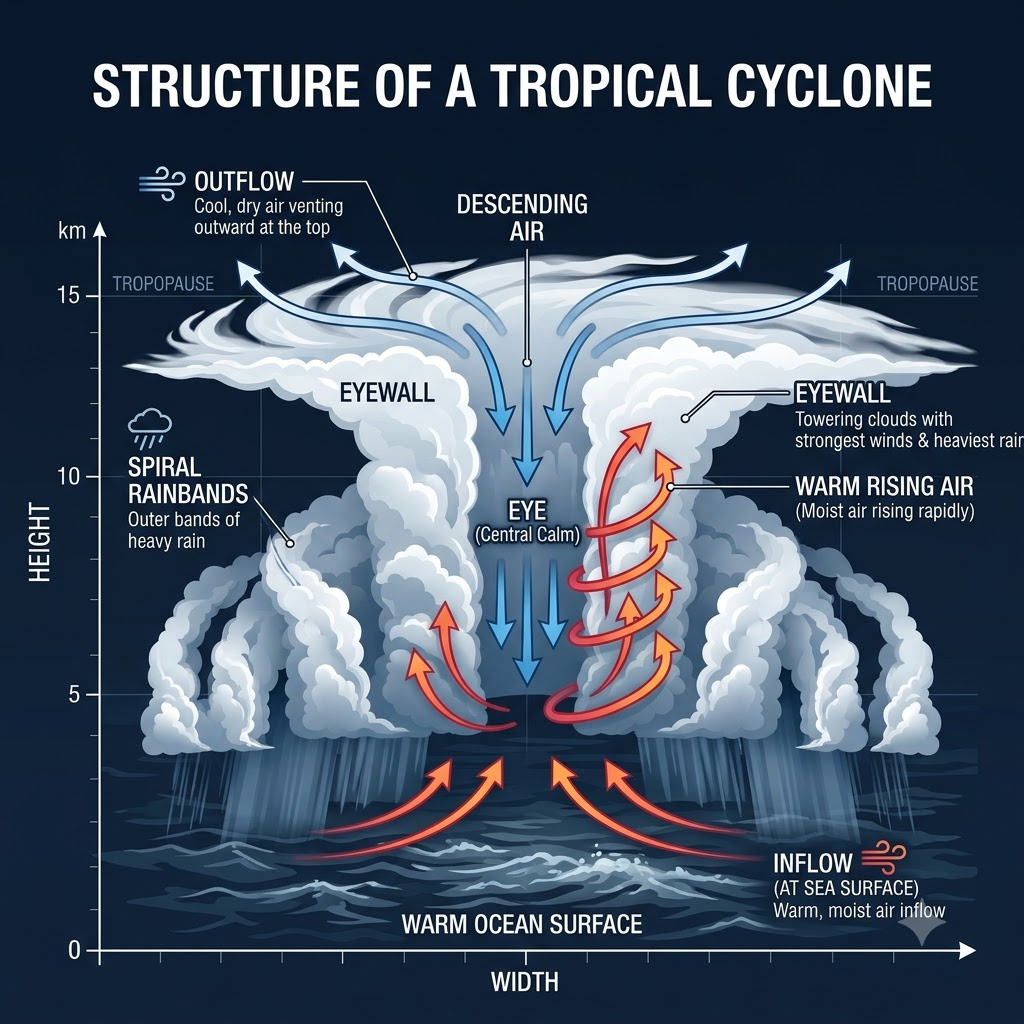
  • Warm ocean water supplies heat and moisture to rising air.
  • As water vapour condenses into clouds, it releases heat, encouraging further uplift and lowering surface pressure.
  • Surrounding air moves towards the low-pressure centre and begins rotating under the influence of the Coriolis force.
  • High ocean heat content, moist air and limited vertical wind shear can support intensification. Strong wind shear can disrupt the storm’s structure.
Cross-section showing a tropical cyclone’s eye, eyewall, spiral rainbands, surface inflow and upper-level outflow.
The eye, eyewall and circulation of a tropical cyclone; schematic, not to scale.

What are compound disaster risks?

  • Compound risks arise when hazards occur together or in close succession and intensify their combined effects.
  • Earlier rainfall can saturate soil, leaving less capacity to absorb fresh rain. This increases runoff, flooding and landslide risks.
  • Damaged roads, power lines and communications can delay evacuation and emergency assistance during the next storm.
  • Storm surge is an abnormal rise of seawater driven towards the coast by the cyclone. Its impact can worsen when it coincides with high tide and river flooding.

Preparedness priorities

  • Forecasts must lead to timely evacuation, accessible shelters and clear communication with fishing communities.
  • Authorities should reassess weakened embankments, unstable slopes, damaged buildings and disrupted drainage systems.
  • Recovery planning should restore essential services while reducing exposure to the next event.

Geography

3

El Niño, the Indian Ocean Dipole and monsoon variability

Geography

Why in news

  • Comparisons between different El Niño years show that a strong El Niño increases drought risk but does not determine India’s monsoon rainfall by itself.

Key climate processes

Process Explanation
El Niño
  • Surface waters in the central or eastern equatorial Pacific Ocean become unusually warm.
  • This warming changes the normal pattern of trade winds and shifts areas of rising air and cloud formation.
  • It alters rainfall across the tropics and beyond, bringing wetter conditions to some regions and drought to others.
  • It can also influence global temperatures and weather patterns.
ENSO
  • The El Niño–Southern Oscillation, or ENSO, is a recurring climate pattern involving the tropical Pacific Ocean and the atmosphere above it.
  • It has three main phases: the warm El Niño phase, the cool La Niña phase, and the neutral phase.
  • Changes in ocean temperatures are linked to changes in air pressure, trade winds, rainfall, and atmospheric circulation.
  • These interactions allow ENSO to affect weather around the world.
Indian Ocean Dipole
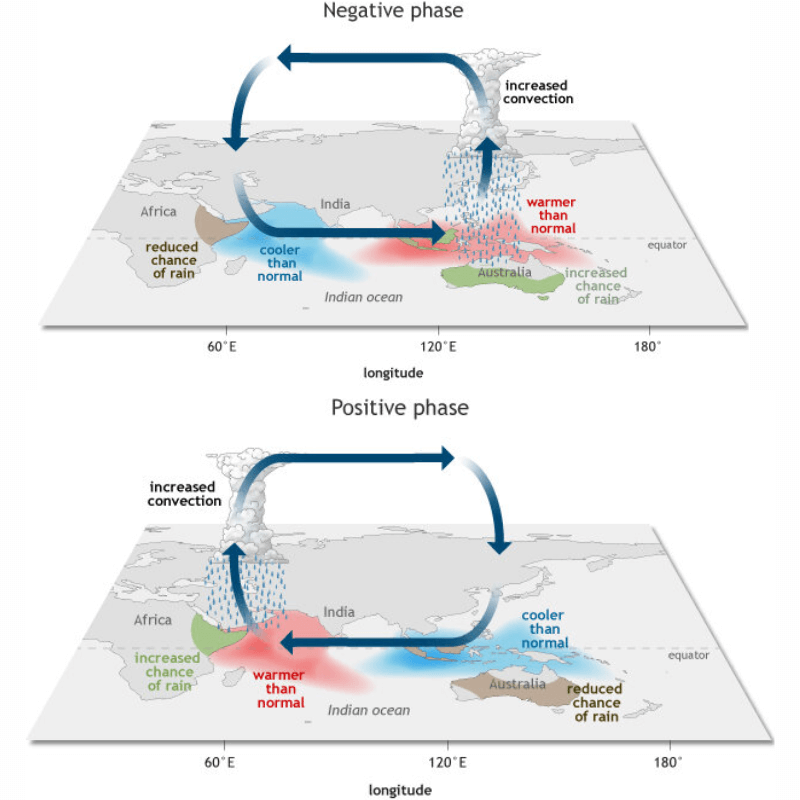
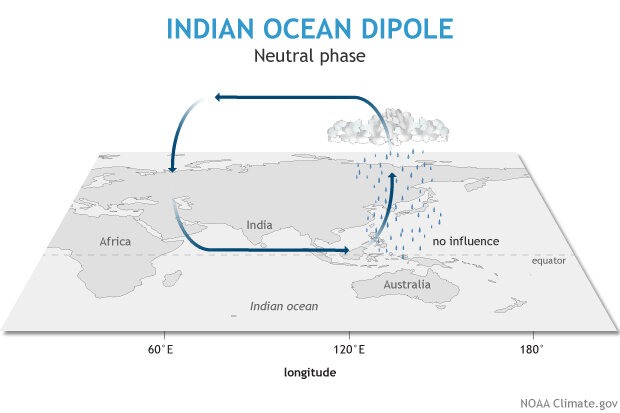
  • The Indian Ocean Dipole, or IOD, describes the difference in sea-surface temperatures between the western equatorial Indian Ocean near Africa and the eastern equatorial Indian Ocean near Indonesia.
  • During a positive IOD, the western Indian Ocean is warmer and the eastern region is cooler.
  • This pattern often changes rainfall around the Indian Ocean basin.
  • A negative IOD has the opposite temperature pattern and can also influence droughts, floods, and monsoon rainfall.
Madden–Julian Oscillation
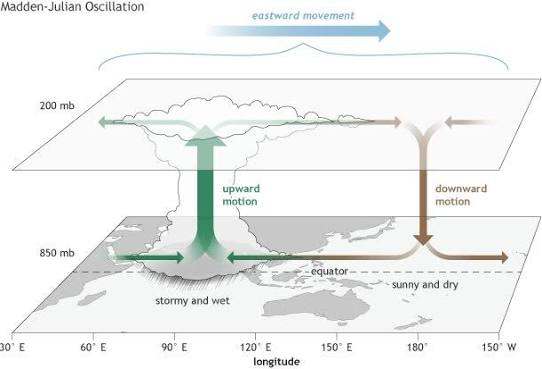
  • The Madden–Julian Oscillation, or MJO, is a large-scale pattern of tropical atmospheric activity that moves eastward around the globe.
  • It consists of alternating regions of enhanced rainfall, where air rises and thunderstorms become more common, and suppressed rainfall, where air sinks and skies are generally drier.
  • The MJO usually recurs over about 30–60 days.
  • It can affect monsoons, tropical cyclones, and weather patterns far beyond the tropics.
Neutral Indian Ocean Dipole circulation, with rising air near Indonesia and Australia.
The neutral phase of the Indian Ocean Dipole.
Comparison of negative and positive Indian Ocean Dipole phases, showing opposite ocean-temperature and rainfall patterns.
Negative and positive Indian Ocean Dipole phases; regional effects vary with other climate conditions.
Eastward-moving Madden–Julian Oscillation with rising air and wet conditions followed by descending air and dry conditions.
The Madden–Julian Oscillation’s eastward-moving wet and dry phases.

How these processes affect India

  • During El Niño, changes in atmospheric circulation can favour descending, drier air over India and weaken monsoon rainfall.
  • A positive IOD occurs when the western equatorial Indian Ocean is relatively warmer than the eastern side. It can support rainfall over India and sometimes partly offset El Niño’s influence.
  • The MJO can strengthen or suppress rainfall depending on where its active phase is located.
  • The position of the warmest Pacific waters, Arabian Sea moisture and regional pressure systems also influence the outcome.

What past seasons illustrate

  • India received near-normal rainfall in 1997, despite a very strong El Niño.
  • In 2015, a comparably strong El Niño coincided with a rainfall deficit of around 13%.
  • In 2023, seasonal rainfall was 94.7% of the long-period average.
  • In 2026, rainfall was 87.4% of the long-period average, against a forecast of 92%, with an error margin of five percentage points.

Why forecasts remain difficult

  • Several interacting processes can reinforce or offset one another, and their timing matters.
  • A seasonal national average can conceal severe regional shortages or damaging short periods of heavy rain.
  • Multi-model forecasts combine several climate models to improve reliability, but uncertainty remains.
  • Better forecasts support crop planning, reservoir management, drinking-water preparedness and food-price management.

Science & Technology

4

Binance hack and cryptocurrency-exchange security

Science & Technology

Why in news

  • Binance reported unauthorised withdrawals worth approximately US$6.3 billion following a cyberattack on 29 October 2026.
  • Around US$3 billion in affected assets had been frozen during the initial response. The full intrusion mechanism remained under investigation.

Important components

  1. A cryptocurrency exchange enables users to buy, sell and transfer digital assets. A centralised exchange may also hold assets on customers’ behalf.
  2. A hot wallet is connected to online systems and supports routine transactions. Its accessibility also creates opportunities for attack.
  3. A cold wallet is kept offline and is used to store digital assets with reduced exposure to online attacks. It is less convenient for routine transactions but can provide stronger protection for longer-term holdings.
  4. A private key is a secret digital code that proves ownership of a cryptocurrency address and allows someone to approve transactions from it. Anyone who obtains the private key may be able to move the assets, so it must be kept secure.
  5. A transaction-signing system processes withdrawal requests and obtains the necessary authorisation. Compromising this system can be dangerous even without extracting the private keys themselves.

What the initial investigation indicates

  • Investigators identified a potentially compromised employee laptop and subsequently found additional points of compromise.
  • Binance said it had found no evidence that wallet private keys had leaked.
  • The distinction matters: strong cryptography cannot prevent theft if an attacker manipulates the systems that approve or sign transactions.
  • The exchange committed to covering losses through its Secure Asset Fund for Users, or SAFU, and corporate funds. A company’s reimbursement commitment is different from statutory deposit insurance.

Associated concepts

  • Stablecoins aim to maintain a relatively stable value, often against the US dollar. Some issuers can freeze tokens using administrative controls.
  • Proof of reserves can provide evidence about assets held by an exchange, but its scope matters. It is not automatically a complete audit of liabilities, governance and internal security.
  • Blockchain records can help trace stolen funds, although tracing does not guarantee recovery.

Significance and safeguards

  • The incident highlights risks concentrated in exchanges, employee devices, privileged accounts and withdrawal systems.
  • Effective safeguards include separating duties, limiting access, independently checking large withdrawals and monitoring unusual transaction patterns.
  • Attribution to a particular attacker should remain qualified until supported by verified investigative findings.

Economy

5

Cruise Bharat Mission and India’s cruise-tourism sector

Economy

Why in news

  • India is expanding cruise terminals and vessel capacity while seeking to increase annual cruise-passenger traffic to about one million by FY2028–29.

Sector snapshot

  • In FY2025–26, nine ports handled 212 ship calls and 4.62 lakh passengers.
  • Domestic cruises accounted for 78% of ship calls and more than 90% of passenger traffic.
  • Mumbai handled 45% of ship calls and 52% of passengers.
  • The proposed Goa terminal covers about 13 acres, involves expenditure of approximately ₹185 crore, and is designed to berth four vessels simultaneously.

Important concepts

  • A home port is the base where a cruise begins or ends and where ships obtain supplies and services.
  • A port of call is an intermediate stop where passengers may visit local attractions.
  • Ro-Ro, or roll-on/roll-off, facilities allow vehicles to move directly on and off vessels.
  • The blue economy involves using ocean resources for economic development while protecting marine ecosystems.

Role of Cruise Bharat Mission

  • The mission seeks to strengthen cruise infrastructure, passenger services and coordination among ports, tourism authorities and other agencies.
  • Better tourist circuits can connect coastal destinations with local heritage, food, crafts and transport services.
  • Home-porting can generate additional demand for provisioning, maintenance, accommodation and other services.

Significance and challenges

  • Cruise tourism can support employment and spending across port cities and nearby destinations.
  • Terminal construction must be accompanied by clear taxation, efficient customs and immigration procedures, and dependable transport connections.
  • Red Sea insecurity can change itineraries and raise fuel and insurance costs.
  • Growth also requires management of wastewater, solid waste, emissions and pressure on sensitive coastal destinations.

Tuesday, 3 Nov

Polity

1

Green crackers, religious freedom and public health

Polity

Why in news

  • The Supreme Court permitted the conditional use of certified green crackers in Delhi-National Capital Region during Deepavali, while emphasising that religious freedom must accommodate public health.

Main conditions

  • Crackers may be burst on 7 and 8 November, between 6–7 a.m. and 8–10 p.m.
  • Fireworks are prohibited within 300 metres of hospitals, educational institutions, old-age homes and notified silence zones.
  • Permitted products must carry product-specific QR codes. Conventional crackers cannot be mixed with certified products, and prohibited joined crackers cannot be sold.

What are green crackers?

  • Green crackers use modified chemical formulations to reduce emissions compared with conventional fireworks.
  • Examples of green crackers include SWAS (Safe Water Releaser), SAFAL (Safe Minimal Aluminium), and STAR (Safe Thermite Cracker).
  • The Council of Scientific and Industrial Research–National Environmental Engineering Research Institute, or CSIR-NEERI, develops and validates these formulations. The Petroleum and Explosives Safety Organisation, or PESO, regulates explosives safety.
  • “Green” means comparatively less polluting; these crackers still produce smoke, particles and noise.

Constitutional principles

Provision Relevance
Article 21 The right to life includes protection of health and a healthy environment.
Article 25 Religious freedom is subject to public order, morality, health and other fundamental rights.
Article 48A The State must endeavour to protect and improve the environment.
Article 51A(g) Citizens have a duty to protect the natural environment.

Significance and challenges

  • Restrictions must balance lawful celebration with protection of children, older people and those with respiratory illnesses.
  • Effective certification, traceability and enforcement are essential to prevent conventional fireworks from being sold as green crackers.

Polity

2

Rehabilitation of rescued bonded labourers

Polity

Why in news

  • The Supreme Court stressed that the State’s responsibility continues after rescue and requires timely financial assistance and meaningful rehabilitation.

What is bonded labour?

  • Bonded labour arises when a person is compelled to work under conditions that restrict their freedom, often because of a debt, advance, inherited obligation or social pressure.
  • Workers may be unable to leave employment, negotiate wages or move freely. Physical confinement is not necessary for exploitation to amount to bondage.

Constitutional and legal framework

  • Article 23 prohibits human trafficking, begar and similar forms of forced labour. Begar means compulsory work without payment.
  • Article 21 protects dignity and meaningful personal liberty.
  • The Bonded Labour System (Abolition) Act, 1976 abolishes the bonded-labour system and extinguishes bonded debts.
  • The Central Sector Scheme for Rehabilitation of Bonded Labourer, 2021 provides rehabilitation support.

Important directions

  • Complaints should ordinarily be verified within 24 hours, followed by prompt rescue where required.
  • After identification and inquiry, release certificates should ordinarily be issued within 24 hours of the determination.
  • Admissible immediate assistance should ordinarily reach the survivor within seven days of the release certificate, subject to verification.
  • States and Union Territories must implement the revised standard operating procedure within six months. Supplementary guidelines are to be issued within three months.
  • Interstate coordination must prevent disputes over responsibility from delaying assistance.

Why rehabilitation matters

  • Survivors need shelter, food, healthcare, documents, education and dependable livelihoods.
  • Delayed assistance can force them back into debt and exploitation. Rescue, release and rehabilitation are therefore connected responsibilities.

Science & Technology

3

Using light to detect deepfakes

Science & Technology

Why in news

  • Researchers developed a hybrid electronic–optical system that can screen several videos simultaneously for manipulation.

Essential components

  • A deepfake is AI-generated or manipulated media that can falsely depict a person’s appearance, speech or actions.
  • A digital encoder processes selected video frames and converts their information into a pattern.
  • A spatial light modulator is a device that controls light according to that pattern.
  • An optical decoder uses the propagation of light to perform part of the classification.
  • Detectors measure the resulting light intensity and provide signals for the final decision.

How detection works

  1. The computer selects frames. It examines 12 frames from each video and extracts features from the faces.
  2. The information is encoded into light. The spatial light modulator changes the light according to the encoded pattern.
  3. The optical system transforms the pattern. Light passes through the trained optical arrangement, producing different intensity patterns.
  4. The detectors support classification. Two detector regions correspond to each video. Their relative brightness helps classify it as real or fake.

What the experiment showed

  • The system processed 15 videos simultaneously, achieving 97.79% overall accuracy.
  • It correctly detected 99.86% of fake videos and correctly recognised 95.72% of real videos.
  • The estimated energy saving for the complete hybrid system was approximately 13% compared with the electronic alternative.

Significance and limitations

  • Parallel optical processing could reduce the computing burden of large-scale screening.
  • Performance on a test dataset does not guarantee equal success against every new manipulation method.
  • The technology is suitable for preliminary screening followed by further verification.

Science & Technology

4

Galactic archaeology and the Milky Way’s formation

Science & Technology

Why in news

  • Research on stellar movements and composition is revealing how the Milky Way grew through mergers with smaller galaxies.
  • Vasily Belokurov, Amina Helmi and Rodrigo Ibata received the 2026 Kavli Prize in Astrophysics for discoveries establishing this merger history.

What is galactic archaeology?

  • Galactic archaeology reconstructs a galaxy’s history by studying surviving stars and star clusters.
  • Stars retain evidence of their origins through their ages, chemical composition and orbits.
  • Hierarchical accretion means that a large galaxy grows by drawing in smaller systems and incorporating their material.

How astronomers identify past mergers

  • Photometry measures how bright and what colour stars are, helping scientists estimate their properties and ages.
  • Spectroscopy splits starlight into different wavelengths, helping scientists identify chemical elements and measure how stars are moving.
  • Stars with similar chemical compositions and unusual shared orbits may have come from the same galaxy that was absorbed.
  • Gravity can pull apart a disrupted galaxy and stretch its stars into long stellar streams. These streams may still be visible long after the galaxies merge.

Important findings

  • A 1999 study of 97 nearby stars identified seven with unusual orbits, providing evidence of an external origin.
  • Gaia measurements helped identify Gaia–Enceladus, a galaxy involved in a major merger approximately 10 billion years ago.
  • A study of 39 globular clusters linked 12 to an even earlier merger around 12 billion years ago. Globular clusters are dense groups of stars held together by gravity.

Significance and limitations

  • These findings explain the development of the Milky Way’s halo and thick disc.
  • Stellar-age estimates and orbital changes introduce uncertainty, so proposed common origins require several independent lines of evidence.

Economy

5

Government intervention in airfares

Economy

Why in news

  • New aviation rules published on 31 October 2026, under the Bharatiya Vayuyan Adhiniyam, 2024, provide for written government directions on airfares during extraordinary situations.

What the framework provides

  • The government may intervene in the public interest when extraordinary circumstances warrant action.
  • Airlines must submit tariff information to the Directorate General of Civil Aviation, or DGCA, in the prescribed manner.
  • Tariffs must be published on airline websites or other specified digital platforms.
  • Booking displays and tickets must show the total amount payable and disclose the relevant charges and conditions.

What passengers should be able to see

  • The fare breakdown must identify the base fare, taxes, fees and other applicable charges.
  • Cancellation charges and refund conditions must also be disclosed.

Important economic concepts

  • Dynamic pricing allows ticket prices to change with demand, available seats, booking time, operating costs and seasonal conditions.
  • Price gouging refers to sharply increasing prices during emergencies or shortages.
  • Information asymmetry arises when passengers lack clear information about the actual price or conditions of purchase.

Significance and limitations

  • The framework does not introduce routine fare caps or government approval of every ticket price.
  • Market-based pricing has broadly prevailed since the repeal of the Air Corporations Act in 1994.
  • Emergency intervention can protect passengers, but unclear criteria for “extraordinary situations” may create uncertainty for consumers and airlines.

Earlier editions

  1. 44 26 Oct-1 Nov, 2026 65 entries
  2. 43 19-25 Oct, 2026 72 entries
  3. 42 12-18 Oct, 2026 73 entries
  4. 41 5-11 Oct, 2026 88 entries
  5. 40 28 Sep-4 Oct, 2026 105 entries
  6. 39 21-27 Sep, 2026 109 entries