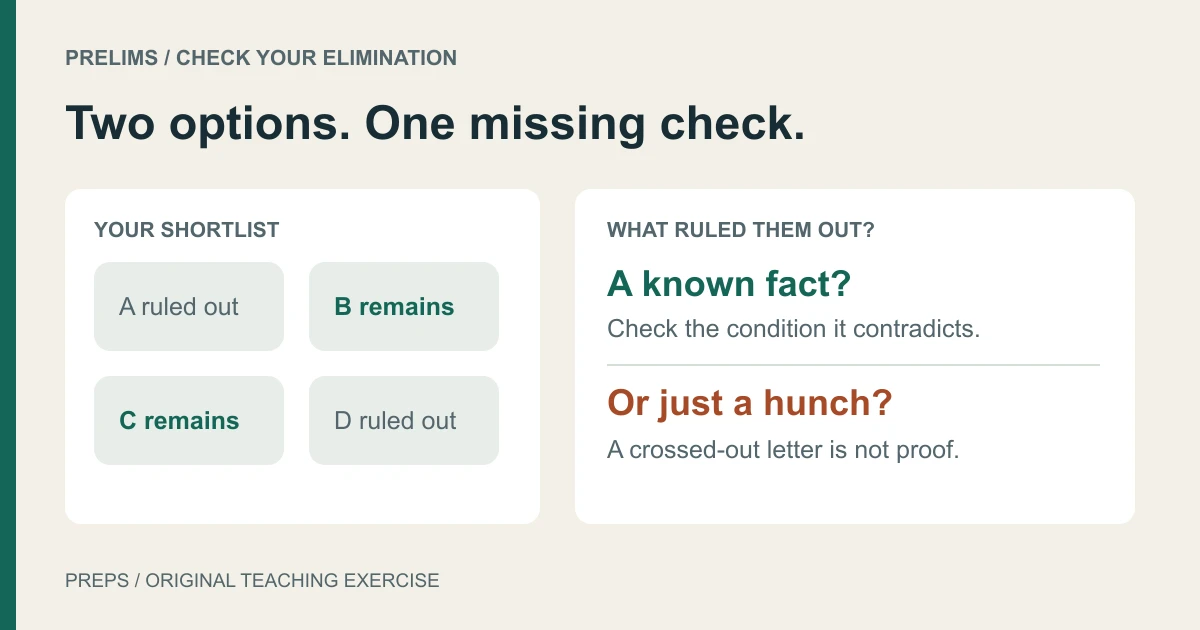
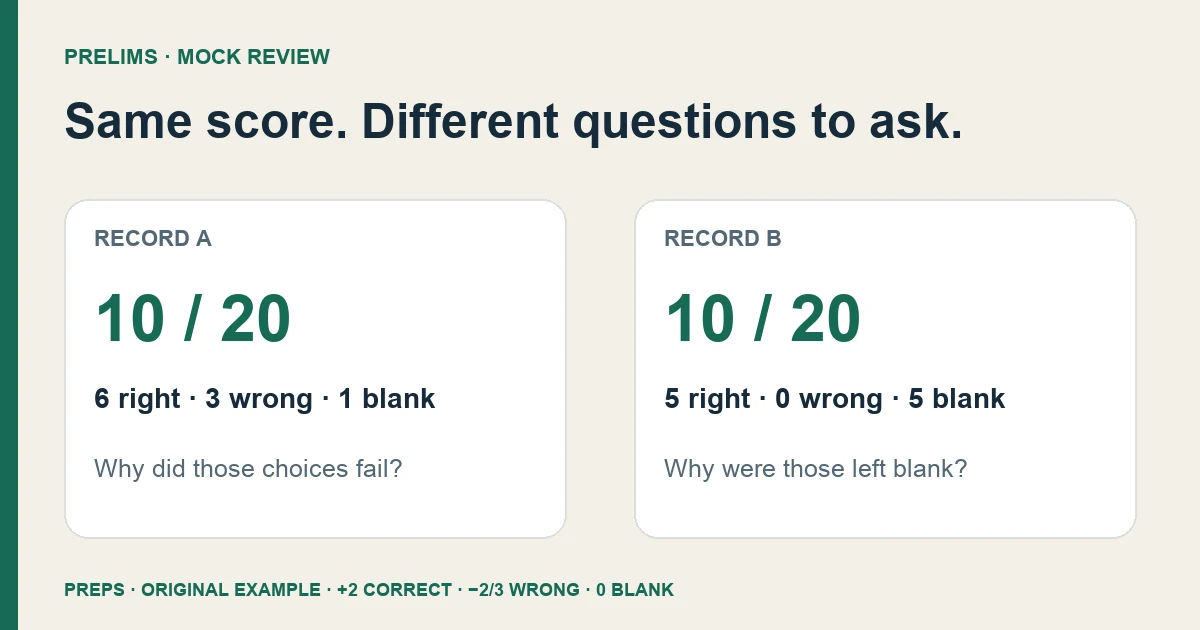
Definitions yaad hain. Economy ke statements phir bhi galat kyun ho rahe hain?
You can define repo rate. You have underlined inflation, revised the banking chapter and watched the explanation twice. Then a question changes one condition, and the answer you were sure of falls apart.
Another reading of the same definition may leave you just as stuck. I'd first check whether you can explain what happens between the policy decision and the outcome. That is where a short, memorable rule can hide a very large assumption.
Let's work through one relationship properly. You can use the same approach when studying other Economy topics for UPSC.
Repo rate badha. Does every loan immediately become costlier?
Here is an original teaching statement, not a UPSC PYQ:
An increase in the RBI's policy repo rate necessarily raises the interest rate on every existing bank loan by the same amount on the same day.
Before deciding, underline the claims you would have to defend: every existing loan, same amount, same day. Recognising “repo rate” hasn't answered any of them.
The RBI's monetary-policy overview describes the repo rate as the rate at which it supplies liquidity under the liquidity adjustment facility against eligible securities. In simpler terms, this is a central-bank funding operation. It isn't the rate printed on every household's loan agreement.
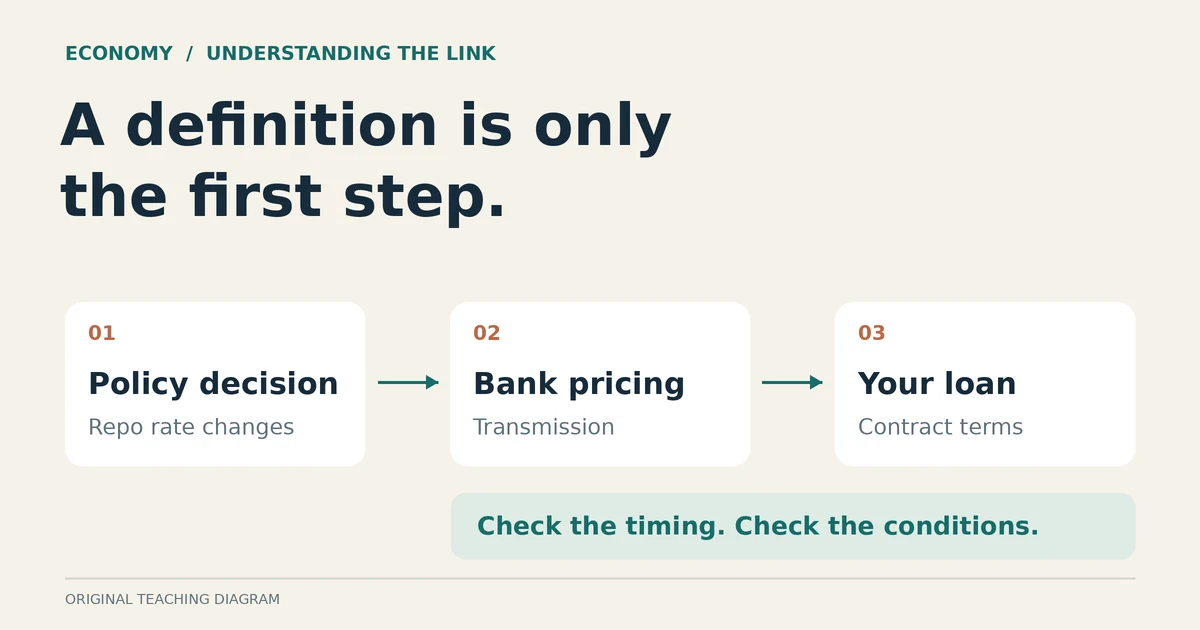
To reach a borrower's payment, the explanation needs more steps. A policy-rate change influences financial-market rates and banks' pricing decisions. The effect on a particular loan then depends on its terms, including whether its interest rate can change and when it resets. Borrowers and firms may respond to changed borrowing costs by changing spending or investment. Those responses affect demand, alongside other influences on prices and output.
The RBI's account of monetary-policy transmission explains this movement through interest rates and spending, with effects taking time. That is the mechanism to understand. Don't turn its older description of the operating framework into a claim about today's policy settings.
Now return to the statement. It treats several stages as one automatic event. A policy-rate increase alone doesn't establish an identical, immediate increase across every existing loan. You need information about the loan contracts and transmission. The statement is false.
Look at a real episode before trusting your shortcut
The RBI's October 2023 Monetary Policy Report, section IV.2, Table IV.4 records the following changes for April 2022 to August/September 2023. The table uses the latest available observation for each series; the lending-rate observations below end in August 2023.
| Measure | Increase |
|---|---|
| Policy repo rate | 250 basis points |
| Weighted average lending rate on fresh rupee loans | 184 basis points |
| Weighted average lending rate on outstanding rupee loans | 110 basis points |
One hundred basis points equal one percentage point. These are changes in rates, not the levels of the rates and not percentage changes in loan instalments.
The three changes differ. That is enough to challenge the shortcut that policy and lending rates must move identically. It does not tell you what happened to a particular person's loan, establish a permanent transmission ratio, or predict the next policy cycle. Aggregate averages cannot supply the missing contract.
I'd keep this dated example beside the explanation. If you keep only “repo up → loans up”, you have deleted precisely the qualifications a statement can test.
Three checks that force you to explain the relationship
Try these original checks with the explanation closed. Decide whether each claim follows, then write your reason before reading the discussion.
1. The policy repo rate increased, so every existing loan's interest rate increased by exactly the same amount.
This doesn't follow. The policy rate and a particular lending rate are different objects. The historical table also shows different aggregate changes. A defensible answer needs to identify the missing link, rather than merely call the statement “too extreme”.
2. A higher borrowing rate can discourage an investment that was worthwhile at a lower borrowing cost, assuming its expected receipts and other costs are unchanged.
This is a defensible conditional relationship. Financing has become costlier while the other stated factors remain the same. A firm might still proceed if the project remains worthwhile; the statement says “can”, not that all investment stops. Explain the incentive instead of memorising an arrow.
3. Inflation rose after a policy-rate increase. Therefore, the increase had no restraining effect on inflation.
That conclusion isn't established. A before-and-after observation doesn't tell you what inflation would have been without the action. Other developments can raise prices, and transmission takes time. Equally, this observation alone doesn't prove that the policy worked. You would need more evidence to assess its effect.
Notice the different work in those answers: identifying a missing contract, explaining an incentive and questioning a causal conclusion. A list of definitions cannot do all three jobs for you.
Give your next Economy chapter a question to settle
You don't need to rebuild your entire preparation around monetary policy. Use this example to change one study session.
Choose a relationship in your current chapter: how a tax affects a purchase decision, how imports enter an external-sector account, or how a change in a price measure differs from a change in the price level. Locate the explanation in a suitable source. For money and banking, NCERT's Introductory Macroeconomics, chapter 3 is a useful starting point. Use the edition you are reading; a textbook is a conceptual source, not a live rates page.
Write a short explanation that names who acts, what changes and why the next step follows. Then change one condition. Does your explanation survive?
For our example, the change might be: suppose the existing loan has a fixed rate for the period being discussed. Your answer must now account for that contract. Repeating the original policy-rate sentence more confidently won't help.
If you cannot explain the first step, return to the source or seek help with that exact point. If you can explain it but miss a condition in the question, practise reading and applying the relationship. These problems need different corrections. Another book isn't automatically the answer to either.
For a beginner, one understood relationship and a few questions can be a manageable session. For a repeater, I'd start with an error you can trace to an assumption. Reopen the relevant part of the chapter, rather than sentencing yourself to another complete reading without knowing what it should repair.
Let current affairs test what you understood
When you next read an economic announcement, separate the decision from its possible consequences. Record the institution, action and date accurately. Then explain one channel through which it could matter, including the condition or delay that limits your claim.
An announcement is evidence that something was announced. An observed outcome needs its own source. A forecast needs its assumptions. Keep those distinctions even when the newspaper gives you a very convenient headline.
Use an actual past question to check how much reasoning your topic now supports. The PYQ-analysis article explains how to review a familiar question without mistaking a remembered answer for fresh understanding. Keep original exercises, official past questions and unofficial explanations clearly labelled.
For your next session, return to the first statement about every bank loan. Explain exactly why it fails, then rewrite it into a narrower claim you can defend. If you can name the missing link without opening the book, the definition has finally started doing some work.