Another day of UPSC lectures. Still no time to study on your own?
Updated
Five two-hour lectures contain ten hours of video before you pause to think, make a note or attempt a question. You can finish that playlist and still have a substantial amount of studying left.
If you're trying to clear a lecture backlog, I'd first separate two questions: how much teaching remains, and what you can do with the material already taught. They deserve different answers. A progress bar only answers the first.
This isn't a recommendation to abandon a useful course. A good explanation can unlock a topic you've been struggling with. I want the next lecture to have a reason to be on your timetable, and some room afterwards for you to work without the teacher doing the reasoning.
Give tomorrow's lecture a specific job
Before opening the next recording, finish the sentence: “I'm watching this because I need help with…”
“The difference between these two concepts” is a useful answer. So is “I haven't studied this part of the syllabus and need an introduction.” “There are still 47 videos in the folder” tells you about the folder.
For a topic you've already encountered, try a small task before deciding to watch it all again. Explain the idea, work through a suitable question, or sketch an answer to a question you've read carefully. Keep the first attempt. You're looking for the point where you stop being able to proceed independently.
If you can't begin because the concept is unfamiliar, use the explanation you need. If you understand it but can't recall a condition, check the relevant passage rather than automatically replaying the entire chapter. If the difficulty lies in interpreting a question, another general lecture on the subject may leave that difficulty untouched.
You don't need to prove that you can teach yourself everything. You need to identify what help would move this particular piece of work forward.
Leave room for the parts the recording can't complete
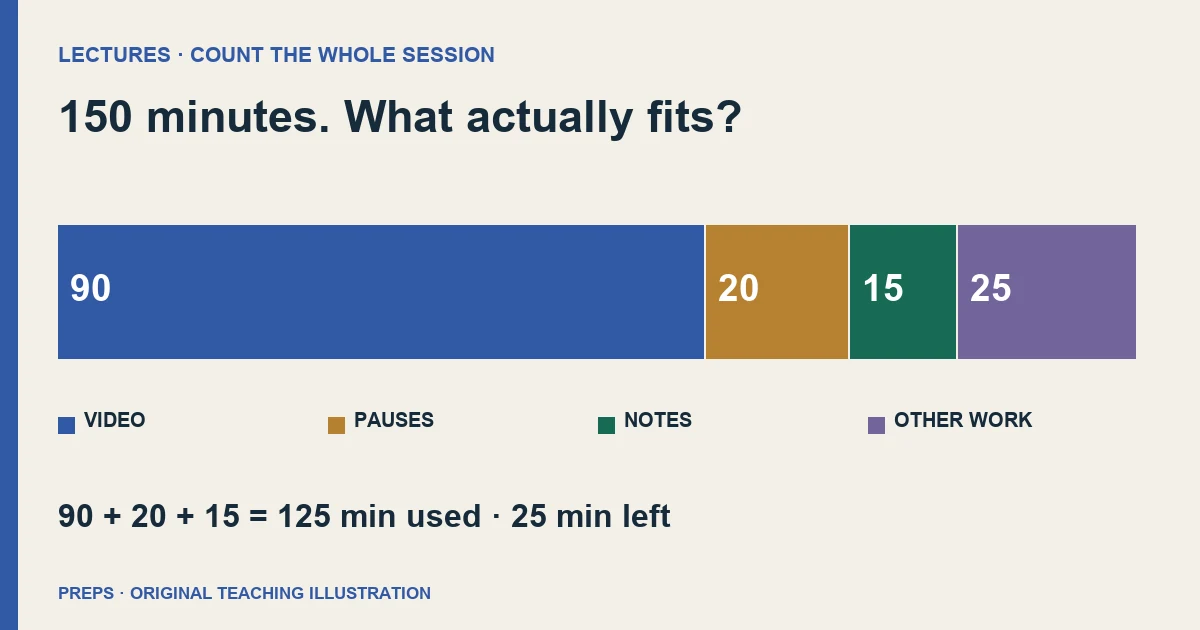
Here's an invented capacity calculation, not a recommended UPSC routine. Suppose a session has 150 minutes available. A 90-minute recording, 20 minutes of pauses and 15 minutes of note-taking use 125 minutes. That leaves 25 minutes for everything else in that session.
Those 25 minutes may let you attempt a small task. They don't establish that you've revised the whole chapter, practised both examination formats and resolved every doubt. Put the unfinished work somewhere visible before adding another recording.
Playing the video faster changes the running time, but doesn't tell you how much explanation you understood. Rewinding, looking up unfamiliar terms and writing may use the time you thought you saved. Plan from your actual session, including those activities, rather than from the nominal duration divided by playback speed.
I'd record the unfinished task plainly:
I followed the explanation of the process, but couldn't explain why the last step follows. Revisit that part and attempt a changed example before adding the next topic.
That's an original example of a study note. It gives the next session something definite to do. “Economy lecture complete” would conceal the unresolved point.
Decide what to read alongside the class
Your course notes and a standard book may overlap. They may also differ in precision, coverage or currency. Don't assume that either must be copied into the other in full.
Take a small section and compare the claims. Where the class notes explain the concept adequately and you can use it, keep them as your working source. Where a book supplies a missing condition, a clearer explanation or material in the syllabus, retain that addition with a source reference. If two sources contradict each other, resolve the disagreement against an appropriate authoritative reference before memorising either version.
You may still need to read a whole foundational chapter, especially when the lesson assumes knowledge you don't have. Targeted reading is a decision based on what you've understood, not permission to skip unfamiliar foundations. Optional subjects can have different depth and source requirements; don't generalise a GS experiment into a rule for every optional paper.
And if you learn more comfortably through an explanation in your own language, keep that useful support. The relevant test is whether you can subsequently work with the idea, including in the language and format in which you intend to answer. The medium itself doesn't settle that question.
Triage a backlog before increasing the daily count
Separate the recordings by what you still need from them:
- Unstudied foundations: keep enough teaching and reading to build the concepts. Don't mark these complete because a familiar title makes them look easy.
- A particular unresolved point: locate the relevant segment or ask a precise question. Recheck the point afterwards.
- Familiar material you can already use: compare the recording's stated coverage with your actual work. A selective review may be enough; don't skip required course components without checking their purpose.
- Old updates: verify the underlying fact or rule before spending time on the recording. An older video can explain a lasting concept while containing figures or instructions that have changed.
This is an editorial way to organise work, not a formula for how many lectures an aspirant should watch. A demanding new subject may need substantial guided teaching. A familiar subject may need practice and correction. An identical daily lecture target can serve one badly and the other worse.
If the timetable still doesn't fit, change the scope or sequence. A permanently compressed night's sleep isn't an extra study slot to build into this calculation. For a week constrained by employment, the working-aspirant planning example shows how to acknowledge lost capacity instead of pretending the same work still fits.
Look at the work left behind
After a few sessions, compare your actual records. Can you explain something that previously required the recording? Can you solve a changed question? Does your answer use the distinction accurately? Keep those observations separate from a remembered solution or an open-book attempt.
If you're stuck at the same step, take that attempt to a teacher or another reliable source. “I understood the video” can be difficult to investigate. A paragraph, calculation or explanation showing exactly where you stopped gives someone a chance to help.
The next recording can wait while you finish that piece of work. You've already paid for the explanation with your time. Give yourself a chance to use it.