Your UPSC timetable forgot you have a full-time job. Let’s fix that.
Updated
At 8:45 pm, your timetable says “two hours of optional”. You still have dinner to sort out, tomorrow's work is unresolved, and the lecture you meant to finish has another seventy minutes left.
You can move the lecture to tomorrow. That doesn't create seventy minutes tomorrow.
For UPSC preparation with a full-time job, I'd begin the weekly plan with the time you can actually use. Then I'd choose the work it can hold. A timetable borrowed from someone with free mornings and dependable weekends may be perfectly sensible for their life. It needs checking against yours.
Look back at the week before drawing the next one
Use a few recent ordinary workdays and, if your job varies, a busier period too. Note when you were available, whether you could concentrate, and what interrupted the session. You don't need an elaborate time-tracking system. “Home at nine; dinner and family work; twenty usable minutes” is enough to challenge a two-hour assumption.
Separate dependable slots from possible extras. A quiet hour before work might be dependable for you. A lunch break interrupted by calls might not be. If you drive, don't put reading or question-solving into the commute. A possible slot shouldn't become a requirement that the rest of the plan depends on.
Keep meals, sleep, care responsibilities and essential work in the picture. They aren't empty cells waiting for a subject name. I wouldn't build a normal timetable around cutting sleep to rescue a plan that repeatedly exceeds the available day.
Once you know the available slots, name the work. “Polity” won't help much when you have thirty minutes and need to decide where to begin. “Check why I rejected these two statements, then write the unresolved doubt” gives the session an end.
A busy week, with the tradeoffs left visible
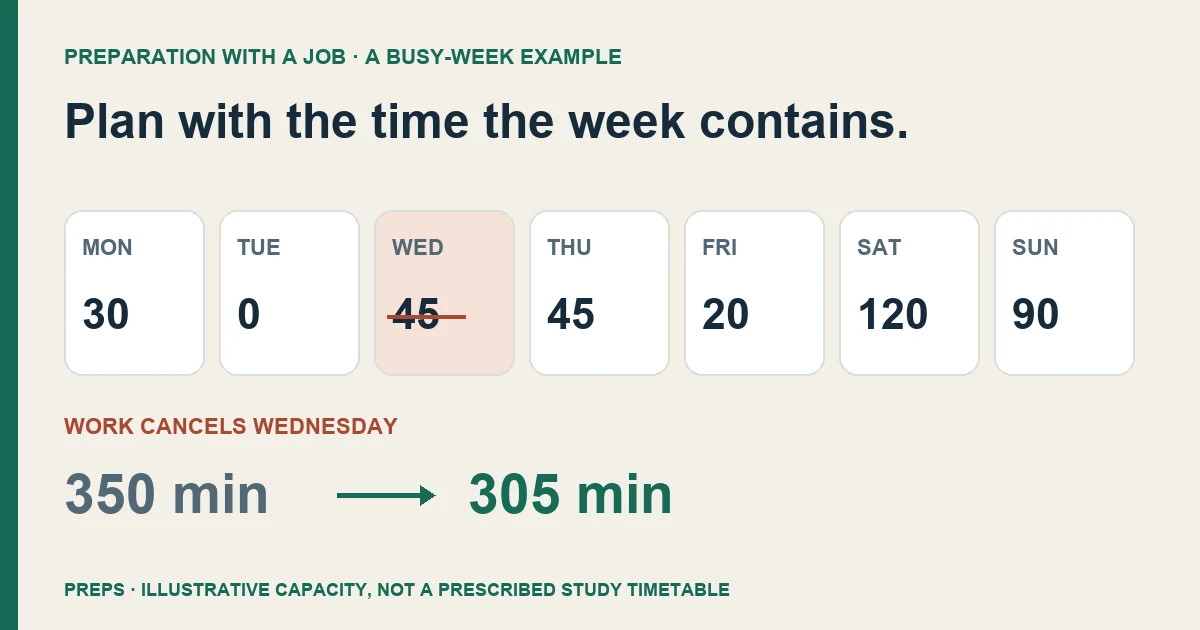
Here's an invented deadline-week example, not a prescribed timetable or a claim that this amount of work is sufficient for UPSC. The hypothetical person has already studied the chosen topic and needs to review it, check CSAT and keep an optional topic moving.
| Available slot | Planned work |
|---|---|
| Monday, 30 minutes | Revisit two errors from the last practice session |
| Tuesday, no dependable slot | Work commitment; no study task assigned |
| Wednesday, 45 minutes | Read one defined section of a polity source and explain its main distinction |
| Thursday, 45 minutes | Attempt related questions, keeping the reasoning before checking solutions |
| Friday, 20 minutes | Resolve one doubt from Thursday; leave the rest clearly marked |
| Saturday, 120 uninterrupted minutes | Attempt a CSAT paper under its applicable conditions |
| Sunday, 90 minutes | Review the most useful CSAT gaps for 45 minutes; study a defined optional topic for 45 minutes |
That's 350 minutes: 5 hours and 50 minutes. I've left Tuesday empty because the example has no dependable study time there. The empty cell is more useful than a promise you'll have to move later.
This is deliberately a reduced week. It doesn't contain a balanced allocation for the entire syllabus, regular current-affairs coverage, substantial optional study and Mains writing. Those omissions matter. If most weeks look like this, you need a wider plan with an honest timeline and additional capacity where possible; copying the table won't make those demands disappear.
The 2026 CSE notification gives each Prelims paper a normal duration of two hours. Use the time conditions applicable to you, including any official accommodation. A full-paper attempt therefore needs a different kind of slot from a short recall session. Check your target cycle's instructions rather than assuming a past rule will always apply.
When Wednesday disappears
Suppose an urgent work task takes Wednesday's forty-five minutes. The week's available time is now 305 minutes. I wouldn't keep calling it a 350-minute week by placing a second Wednesday inside Sunday.
Look at Thursday's dependency first. Its questions were meant to follow the reading you missed. You could use Thursday for the reading and move the questions to a named slot next week. Or, if that reading is less urgent than another demonstrated gap, defer the pair together.
You could also reduce another task deliberately. What I wouldn't do is remove the CSAT review without noticing, then later conclude that taking full papers hasn't helped. The review had a reason to be there.
Write the revised commitment where you'll see it:
Thursday: read the defined section. Move its questions to Monday's first available session. Keep Sunday's CSAT review. Don't add another polity topic until this pair is finished.
That is one possible adjustment, not the uniquely correct one. If the test is imminent or the optional task is more urgent, your priorities will differ. The useful part is making the loss and its consequence explicit.
After repeated cancellations, change the normal plan. A session that exists only when the job becomes unusually quiet belongs in the optional-extra column.
Choose smaller work without quietly dropping whole areas
Short sessions can carry a complete task: explain one distinction, outline an answer, check a calculation or revise a compact note. They are less suited to a long uninterrupted paper. Decide which condition you need rather than treating every task as interchangeable minutes.
Keep a place for CSAT, the optional, Mains writing, current affairs and revision across the wider plan. The syllabus can help you audit what has vanished. You needn't touch every component every evening, but the same areas shouldn't disappear for weeks without a decision about them.
For current affairs, one issue can be a useful short session if you connect it to the syllabus and leave a specific update or question. The newspaper-selection article shows how to avoid copying the same background from several sources. A video playlist is another source of work; its total running time doesn't include all the time you'll need to understand, check and revisit it.
For Mains, a short slot might hold an outline or the revision of one paragraph. Keep longer timed writing elsewhere when that's the skill you're testing. The worked answer-writing revision is useful when you have an existing answer and need to inspect it.
If you're beginning, the first study-cycle guide can help you define that first unit. If you're returning to preparation, check what you can still explain and apply before assigning yourself every foundational lecture again.
Decide what the calendar can honestly carry
After a few weeks, compare the intended work with what you actually completed and understood. Were the sessions available? Were the tasks too large? Did watching consume the space intended for practice and review? The answers may justify changing a resource, reducing new material or extending the preparation timeline.
They may also reveal a real capacity problem. A careful plan cannot guarantee that a demanding job, care responsibilities and a particular examination date will fit together. Don't answer that problem with a promise that a fixed number of daily hours is enough for everyone.
Check eligibility for your target cycle and the official examination calendar before committing to an attempt. Employment and study-leave decisions need their own consideration of your obligations and options. A good or bad mock score alone doesn't settle them.
Before tonight's session ends, leave the next task open at the right page, with the question you intend to answer beside it. Tomorrow may still be busy. At least you won't spend its first usable minutes trying to remember what “do optional” was supposed to mean.