Reading NCERTs for UPSC—when can you move on?
Updated
You finish a chapter, underline most of it, and face an awkward decision: read it again, make notes, or move on. The book is clearer than your plan.
I'd begin by deciding what you need this chapter to explain. “Finish NCERTs” gives you a stack to get through. “Understand why these drainage patterns differ” gives you something you can check.
You don't need to turn every page into a separate notebook. You do need to notice when a familiar word is hiding an unfamiliar idea.
Choose an entry point you can actually follow
Keep the UPSC syllabus beside the contents page. Find the chapter that addresses the topic you're studying, then read its opening and look at its figures and exercises.
If the opening depends on terms you can't explain, go back to the chapter or earlier textbook that introduces them. If you can follow it, start there. Beginning at the lowest class for every subject can spend a great deal of time repairing foundations that are already sound.
For a new subject, I'd read the chapter in sequence: the explanation may build across sections. For a subject you've studied before, a specific gap can justify a targeted return. Skipping directly to a definition is less useful when the missing piece is the process that produces it.
Use the book's title, class and edition when locating a chapter. Chapter numbering and contents can change; an old PDF list is a locator, not an instruction to collect every edition.
Go inside one chapter
Take NCERT's Class XI India: Physical Environment, Drainage System, 2026–27 reprint. The drainage-pattern box on printed page 17 distinguishes radial and centripetal patterns.
You could underline both definitions and move on. I'd spend a little longer on the direction of flow.
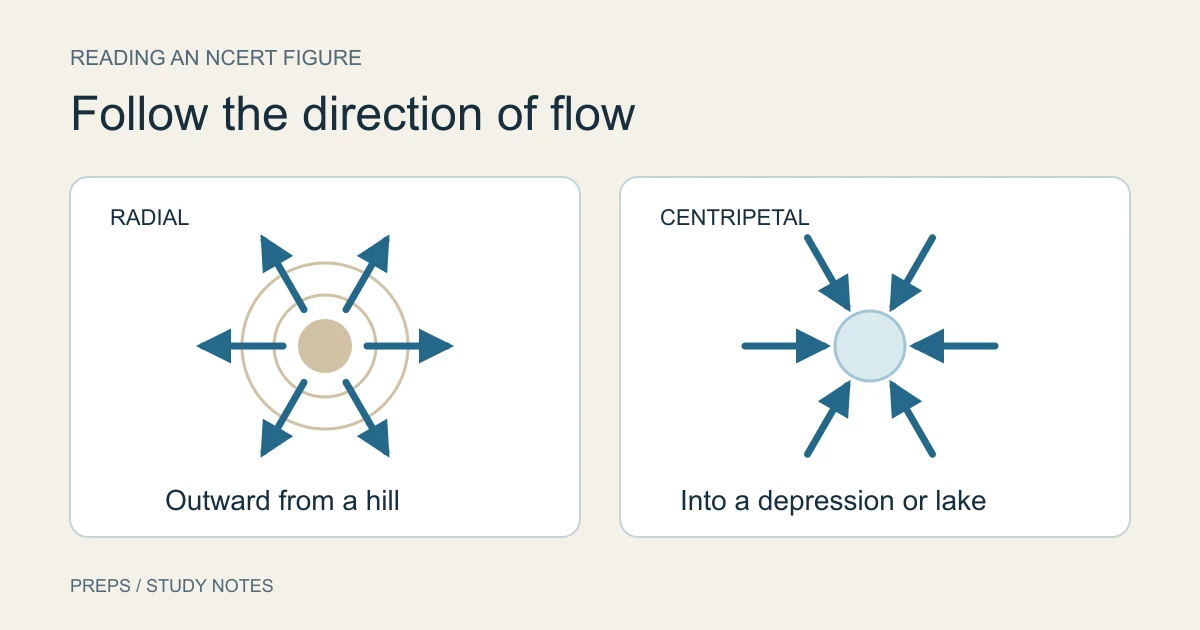
In a radial pattern, rivers flow outward in different directions from a hill. In a centripetal pattern, streams converge towards a depression or lake. Draw a central high point with outward arrows, then a depression with inward arrows. These are rough teaching sketches, not maps of actual rivers.
Now give yourself this original check:
Several streams approach the same low-lying basin from different sides. What feature of that description helps you distinguish the pattern?
The useful clue is the inward direction towards a common low area. Recognising that clue is different from recognising the word centripetal on a page you've just read.
Next, change your sketch: make the centre a hill and reverse the arrows. Explain why your label must change. If your explanation still says “rivers spread in different directions” for both drawings, return to the box. You've found the exact confusion the next reading needs to resolve.
Read the parts that are easy to skip
A textbook can place an important distinction in a box, a map caption or a diagram rather than the main paragraph. Work those into the reading.
For a figure, explain what its labels and arrows represent. For a map, locate the features discussed in the text. For a table, identify what is being compared. Then attempt a relevant exercise without leaving the explanation open beside it.
Don't assume every figure needs tracing into your notes. Copying a complicated diagram can occupy the evening while leaving its explanation untouched. A rough sketch is enough when it lets you explain the relationship accurately.
Leave useful marks in the book
For the drainage example, a short margin note might read:
Radial: outward from a high centre. Centripetal: inward towards a low centre. Check the arrows.
That's an original revision cue based on the cited box. It doesn't replace the rest of the chapter.
I'd annotate a confusing distinction, a connection the chapter doesn't make explicit, or an error your exercise exposed. If the book already explains something briefly and clearly, a page reference may be more useful than copying it.
When annotations become too scattered to find, gather the troublesome points into a small topic note. The revision guide shows how to test whether you can use what you recorded.
Decide what the next source needs to add
Move on when you can explain the chapter's main relationships and attempt its relevant exercises with an understanding of your mistakes. That isn't proof you've mastered every possible examination question. It's enough to decide what work comes next.
A question may reveal that you understand a basic process but lack a particular fact. Look for that fact in a suitable source. If you repeatedly misunderstand the process, another list of facts is unlikely to repair it.
Use previous papers to inspect the demand, while remembering that a small selection can't predict the next paper. NCERTs can supply an explanation you need; completing them doesn't establish complete syllabus coverage.
For your next session, choose one chapter and one question its reading should settle. Keep the book open long enough to understand the explanation, and closed long enough to find out what you've understood.