International Relations
India–Uzbekistan Comprehensive Strategic Partnership
- India and Uzbekistan elevated their relationship from a Strategic Partnership to a Comprehensive Strategic Partnership during Prime Minister Narendra Modi’s visit to Tashkent.
- Both countries set a target of raising annual bilateral trade to US$5 billion by 2030, from the present level of over US$1 billion.
- Eleven agreements and outcomes covered defence cooperation, connectivity, critical minerals, digital payments, culture and environmental restoration.
- A long-term framework was concluded for supplying uranium to India. Defence cooperation will include direct links between industries and possibilities for co-development and co-production.
- National Payments Corporation of India International Payments Limited and Uzbekistan’s National Interbank Processing Centre agreed to connect Indian Unified Payments Interface applications with Uzbekistan’s UZQR merchant-payment network.
- India announced a US$1 million grant for afforestation in the Aral Sea region. A Letter of Intent was also signed for restoring the Buddhist archaeological sites of Fayaz Tepa and Kara Tepa.
- A Foreign Ministers’ Coordination Council and a ministerial-level joint commission will provide institutional support.
- Challenges include weak physical connectivity, high transport costs and the need to convert signed agreements into commercial projects.
Aral Sea
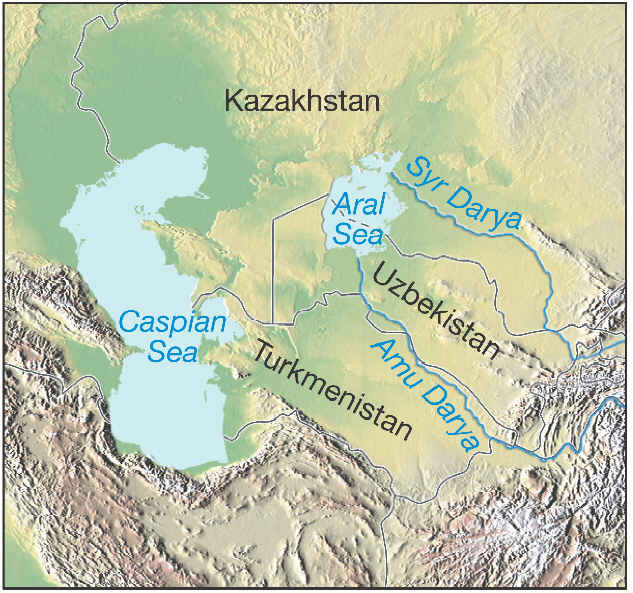
The Aral Sea is an endorheic lake between Kazakhstan and Uzbekistan, fed historically by the Amu Darya and Syr Darya. Soviet-era irrigation diversions caused severe shrinkage, rising salinity, fishery collapse and the formation of the Aralkum Desert. Salt-and-chemical-laden dust now threatens health and agriculture. India announced a US$1 million grant for afforestation and ecological restoration in the surrounding region.
Fayaz Tepa and Kara Tepa
Fayaz Tepa and Kara Tepa are ancient Buddhist complexes near Termez in southern Uzbekistan, an important centre of Buddhism under the Kushan Empire. Fayaz Tepa contains an above-ground monastery, courtyard, stupa, sculptures and wall paintings. Kara Tepa combines rock-cut caves with surface structures and monks’ cells. Their restoration highlights India–Central Asia cultural links and Buddhism’s movement along the Silk Road. UNESCO Silk Roads sites
Fayaz Tepa and Kara Tepa are ancient Buddhist complexes near Termez in southern Uzbekistan, an important centre of Buddhism under the Kushan Empire.